FBI: North Korea's 'FaceStealer' Used Stolen Webcam Videos and AI Deepfakes on Fake Zoom Calls to Steal $400 Million in Crypto — 900+ Recordings Seized
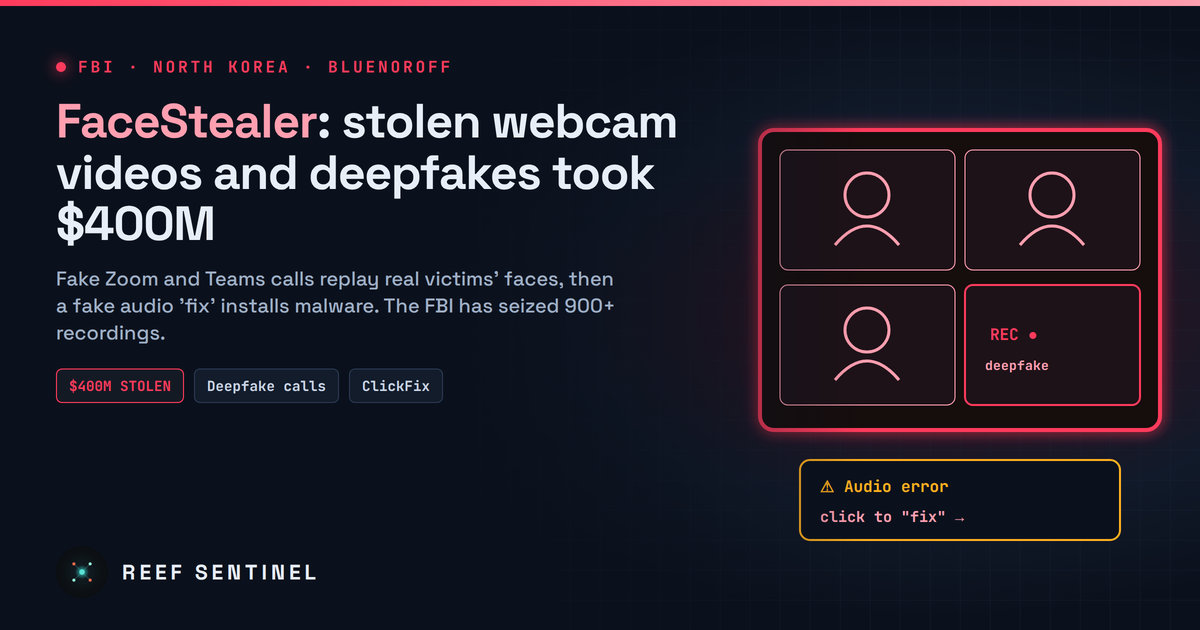
The FBI says North Korea's BlueNoroff stole more than $400 million in 18 months by replaying earlier victims' webcam footage and AI deepfakes on fake Zoom and Teams calls that tricked targets into running fake audio 'fixes'.
The FBI says North Korean hackers stole more than $400 million in cryptocurrency over the past 18 months with a scheme it calls FaceStealer. The scheme uses stolen webcam recordings of earlier victims, and AI-generated deepfakes of well-known crypto figures, to get new targets onto fake video calls. In coordinated actions announced this week, the FBI seized the campaign's cloud infrastructure and more than 900 recorded victim videos. The Department of Justice separately seized more than $1.2 billion in cryptocurrency linked to North Korea's earlier theft from the Binance exchange.
What Happened
FBI Cyber Branch Operations Director Brett Leatherman said the operation had resulted "in the theft of more than $400 million in the last 18 months." The activity is attributed to BlueNoroff, a financially motivated North Korean cluster also tracked as APT38, Sapphire Sleet, Stardust Chollima and UNC1069. The FBI has published an advisory describing the attack chain.
The DOJ's separate seizure of more than $1.2 billion relates to funds recently stolen by TraderTraitor actors after the Binance hack. The DOJ says the money supports North Korea's weapons programmes.
How FaceStealer Works
FaceStealer works like a self-feeding loop. Each victim becomes the bait for the next one:
- Compromise a victim. Attackers steal wallets and seed phrases, hijack the victim's Telegram and other messaging accounts, read their contacts and chat histories, and secretly record them on video.
- Message their contacts. From the hijacked account, the attackers suggest an investment-related meeting and send a Calendly invite, often through Telegram.
- Fake meeting. The link leads to a lookalike Zoom or Microsoft Teams page, with typosquatted domains such as uu01webzoom[.]us and teams.livemeet[.]us.
- Fake people. Prerecorded, genuine webcam footage of the previous victim or a known contact plays in the call. The DOJ says the actors also use AI to create deepfakes of well-known crypto and Web3 figures. Researchers have seen mainstream generative AI tools used for avatars, artwork and synthetic participant video.
- Fake fault. A few seconds in, a mock audio error appears, and the target is sent a "fix" to run. This ClickFix-style trick installs malware.
- Repeat. The new victim's accounts, wallets and webcam footage feed the next round.
Researchers have described FaceStealer as a "victim acquisition platform". The recordings are the key ingredient, because a familiar face on screen lowers suspicion far more than a text message.
Who Is Targeted
Earlier research counted more than 400 victims in over 20 countries, mainly the US, Singapore, the UK, Hong Kong, South Korea and the UAE. About 80% worked in crypto and blockchain or adjacent finance, and CEOs and founders made up 45%. Later reporting puts the number of targets at 677 across 58 countries, more than 80% of them founders and C-suite executives.
Developers and open-source maintainers are also targets. Earlier in 2026 the maintainer of a popular npm package was targeted, which led to a trojanized release carrying a cross-platform remote access trojan.
The Wider North Korean Playbook
FaceStealer runs alongside North Korea's long-running fake-recruiter operations ("Contagious Interview" and its ClickFix variants). In those, candidates are given poisoned coding tests that hide malware in configuration files, VS Code tasks.json auto-run tasks or git hooks. A joint advisory from Japan, the US, Australia and Germany in late September estimated at least 30,000 devices compromised across 100 countries through these schemes.
What To Do Now
- Verify meetings out of band. If a contact suddenly suggests an investment call, confirm it by phone or through a separate channel you already trust before you join.
- Never run "fixes" from a meeting. Real Zoom and Teams audio problems are never solved by pasting commands into a terminal or installing a "driver" from a link someone sends in chat.
- Check the domain. Join meetings only from the official app or from domains you've confirmed. Block known lookalikes such as uu01webzoom[.]us and teams.livemeet[.]us at your DNS filter.
- Protect accounts. Turn on Telegram's two-step verification password, review active sessions regularly, and use hardware security keys on email and exchange accounts.
- Keep signing keys off everyday machines. Store significant crypto holdings in hardware wallets or multi-signature setups, and never on the laptop you use for calls.
- Isolate coding tests. Run any interview assignment or unfamiliar repository in a disposable virtual machine, never on a work laptop. Turn off VS Code automatic tasks for untrusted workspaces.
- Cover the webcam when you're not in a call, and review which apps have camera permission.
If you think you've been targeted, report it to your national cybercrime authority (in the US, the FBI's IC3) and warn your contacts, because your account may be used against them next.
Why It Matters
FaceStealer shows how cheap generative AI and stolen video have changed social engineering. "I saw their face on the call" no longer proves anything. The $400 million figure, the 900 seized recordings and the focus on executives show how well the approach works. The seizures disrupt the infrastructure, but the method is easy to rebuild. Organisations in crypto and finance, and anyone whose leadership is visible online, should treat unexpected video meetings with the same scepticism they already apply to unexpected email attachments.
