Cursor Confirms a Stolen Fireworks AI Key Led to Its Breach: Leaked Agent Traces Held Credentials That Let Attackers Push a Backdoored Claude Code Extension to Up to 5,000 Users
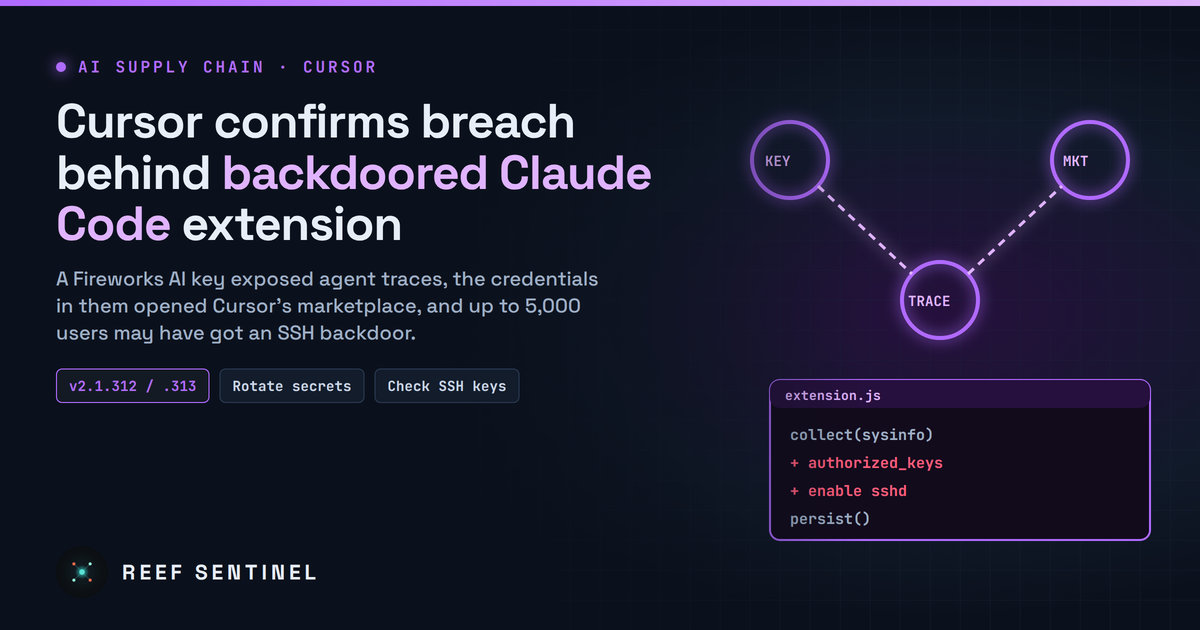
Cursor says attackers used a stolen Fireworks AI key to copy coding-agent traces containing unredacted credentials, then used those credentials to plant backdoored Claude Code extension versions 2.1.312 and 2.1.313 in its marketplace.
Cursor, the AI code editor, has confirmed that the backdoored copies of Anthropic's Claude Code extension pushed to its users on 29 October were the result of a wider breach of its own systems. In an incident report published on Friday 14 November 2026, the company said attackers first got in with an access key stolen from its AI model provider, Fireworks AI. They then copied historical coding-agent traces containing unredacted credentials and used those credentials to reach more internal systems, including the extension marketplace.
What's New
When the malicious extension builds appeared at the start of November, the obvious question was how attackers had managed to publish them through Cursor's marketplace. Cursor's report answers that. It also shows the incident was bigger than one poisoned extension:
- The entry point was a Fireworks AI access key. Fireworks AI disclosed its own breach this month after attackers pivoted through a compromised cloud provider.
- Attackers used the key to copy data from a read-only storage bucket Cursor used to share information with Fireworks.
- That bucket held historical coding-agent traces, mostly from 2025, from users who didn't have Privacy Mode turned on. Some traces contained unredacted API credentials, and attackers used them to reach further into Cursor's systems.
- Attackers also took archived non-production source code, limited support emails and information, product usage metrics and contact details, summaries of some AI agent conversations, and credentials customers had shared with support.
The Malicious Extension
On 29 October, attackers used a stolen credential to place modified versions 2.1.312 and 2.1.313 of the Claude Code extension on the cache that serves Cursor's VS Code-compatible extension marketplace. The builds were available for about 11 hours before removal.
According to Cursor and researchers who analysed the builds, the injected JavaScript:
- collected system information
- installed an attacker-controlled SSH public key
- tried to turn on SSH access
- set up persistence
Coding errors in the payload probably stopped the backdoor from working on many Windows and macOS machines where SSH wasn't already enabled. Linux machines, and any machine with SSH already running, face more risk.
Cursor estimates that up to 5,000 users requested the affected versions during that window. Anthropic's own extension and the Open VSX registry Cursor uses were not compromised. The tampering happened inside Cursor's cache layer.
Scale of the Data Exposure
Cursor says fewer than 0.05% of users had coding-agent traces exposed, and fewer than 0.01% of customers had API credentials compromised. It says production infrastructure, official application releases, customer code repositories, and code and prompts from Privacy Mode users were not affected.
What Cursor Did
- Revoked the Fireworks key and rotated exposed credentials.
- Temporarily shut down some internal and product services as a precaution.
- Moved all inference traffic away from Fireworks.
- Rebuilt its extension marketplace and redeployed production infrastructure.
Who Is Affected
- Anyone who installed or auto-updated the Claude Code extension in Cursor to 2.1.312 or 2.1.313 on 29 October.
- Users who didn't have Privacy Mode turned on and pasted secrets into agent sessions in 2025. Cursor is notifying the small group whose credentials were exposed.
- Customers who shared credentials with Cursor support.
What To Do Now
- Check the installed Claude Code extension version in Cursor, and update past the affected builds if it's still on 2.1.312 or 2.1.313.
- Look for SSH keys you didn't add and for SSH services you didn't turn on:
# Linux / macOS: review authorised keys and SSH service state
cat ~/.ssh/authorized_keys
systemctl status ssh sshd 2>/dev/null   # Linux
sudo systemsetup -getremotelogin         # macOS
# Windows: is the OpenSSH server installed or running?
Get-Service sshd -ErrorAction SilentlyContinue
Get-Content $env:ProgramData\ssh\administrators_authorized_keys -ErrorAction SilentlyContinue- Remove unknown keys, turn off SSH if you don't need it, and look for new scheduled tasks, launch agents, cron entries or startup items created on or after 29 October.
- Rotate any API keys, cloud credentials or tokens that you used in Cursor agent sessions without Privacy Mode, or that you shared with Cursor support.
- Follow the remediation guidance in Cursor's security notice for the extension, and treat a machine that had the extension installed as potentially compromised until you've checked it.
- For teams: turn on Privacy Mode organisation-wide, pin and allowlist extensions, and stage extension updates rather than auto-updating developer machines.
Why It Matters
This is a clear example of a supply-chain chain reaction in the AI tooling stack. A breach at a cloud provider led to a breach at a model host. That breach exposed agent traces at an AI editor, and the secrets in those traces opened the editor's marketplace, which pushed a backdoor to thousands of developers. Coding-agent logs are full of pasted API keys, environment variables and tokens, and they often sit with third-party inference providers. They have become one of the most valuable things an attacker can steal. Anyone using AI coding tools should treat agent transcripts as sensitive data, keep secrets out of prompts, and rotate anything that has passed through a provider that has now disclosed a breach.
