Mitel MiCollab MTLVULN-1864 (CVSS 10.0): Unauthenticated Command Injection Among Five AWV Conferencing Flaws — Patch 10.3.0.18 via KB000129195 or Restrict External Access
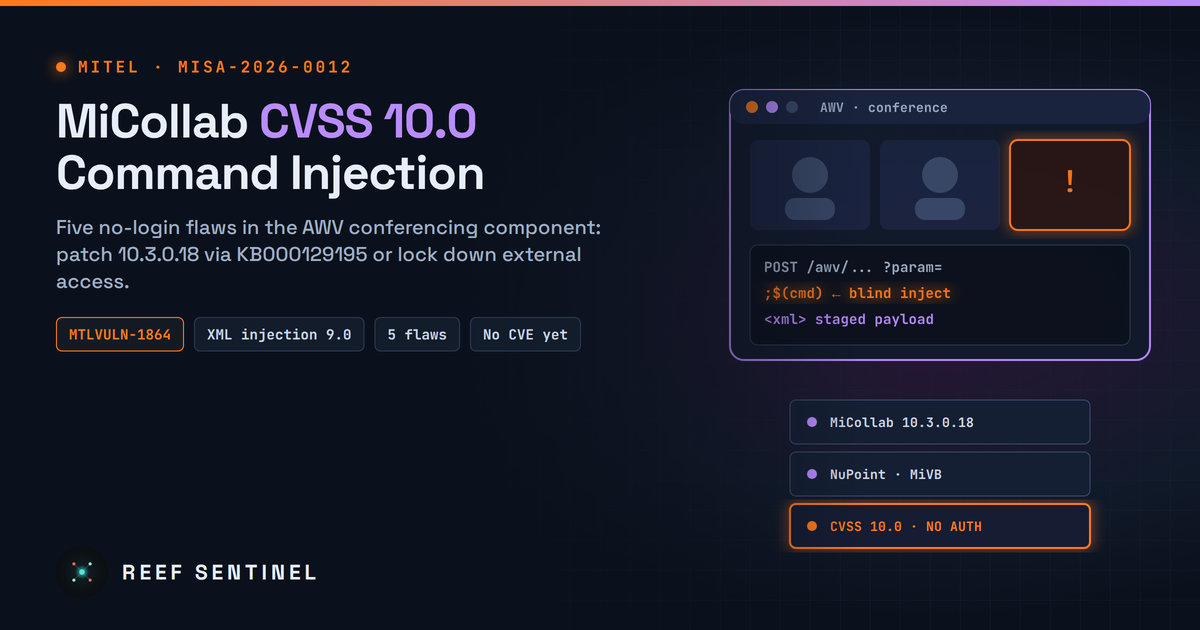
Mitel advisory MISA-2026-0012 fixes five unauthenticated flaws in MiCollab's AWV conferencing component, led by a CVSS 10.0 blind command injection and a CVSS 9.0 XML injection that can be chained, affecting 10.3.0.18 and earlier.
Mitel has released a security update for MiCollab, its unified communications server. The update fixes five vulnerabilities in the Audio, Web and Video Conferencing (AWV) component, and an attacker needs no login for any of them. The most serious, tracked internally as MTLVULN-1864, is a blind command injection rated CVSS 10.0, the highest possible score. A second, MTLVULN-1862, is an XML injection rated CVSS 9.0 that can also end in command execution in the system context.
Mitel's own advisory warns that chaining the five flaws can significantly amplify their impact. This is the second unauthenticated command injection in the same AWV component this year. Attackers have also hit MiCollab in the wild before. Any organisation running the product should treat this update as urgent.
What Happened
Mitel's Product Security Incident Response Team published advisory MISA-2026-0012, "MiCollab Multiple Vulnerabilities", on 16 November 2026 (revision 1.0). It covers MiCollab 10.3 (10.3.0.18) and earlier, and only supported versions are listed. No CVE identifiers had been assigned at publication. Mitel says it has requested them, so for now the flaws can only be tracked by their MTLVULN numbers and the advisory ID.
The advisory says nothing about exploitation in the wild, and we found no public proof-of-concept when this article was written. It does not name the researcher who reported the flaws.
Technical Details
All five issues sit in AWV, the part of MiCollab that hosts audio, web and video conferences. Organisations often expose AWV to the internet on purpose so external guests can join meetings, which is why flaws there are so valuable to attackers.
- MTLVULN-1864: blind command injection (CVSS 10.0, Critical). Parameters are not sanitised properly, so an unauthenticated attacker can inject operating system commands. "Blind" means the attacker does not see the output directly. That does not reduce the risk: the vector is network-reachable, low-complexity, needs no privileges or user interaction, and has a changed scope (AV:N/AC:L/PR:N/UI:N/S:C/C:N/I:H/A:H).
- MTLVULN-1862: XML injection (CVSS 9.0, Critical). Mitel says an unauthenticated attacker could use "pre-staged malicious content" to inject XML, because parameters are not validated properly. Successful exploitation could run arbitrary commands in the system context. Attack complexity is rated high, probably because the content has to be staged first.
- MTLVULN-1861: arbitrary file upload (CVSS 5.3, Medium). File types are not validated properly, so an unauthenticated attacker can upload arbitrary files.
- MTLVULN-1863: unauthorized access (CVSS 5.9, Medium). An attacker who knows a system-generated random identifier, or has pre-staged content, can read sensitive information.
- MTLVULN-1877: authentication bypass (CVSS 5.3, Medium). Improper authentication handling lets an unauthenticated attacker perform unauthorised actions inside the application.
The medium-rated bugs matter more than their scores suggest. Mitel has not published the exact chain, but the XML injection depends on "pre-staged" content and one of the bugs is an unauthenticated file upload. A plausible path is to upload a file without logging in, then reference it to trigger code execution. That would explain Mitel's warning that combining the flaws amplifies the impact.
A Pattern in the Same Component
This is not the first serious AWV bug this year. On 22 July 2026 Mitel published MISA-2026-0006 for MTLVULN-1694, an unauthenticated command injection in AWV rated CVSS 9.8. It affected MiCollab 10.0 through 10.2 SP1 FP2 and 9.8 SP3 FP2 and earlier. The fix was to move to 10.3 (10.3.0.18) or apply version-specific patches, and Mitel credited Hoang Tai of VNPT Cyber Immunity.
That leaves administrators in an awkward position. Release 10.3.0.18 was the safe target for the July bug, and it is now the vulnerable baseline for November. If you upgraded to 10.3.0.18 over the summer and stopped there, you are exposed again. Another patch is needed.
MiCollab also has a record of real-world exploitation. In October 2024 Mitel's MISA-2024-0029 disclosed CVE-2024-41713, an unauthenticated path traversal in MiCollab's NuPoint Unified Messaging component (CVSS 9.8), together with the lower-severity file read CVE-2024-55550. CISA added both to its Known Exploited Vulnerabilities catalogue on 7 January 2025 after confirming active exploitation. Attackers already know this product, and patch analysis has worked against it before.
Who Is Affected
- Organisations running MiCollab 10.3 (10.3.0.18) or any earlier release, in particular those with the AWV conferencing component reachable from the internet.
- Managed service providers and Mitel partners who host MiCollab for several customers. One compromised server can expose call data, directories and the internal network behind it.
- Unsupported MiCollab versions are not covered by the advisory, but they should be assumed vulnerable. They will not receive a fix.
Patch Status
Mitel has released a patch for MiCollab 10.3 (10.3.0.18). Installation instructions are in knowledge base article KB000129195, which is restricted to Mitel customers and partners. Mitel says later MiCollab releases will include the fix. Customers who cannot open the KB article are told to contact their Mitel Authorized Partner.
If you cannot patch straight away, Mitel's interim workaround is to restrict external access to the AWV component.
What To Do Now
- Find every MiCollab instance you run, including test servers, partner-hosted systems and anything left over from migrations, and record its exact version.
- Apply the KB000129195 patch to 10.3.0.18 systems, or upgrade to a later release that includes the fix. Older systems should first move to a supported release.
- Restrict AWV exposure now. Until the patch is in, allow access to the conferencing interface only over VPN or from known IP ranges, and do not leave it open to the whole internet.
- Look for signs of earlier compromise. Check the web root and upload directories for unexpected files, look for unusual child processes started by the web or conferencing services, and watch for new outbound connections from the MiCollab host. The flaws are new, but the AWV component has had a public critical bug since July.
- Segment the server. MiCollab connects to telephony, directory and voicemail systems. Limit what it can reach on the internal network so a compromised appliance cannot be used as a pivot point.
- Watch for CVE assignment and for any change to the advisory. If exploitation is reported, CISA may add these flaws to its KEV catalogue quickly, as it did with CVE-2024-41713.
Why It Matters
Unified communications servers combine several things attackers look for. They sit at the network edge, they are often exposed to the internet by design, they hold sensitive directory and call data, and patching them can lag because changes need partner involvement. A perfect-10 unauthenticated command injection on a product with a history of exploitation, in a component that was already patched for a similar bug four months ago, is the kind of target that gets reverse-engineered soon after a patch ships.
No attacks have been reported so far. That is the window defenders have, and it may be short.
