Italy Fines Meta €805 Million Because Facebook for Android Read Users' Photo Galleries Without Specific Consent, and Orders Gallery Suggestions Off by Default
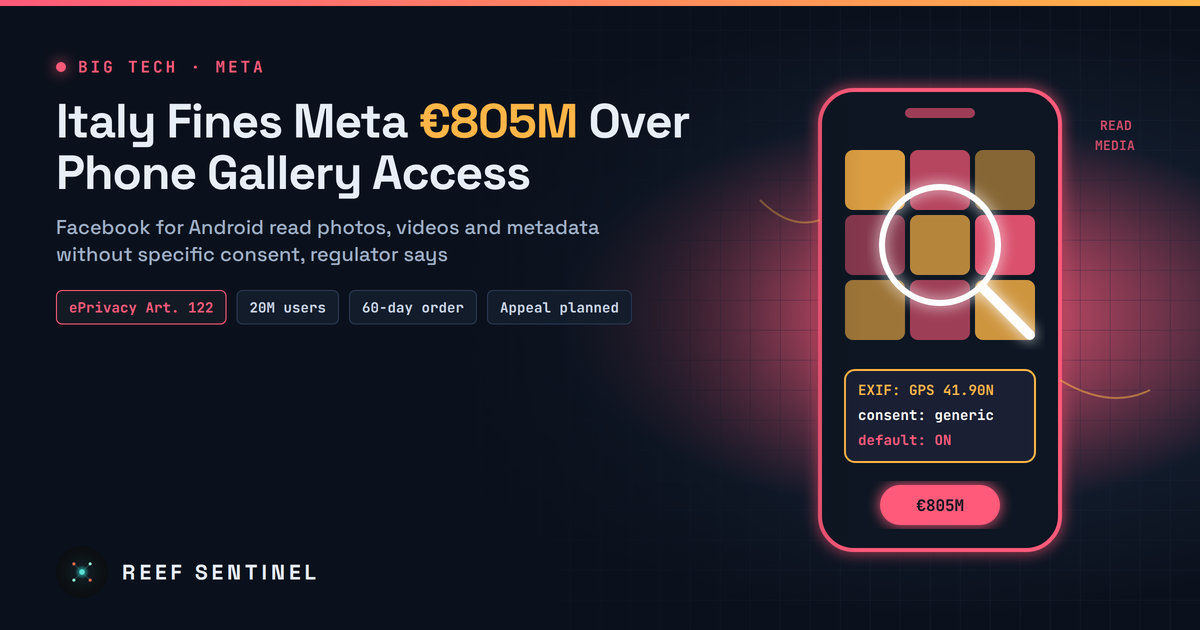
Italy's privacy regulator fined Meta €805 million, its largest penalty ever, because Facebook's Android gallery-suggestions feature read about 20 million users' photos, videos and metadata through a vague, default-on permission. It ordered the feature switched off unless users opt in within 60 days.
What Happened
Italy's data protection authority, the Garante per la protezione dei dati personali, has fined Meta Platforms Ireland €805 million (about $880 million). The regulator found that the Facebook app for Android read photos, videos and their metadata from users' phones without specific consent. It announced the decision on Saturday, 14 November 2026.
The fine is the largest the Garante has ever imposed. It equals roughly 0.47% of Meta's global turnover. The regulator estimates that about 20 million Android users in Italy may have been affected.
Meta says it "strongly disagrees" with how the Garante assessed the facts and applied the law, calls the penalty disproportionate, and says it will appeal.
The Feature at the Centre of the Case
The decision is about a Facebook option called "Get suggestions from gallery when browsing Facebook". Meta introduced it in 2023. It looks through the phone's photo gallery and suggests pictures and videos the user might want to post.
The Garante's main objections:
- One permission for many purposes. Facebook asked for gallery access with a single, app-wide Android permission. The prompt before it used generic wording about "enabling other features". It did not explain that agreeing would also switch on gallery suggestions.
- On by default. The suggestions option came pre-enabled. The regulator says this let the app keep reading the user's entire photo library, with no real control by the user.
- Metadata as well as images. Photos and videos carry metadata, which can include when and where a picture was taken and which device took it. This makes a phone's camera roll some of the most sensitive data a person holds.
The Garante said Italian law treats the smartphone as an extension of the user's private life. Accessing what is stored on it requires free and informed consent, whether or not any data leaves the device and whether or not anyone is harmed.
The Legal Angle: ePrivacy, Not GDPR
The ruling is based on Article 122 of Italy's Privacy Code. That article puts the EU ePrivacy Directive into Italian law, including the "cookie rule" on storing or reading information on a user's device. The Garante did not use the GDPR.
This choice matters. Meta argued that Ireland's Data Protection Commission should handle the case, because Meta's EU headquarters is in Dublin. Under the GDPR, the "one-stop-shop" mechanism usually sends cross-border cases to that lead authority. The Garante rejected the argument, saying the ePrivacy framework has no one-stop-shop. Any national regulator can therefore act on device access in its own country.
The investigation began in July 2025 after a complaint from a consumer protection centre in Bolzano. In setting the amount, the regulator counted several factors against Meta:
- The number of affected users and how long the conduct lasted.
- An earlier Garante decision against Meta in 2019.
- What it called poor cooperation during the investigation.
Corrective changes Meta made along the way earned only partial credit. The Garante called them late.
What Meta Must Do
The fine comes with a set of compliance orders and deadlines:
- Within 60 days: keep gallery suggestions off by default, including for users who had already agreed, and add a separate, clear consent request just for this feature.
- After the 60 days: block the feature for anyone without valid consent.
- Within 30 days: tell the regulator what steps it has started.
- Within 90 days: report on the measures it has put in place.
The decision does not cover whether gallery content was used to train AI models; Meta denies doing so. The Garante said it will separately examine a cloud-processing version of the feature that Meta launched in 2026.
Why It Matters
For privacy and security readers, the main point is broader than one Facebook toggle. A European regulator has said clearly that bundling device permissions does not count as consent. Under this reading, an Android or iOS permission dialog backed by vague text about "other features" does not cover every purpose the app later uses that access for.
Three things stand out:
- Camera rolls are a high-value target. Galleries hold ID documents, screenshots of passwords and recovery codes, banking apps, medical paperwork and location history in EXIF data. Any feature that can read the whole library all the time widens the exposure, even without a breach.
- Default-on is now a liability. The regulator treated the pre-enabled setting as a key part of the violation, not just a design choice.
- The ePrivacy route skips the Irish bottleneck. If other national authorities follow Italy's reasoning, Big Tech firms could face device-access cases in several EU countries at once instead of a single lead regulator.
What It Means for Users and IT Teams
For individual Android users:
- In Facebook's settings, look for gallery or camera-roll suggestions and turn them off if you don't use them.
- In Android settings, check the Facebook app's "Photos and videos" permission. Recent Android versions let you allow only selected photos instead of the whole library.
- Don't keep screenshots of passwords, recovery codes or ID documents in your main gallery. Use a password manager or encrypted storage instead.
For IT and mobile-device teams:
- On managed or work-profile devices, check which consumer social apps have full media access. Where your MDM supports it, limit that access or keep those apps out of the work profile.
- Treat staff camera rolls as possible stores of corporate data, such as whiteboard photos and screenshots of internal systems, and include this in awareness training.
- For in-house app developers, the decision is a design warning: ask for permissions per purpose, explain each purpose in plain words, and leave optional data-reading features off until the user opts in.
What Happens Next
Meta will appeal in the Italian courts, and the fine and orders may be challenged for months or years. The 60-day compliance clock still runs, unless a court suspends the decision. Watch for changes to Facebook's Android consent screens in Italy, and possibly across the EU if Meta prefers one design. Also watch for the Garante's separate review of the 2026 cloud-processing feature. Other EU regulators may also pick up the ePrivacy-without-one-stop-shop argument for their own cases.
