OpenAI Launches Daybreak Red Team and Defense Factory: AI Agents That Prove Web App Flaws Are Exploitable, Then Draft Patches for Engineers to Review
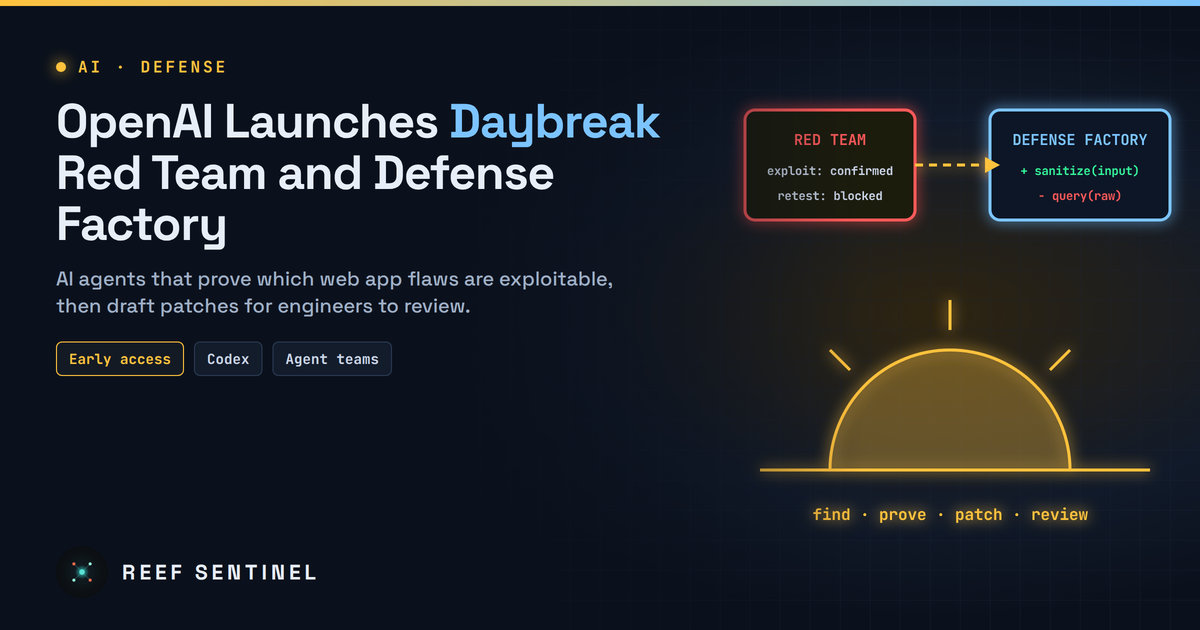
At its Cyber at the Frontier event OpenAI launched Daybreak Red Team, an early-access agent team that checks whether flaws are exploitable, and Daybreak Defense Factory, a preview that traces flaws through code and proposes fixes.
OpenAI has launched two new products under its Daybreak cyber defence brand. Daybreak Red Team is a team of AI agents that tries to prove whether web application flaws are really exploitable. Daybreak Defense Factory follows those findings into the code and drafts patches for engineers to review. OpenAI unveiled both at its "Cyber at the Frontier" keynote on 12 November, one week after it released its GPT-6 Cyber model.
What Happened
OpenAI president Greg Brockman spoke at the event. OpenAI's head of cyber, Johannes Landgraf, said the "defender's window" is "under pressure" as capable models spread more widely and attackers speed up. OpenAI pitches the two products as a pipeline: Red Team confirms what is exploitable, and Defense Factory turns those confirmed findings into tested fixes.
The launch builds on Daybreak, the defensive programme OpenAI introduced earlier this year, and on the Codex Security agents it already offers for code review.
How Daybreak Red Team Works
Red Team pairs web application penetration testing with vulnerability investigation:
- A coordinating agent plans the assessment.
- Worker agents read the application's source code and context and look for possible attack paths.
- Reviewer agents check the results before anything is reported as a confirmed vulnerability.
Red Team can also triage findings from elsewhere: code-scanner output, bug bounty submissions and vulnerability disclosure reports. Once a fix exists, it runs the attack again to check that the patch really blocks it.
OpenAI says assessments run in isolated environments within defined boundaries. A "guardian review" step controls which applications and endpoints the agents may reach. Landgraf said the product paves the way to widening access to OpenAI's frontier cyber models over time.
How Daybreak Defense Factory Works
Defense Factory covers the fixing side:
- Teams connect a GitHub repository. Each person who starts a cloud scan needs their own GitHub connection, and scans run in Codex cloud.
- It can scan a repository's whole default branch or selected folders and files, watch new commits, run scheduled scans and review pull requests before they are merged.
- When it confirms a vulnerability, it traces the flaw through the code, tells the responsible engineer and prepares a proposed patch.
- Engineers review, test and refine the change in Codex before merging. OpenAI says nothing is merged automatically.
- A desktop mode can scan local checkouts and uncommitted changes. An optional Deep scan makes several passes, which takes more time and tokens.
Availability
- Red Team: early access for selected customers, with a waitlist. Registering does not guarantee a place.
- Defense Factory: a preview plugin for workspaces that already have Daybreak access. Reports differ on whether it sits in Codex, ChatGPT or both, and OpenAI describes it as a Daybreak plugin used together with Codex.
- Pricing and models: OpenAI has not published pricing, customer names or benchmark results, and has not said which model powers each product.
What OpenAI Says It Is Not
Clint Gibler, who leads cybersecurity research at OpenAI, said the products are not meant to replace human red teams. Their aim is to close the gap between what defenders can protect and the amount of AI-generated code now being shipped. Fouad Matin, OpenAI's cyber preparedness and safety lead, said they were built to be "turnkey and easy to use" for organisations without large offensive security teams.
What Security Teams Should Consider
- Validation over volume: The main promise is fewer false positives. A finding counts only once an agent has shown it can be exploited. Ask for evidence that this holds on your own stack before trusting the triage.
- Access to source code: Both products need deep access to your code and running applications. Check the GitHub scopes requested, where scans run and what data is kept, and treat the integration as a privileged third party.
- Human review stays essential: AI-written patches can fix the symptom and miss the root cause, or break behaviour elsewhere. Keep normal code review and testing in place.
- Scope control: Make sure any automated attack agent is limited to environments you own. Get written authorisation before it touches anything in production.
Why It Matters
AI labs are now competing for the defensive security budget, not only the developer budget. Agents that both attack and fix code shrink the time between "bug found" and "bug fixed". That matters because the same kind of models are shrinking the time between disclosure and exploitation on the attacking side. Whether Daybreak delivers will depend on numbers OpenAI has not yet shared: how many confirmed bugs it finds, how many false positives it produces, and how often its patches merge without rework.
