Counting the Cost of the Microsoft 365 Outage: 15+ Hours, 16 Services, Seven Countries — How One Failure Hit Governments, Hospitals, Airlines, Banks and AI Tools
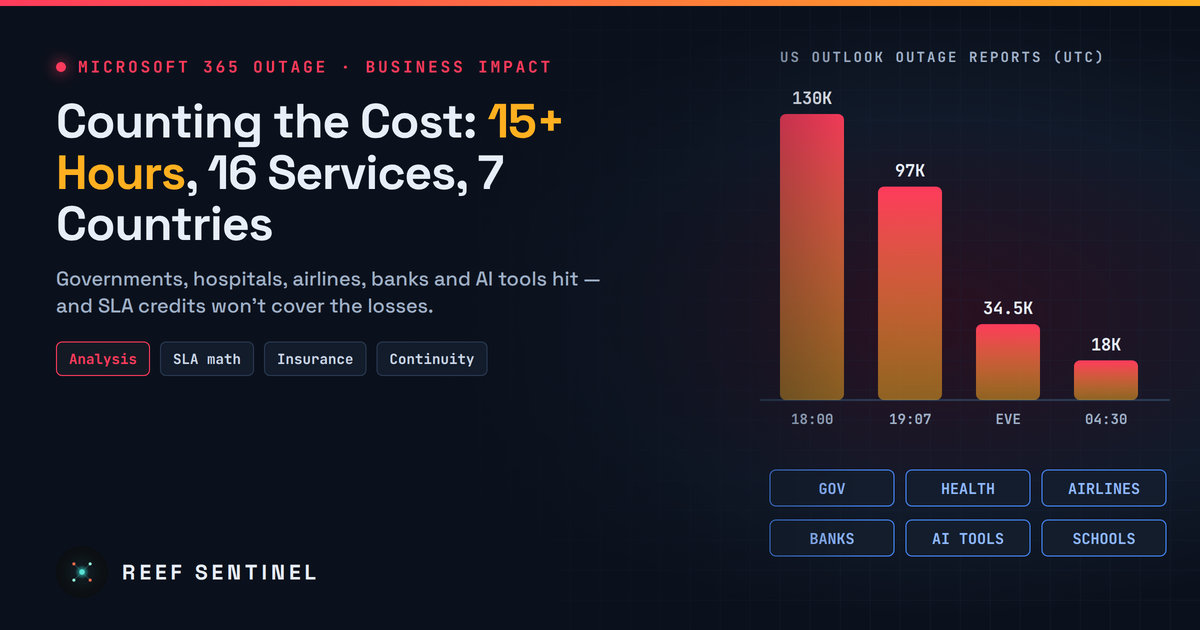
An analysis of the EX1550543 outage's business impact: duration, outage-report curves, the 1-to-16 service fan-out, sectors hit worldwide, a cost model, SLA credit maths, insurance exposure and lessons for continuity planning.
The Short Version
The Microsoft 365 outage that began at 20:17 Mauritius time (16:17 UTC) on Thursday, 12 November 2026 had passed 15 hours by about 11:30 Mauritius time (07:30 UTC) on Friday, and Microsoft still had not declared it resolved. That makes it longer than the roughly 10-hour Microsoft 365 outage in January 2026, the company's previous major failure this year.
The outage did not stay in one region or one product. In about a day it:
- hit named organisations in at least seven countries (the US, Canada, Australia, Japan, Singapore, Taiwan and India), with outage reports from 74 countries and territories;
- spread from one Exchange Online incident to 16 listed Microsoft services and admin tools;
- ran through the US working afternoon and then the full Asia-Pacific working morning on Friday, so many organisations lost a large part of a business day.
This analysis looks at what the outage actually cost businesses, where the damage concentrated, and what it says about how organisations depend on a single productivity cloud.
Measuring the Scale
Duration
Measured from Microsoft's official start time, the outage reached:
- 5 hours by 01:17 Mauritius time Friday (21:17 UTC Thursday), the end of the US East Coast working day;
- 10 hours by 06:17 Mauritius time (02:17 UTC) Friday;
- 15+ hours by 11:30 Mauritius time (07:30 UTC) Friday, deep into the Asia-Pacific working day.
The problems began for Australian users just after 03:00 local time on Friday, so organisations there started their day without reliable email. Microsoft's partial fixes repeatedly failed to hold: restored servers fell over again once traffic returned.
Public outage reports
Outage-report counts are not user counts. They measure how many people bothered to file a report, and they rise and fall with time of day. Even so, the curve tells a story:
- More than 130,000 Outlook reports in the US at the peak, around 22:00 Mauritius time (18:00 UTC) on Thursday. Microsoft 365 as a whole drew roughly 47,000 to 48,000 reports at its peak, and Teams a few thousand.
- About 97,000 Outlook reports at 23:07 Mauritius time (19:07 UTC), around 34,500 by Thursday evening, and still more than 18,000 at 08:30 Mauritius time (04:30 UTC) on Friday, which was 23:30 in New York.
- In Australia, more than 4,400 Outlook reports by 08:20 local time on Friday.
The fall from the peak is mostly the US going home, not the service coming back. Reports fell by around 86% between the afternoon peak and midnight Eastern time, while Microsoft was still describing recovery as partial and unsustained. Then Asia-Pacific woke up and a second wave began.
Outage reports came from 74 countries and territories within about an hour of the incident going global.
Blast radius
The incident began as an Exchange Online mailbox problem (EX1550543). The companion advisory (MO1550821) grew through the afternoon and night until it listed impact on:
- Exchange Online
- Microsoft Teams (calendar, scheduling, events)
- SharePoint Online
- Microsoft 365 Copilot and Copilot Chat
- Microsoft Graph
- Defender for Office 365 and Defender XDR
- Microsoft Purview
- Microsoft Intune
- Planner
- To Do
- Universal Print
- Power BI and Fabric
- Windows 365 (tenants using Purview Customer Key)
- Microsoft 365 admin center
- Microsoft 365 Apps admin center
- Microsoft 365 Education
That is a 1-to-16 fan-out from one root failure. The point for businesses is that the email outage was not just email. It reached calendars, compliance, endpoint management, printing, reporting and part of the security stack.
Where the Damage Landed
Governments and the public sector
Public bodies on three continents reported disruption:
- United States: Michigan's state technology department said some state operations were affected and email and other Microsoft apps were down. Detroit's city hall operations were disrupted. The US House of Representatives said some users were affected and its engineers were working with Microsoft.
- Japan: a senior government spokesperson said the outage was affecting government information system infrastructure.
- Australia: the national intelligence agency and the federal police were among those affected. The home affairs minister said the impact was "very much on email systems". The country's national cyber security coordinator was monitoring the situation. Some users could not receive two-factor authentication codes, which locked them out of other services as well.
- Singapore: email at some government agencies and the courts was disrupted. The national digital identity service was not affected.
Healthcare
In Michigan, a major academic medical centre confirmed problems accessing Outlook and other Microsoft apps, and another large health system reportedly lost Outlook and Teams. In Toronto, a hospital network stressed that patient care was not affected. That pattern held across the reports: clinical systems mostly kept running, but hospitals lost the email, scheduling and messaging that coordinate staff.
Transport and airlines
- Canada's national passenger rail operator warned that travellers might not receive emails about their trips.
- In India, two airlines said their email-based customer support was affected.
These are customer-facing failures. When booking confirmations, changes and support tickets run through Exchange Online, an internal IT outage becomes a customer service problem.
Banking and finance
- In Singapore, email at several major banks was disrupted.
- In Taiwan, securities firms, life insurers and investment trusts reported disruption to fund management. One firm cancelled a bond repurchase agreement it had already scheduled.
That last example is the clearest case of an outage turning directly into a financial transaction that did not happen.
Corporate disclosure
A US-listed electric truck maker postponed its third-quarter results announcement from 12 to 16 November, citing the outage. Moving a scheduled earnings release is rare and visible to investors. It shows how far down the corporate process chain email now sits.
AI tools and automation
OpenAI and Anthropic both reported problems with their Microsoft 365 connectors. New connections could fail and existing integrations might not work, because the mailboxes and calendars they read were unavailable. Microsoft's own Copilot was hit too.
This is a newer category of impact. In 2026, many organisations run AI assistants, agents and workflow automation on top of Microsoft Graph and Exchange data. When the data layer goes down, every AI tool built on it stops as well, whichever vendor made it.
Education
Universities in North America reported problems. Some Australian schools reportedly could not run online classes on Friday and asked parents to phone in absences instead of emailing.
The Analytics of Cost
No credible total yet
There is no reliable estimate of the total economic cost of this outage. Multiplying outage reports by an assumed hourly wage does not give a meaningful number, and nobody has published a sound aggregate figure. Any headline figure that appears in the coming days should be treated with caution.
What we can do is model the cost for a single organisation.
An illustrative model for one company
Take a company with 1,000 office staff, an average fully loaded labour cost of $50 per hour, and 6 working hours affected. If the outage cuts productivity by:
- 10% (people switch to other work, phones and local files), the cost is about $30,000;
- 25% (meetings missed, approvals stuck, customer emails unanswered), about $75,000;
- 50% (email-dependent roles largely idle), about $150,000.
These numbers are illustrative only. They leave out lost sales, missed deadlines, contract penalties and the overtime spent clearing backlogs afterwards. They also show why customer-facing and email-heavy sectors (finance, travel, professional services, public administration) feel outages like this far more than others.
What Microsoft's SLA returns
Microsoft's financially backed SLA for its online services promises 99.9% monthly uptime, with service credits stepping up as availability falls:
- below 99.9%: 25% credit;
- below 99%: 50% credit;
- below 95%: 100% credit.
November has 43,200 minutes. 99.9% allows about 43 minutes of downtime, and 99% allows about 7.2 hours. A tenant that was fully down for 15 hours would sit at about 98% availability for the month, which falls in the 50% credit tier. Getting to the 100% tier would take about 36 hours of downtime.
In practice, availability is measured per tenant and per user, so many organisations with partial impact will qualify for less. And credits apply only to the fee for the affected service. Even a 50% credit is a small fraction of what the model above shows a mid-sized company can lose in one afternoon. Credits cap Microsoft's liability; they do not make customers whole.
What insurance covers
Insurers are already looking at this outage through the lens of contingent business interruption: losses caused by a supplier's failure rather than an attack on you. Several points stand out:
- One major insurer's claims data shows contingent business interruption rose from about 6% of the value of large cyber claims in 2024 to about 15% in the first half of 2025. Failures at cloud and software providers are a growing share of losses.
- Cyber business-interruption cover usually has a waiting period of 8 to 12 hours before it pays. This outage was long enough to pass that threshold, which many shorter cloud outages do not.
- The open questions are wording ones: does "system failure" cover apply when the failure happens at a third party, and does dependent business-interruption cover include SaaS providers or only named cloud hosts?
- Newer parametric products pay on measured downtime at cloud providers, but it is unclear whether they respond here, because this was a Microsoft 365 software service failure rather than an outage of Azure's underlying infrastructure.
For past comparison: the CrowdStrike incident in July 2024 was estimated to have cost Fortune 500 companies about $5.4 billion, of which only around 10 to 20% was likely insured. Most of the cost of large IT failures stays with the businesses affected.
Market reaction
Analysts expected investors to look past the outage in the short term, because organisations rarely leave the Microsoft ecosystem quickly. The longer-term risk for Microsoft is reputational: this is its second major Microsoft 365 outage of 2026, and it follows an Azure outage last month that also disrupted its productivity services. Repeated failures give customers a reason to ask harder questions at renewal.
What the Outage Revealed
1. The fallback was on the same platform
The most common continuity plan for an email outage is "move to Teams". This time, Teams calendars, scheduling and events were affected too, along with SharePoint and Copilot. A fallback hosted on the same provider is not a fallback. Organisations that came through best had a channel outside Microsoft: phone trees, SMS alerting or a separate chat platform.
2. Email is part of identity and security
Exchange Online carries password resets, MFA prompts, approval workflows and security alerts. In Australia, users who could not receive authentication codes lost access to unrelated services. Defender for Office 365 and Purview were also degraded, so email filtering, quarantine review and compliance tooling were weakened at the same time as staff were most likely to fall for outage-themed phishing.
3. The impact follows the sun
Because recovery stalled overnight, the outage hit the Americas' Thursday afternoon and then Asia-Pacific's Friday morning. For global businesses, that means two regional business days lost to one incident. Continuity plans written around "a few hours, one region" did not match what happened.
4. AI magnifies dependency
AI assistants, agents and automations from several vendors all depend on the same Microsoft Graph and Exchange data. A single data-layer failure took out Microsoft's own Copilot and third-party connectors at the same time. As more business processes run through AI layers, the reach of a productivity-cloud outage keeps growing.
What Businesses Should Do Next
- Document the impact now: start and end times as you experienced them, staff hours lost, failed or delayed transactions, and customer complaints. You will need this for SLA claims, insurance claims and internal reviews.
- File for SLA credits once Microsoft publishes the official duration, and keep its preliminary and final post-incident reviews.
- Check your insurance wording with your broker: does it respond to non-malicious SaaS failures, what is the waiting period, and would a parametric layer have helped?
- Build a non-Microsoft communication path for incidents, including alerting that does not depend only on Exchange Online.
- Map your single points of failure: which customer emails, approvals, MFA flows and AI automations stop when Exchange Online stops?
- After recovery, review security: check quarantine and delivery logs for anything that arrived while Defender was degraded, and warn staff about outage-themed phishing.
Bottom Line
The numbers point to one conclusion. A single component failure inside Microsoft's mail infrastructure turned into a multi-day, multi-continent business interruption, across government, healthcare, transport, finance, education and the AI tools built on top of it. The direct cost to any one organisation can run into tens or hundreds of thousands of dollars in lost productivity. SLA credits recover a small fraction of that, and insurance may or may not respond.
For most businesses, the lesson is not to leave Microsoft 365. It is that their continuity planning has to assume the whole productivity stack can fail at once, and for longer than a working day.
