SAP NetWeaver CVE-2025-42884 Now Exploited: A Year-Old 'Medium' JNDI Injection Flaw in Enterprise Portal Hits CISA KEV With a 23 November Deadline — Apply SAP Note 3660969
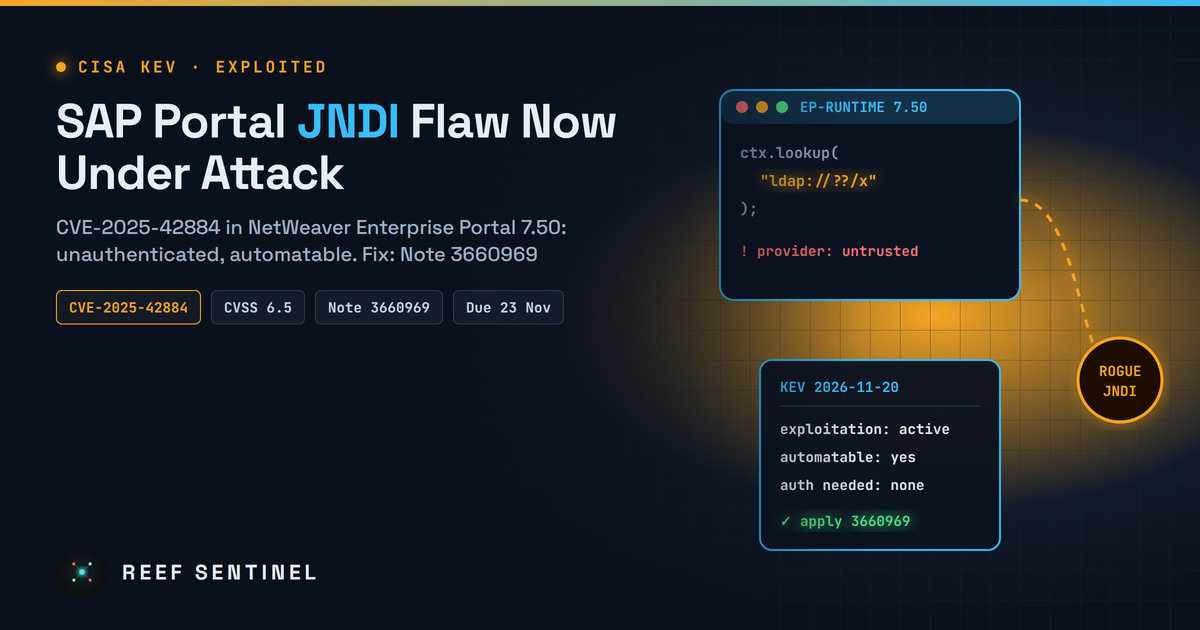
CISA says attackers are exploiting CVE-2025-42884, an unauthenticated JNDI injection flaw in SAP NetWeaver Enterprise Portal 7.50 that SAP fixed a year ago in Note 3660969.
A year-old SAP bug rated "Medium" is now on the US government's list of flaws attackers actually use. On 20 November 2026, CISA added CVE-2025-42884, a JNDI injection vulnerability in SAP NetWeaver Enterprise Portal, to its Known Exploited Vulnerabilities (KEV) catalog. Federal civilian agencies were given until 23 November 2026 to act, a three-day window.
SAP fixed the flaw a year ago, on its November 2025 Security Patch Day, with SAP Security Note 3660969. Any portal that has been patched since then is protected. Systems that skipped the note because a CVSS score of 6.5 looked like something for later are the ones at risk now.
What Happened
CISA listed CVE-2025-42884 under the name "SAP NetWeaver Improper Neutralization of Special Elements in Data Query Logic Vulnerability". It was added in the same batch as three critical flaws that already had public exploitation evidence:
- Cisco Expressway hard-coded credentials (CVE-2026-76466)
- VMware vCenter authentication bypass (CVE-2026-123890)
- Apache Roller deserialization (CVE-2026-129448)
The KEV entry is short, which is typical. It confirms active exploitation but does not name a threat actor, describe the attack chain or publish indicators of compromise. In its own vulnerability scoring for the record, CISA marks exploitation as active, the flaw as automatable and the technical impact as partial. "Automatable" matters most: an attacker can scan for and hit vulnerable portals at scale without any human interaction.
SAP and the researchers who reported the bug have not said publicly who is behind the attacks or how many systems have been compromised. We found no reliable public reporting that answers either question.
Technical Details
The official description says SAP NetWeaver Enterprise Portal "allows an unauthenticated attacker to inject JNDI environment properties or pass a URL used during JNDI lookup operations, enabling access to an unintended JNDI provider". SAP says this can lead to disclosure or modification of information about the server, with no impact on availability.
The key facts from the CVE record and the vendor:
- CVSS 3.1: 6.5 (Medium), vector
AV:N/AC:L/PR:N/UI:N/S:U/C:L/I:L/A:N. It is reachable over the network with low complexity, needs no credentials and needs no user action. - Weakness: CWE-943, Improper Neutralization of Special Elements in Data Query Logic.
- Affected components: EP-BASIS 7.50 and EP-RUNTIME 7.50 (application component EP-PIN-APF-CAT).
- Discovered by: security researchers who reported it privately to SAP. SAP published the fix on 11 November 2025.
JNDI (Java Naming and Directory Interface) is the Java API that applications use to look up objects and resources from naming services such as LDAP, RMI or DNS. If an attacker can control the provider URL or the environment properties of a lookup, the server can be made to contact a system the attacker runs. That is the same family of weakness that made Log4Shell so damaging in 2021.
Do not stretch the comparison too far, though. SAP scores the confirmed impact here as limited confidentiality and integrity loss, not remote code execution, and no public analysis has shown a code-execution chain for this CVE. Even so, an unauthenticated attacker who can steer a server's outbound lookups and read or change server details gets a useful foothold for reconnaissance. Attackers often chain bugs like this one with other weaknesses in SAP landscapes.
Who Is Affected
The flaw affects organisations running SAP NetWeaver AS Java with Enterprise Portal 7.50 that have not applied Note 3660969. Enterprise Portal is often the internet-facing front door for SAP: employee self-service, supplier portals and partner access all run through it. That makes it a common target for internet-wide scanning.
SAP Java stacks have been heavily targeted before. In 2025 a critical flaw in the NetWeaver Visual Composer component (CVE-2025-31324) was exploited by several groups, including China-linked espionage actors, to plant webshells on portal servers. Organisations that hardened their portals after that campaign are in a better position now. Those that only removed Visual Composer may still be running an unpatched portal runtime.
Patch Status
A fix has existed for a full year:
- SAP Security Note 3660969 corrects the JNDI lookup handling in EP-BASIS / EP-RUNTIME 7.50. It was released on 11 November 2025 alongside 25 other new and updated notes, four of them HotNews.
- No new patch is needed in response to the KEV listing. The task is to confirm that the year-old note is actually deployed.
- CISA's required action is to apply the vendor mitigations. Where mitigations cannot be applied, agencies must stop using the product.
Because SAP patches ship as notes and support packages, a system can show a recent support package level and still be missing a specific correction. Check note implementation status directly. Do not infer it from the patch level.
What To Do Now
- Confirm Note 3660969 is implemented on every NetWeaver AS Java system running Enterprise Portal 7.50, including test, QA and disaster-recovery copies that are reachable from the network.
- Limit exposure. If a portal does not need to be reachable from the internet, put it behind a VPN, a reverse proxy with an allow-list, or SAP Web Dispatcher rules that block unauthenticated access to portal components it does not need.
- Control outbound traffic. JNDI abuse usually relies on the server reaching out to an attacker-run LDAP, RMI or HTTP endpoint. Application servers rarely need arbitrary outbound connections, so block them at the firewall and alert on any attempts.
- Hunt for signs of probing. Review HTTP access logs on the portal and Web Dispatcher for unusual unauthenticated requests carrying JNDI-style URLs (for example
ldap://,rmi://ordns://strings) or naming-context parameters. Also look for unexpected outbound connections from the Java server processes. - Review the rest of the landscape. The same patch day fixed CVSS 10.0 issues in SQL Anywhere Monitor (CVE-2025-42890) and NetWeaver AS Java deserialization hardening (CVE-2025-42944), plus a CVSS 9.9 code injection flaw in Solution Manager (CVE-2025-42887). A portal missing one of those notes is probably missing others.
A quick first check on a Linux-based AS Java host is to look for outbound sessions from the Java server processes to unexpected destinations:
# List established outbound connections from SAP Java server processes
sudo ss -tnp state established | grep -i 'jstart\|java'
Why It Matters
This listing shows once again that CVSS severity and real-world risk are not the same thing. A Medium-rated bug that needs no login, has a network attack vector and can be automated is exactly what attackers like to put into scanning tools. Many vulnerability programmes still sort SAP notes by priority and leave Medium items for quarterly maintenance windows, and this one stayed in that queue for a year.
CISA's three-day deadline signals that it considers the risk immediate. Organisations outside the US federal government are not bound by it. They face the same attackers, though, and the fix is already in their SAP support portal.
