Microsoft Entra Connect Health API Flaw Exploited: Attackers Read Admin Emails, Tenant IDs and Sync Status for Four Months Before a 19 November Server-Side Fix
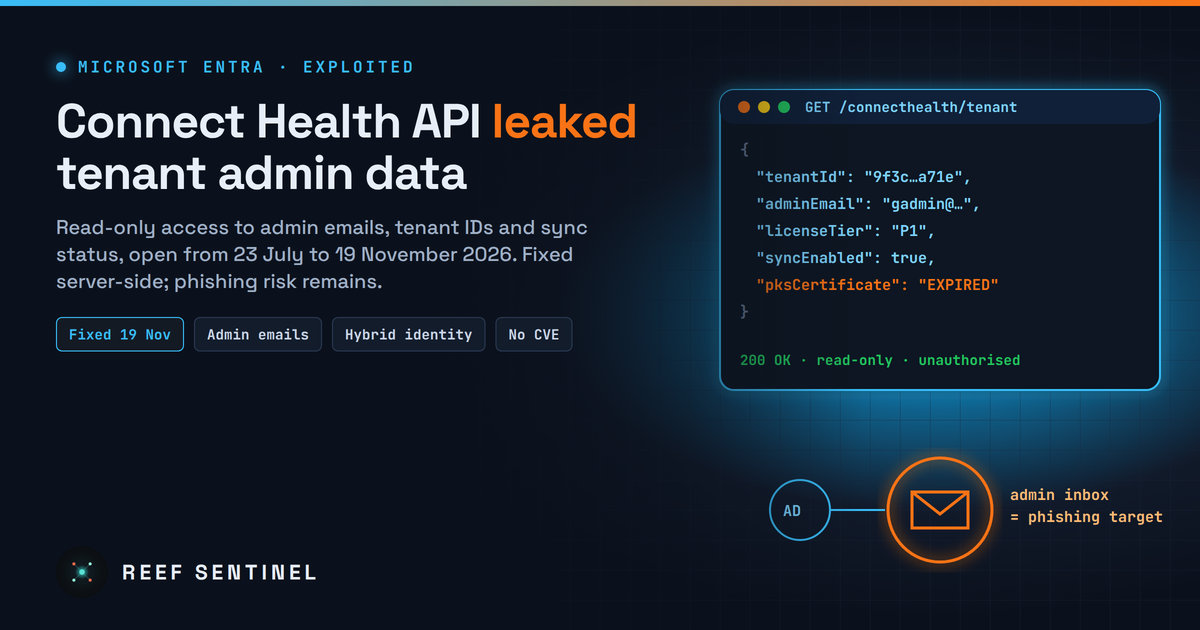
Microsoft says an attacker abused a Connect Health API bug introduced on 23 July 2026 to read tenant metadata including administrator email addresses, and although no customer patch is needed, the leak hands attackers a ready-made spear-phishing list.
Microsoft is notifying organisations that an attacker exploited a flaw in the Microsoft Entra Connect Health API to read tenant-level metadata, including the email addresses of administrator and technical contact accounts. The vulnerability sat in the service for almost four months before Microsoft found it. Microsoft fixed it on its own servers on 19 November 2026, so customers have nothing to patch. They do have a phishing problem to plan for.
What Happened
According to the customer notice, which administrators have shared publicly and Microsoft has confirmed to the press, the timeline is:
- 23 July 2026: the vulnerability was introduced into the Connect Health API.
- 9 November 2026: Microsoft detected it.
- 19 November 2026: Microsoft deployed a server-side fix and reviewed telemetry for unauthorised API calls.
- 20 November 2026: Microsoft concluded its investigation and began notifying affected tenants through Azure Service Health.
The notice states: "On 20 November 2026, we concluded our investigation and determined that unauthorized read-only access to tenant-level metadata associated with your organization had occurred." It adds: "We did not identify any unauthorized configuration changes."
A Microsoft spokesperson said the company "deployed a fix on November 19, 2026, and have notified impacted customers through Azure Service Health", and declined to give more detail. Microsoft has not said how many tenants were affected, who exploited the flaw, or when the abuse started. No CVE identifier has been published. That is common for cloud-only flaws fixed entirely on Microsoft's side, but it means the incident will not appear in normal vulnerability feeds.
Some administrators said they received the notice for their own tenant. Managed service providers reported notices for several customer tenants at once, which suggests the exposure was not limited to a handful of organisations.
What Connect Health Is
Microsoft Entra Connect Health is the monitoring part of Microsoft's hybrid identity stack. Organisations install an agent on their on-premises identity servers, which can be Entra Connect Sync, AD FS or AD DS domain controllers. The agent reports alerts, performance data, sync errors and usage analytics to the Entra admin center. It requires an Entra ID P1 licence. In practice it is used mostly by larger organisations that still run on-premises Active Directory alongside Microsoft 365.
That makes the customer list itself valuable. Any tenant with Connect Health onboarded is a confirmed hybrid identity environment, and attackers have repeatedly targeted Entra Connect servers and their sync accounts to move from on-premises AD into the cloud.
What Was Exposed
According to Microsoft's notice, the API returned:
- Email addresses of tenant technical contacts and administrator accounts
- Tenant IDs, display names, initial domain names, country codes and regional information
- Entra licence tier and directory synchronisation status, including whether sync is enabled and the last sync timestamp
- Connect Health onboarding status
- An expired certificate once used to register Connect Health agents with a Microsoft internal service that was decommissioned in late 2024. Microsoft says the certificate was no longer in use but was still stored and returned by the API
Microsoft says the flaw did not expose passwords, password hashes, authentication tokens, valid cryptographic keys, on-premises server or Active Directory topology, or Azure subscription information. The investigation also found that the bug could have allowed changes to Connect Health monitoring configurations. Microsoft says it saw no such changes.
Why It Matters
On its own, this is a read-only metadata leak. Combined with other data, it is a ready-made targeting list. An attacker now holds, for an unknown number of organisations:
- The real email addresses of the people who administer the tenant
- Proof that the tenant runs hybrid identity, plus when it last synced
- The licence tier, which hints at which security features (Conditional Access, Identity Protection) are likely in place
- The tenant's own name, domain and region to make lures convincing
That is enough for well-targeted spear-phishing, device-code phishing, fake "Microsoft support" calls or fake outage notices addressed to exactly the people with Global Administrator rights. Fake Microsoft 365 service notices quoting real incident IDs have already been used to phish admin logins this month. Attackers who know who holds the keys, and that the victim has an on-premises sync server worth reaching, can skip much of their reconnaissance.
The fact that an expired certificate from a retired service was still being returned is also worth noting. It does not appear usable, but it shows that old secrets were left in storage long after their service was retired. Security teams should check their own environments for the same mistake.
What To Do Now
Microsoft says no software update or customer remediation is required. Even so, if you received the Service Health notice, or you run Connect Health and are unsure, these steps are sensible:
- Check Azure Service Health (Health history and Security advisories) for the Connect Health notice, and make sure the right people receive Service Health alerts.
- Warn your administrators and help desk to expect targeted phishing, MFA-fatigue attempts, device-code prompts and phone calls posing as Microsoft. Treat any unsolicited "Microsoft support" contact about your tenant as hostile.
- Enforce phishing-resistant MFA (FIDO2 security keys, Windows Hello for Business or certificate-based authentication) for every privileged role, through Conditional Access authentication strengths.
- Block device-code flow where it is not needed, and review risky sign-ins for admin accounts.
- Review Entra audit and sign-in logs for unusual activity against administrator accounts since late July.
- Review Connect Health configuration, including registered services, monitored servers and alert notification recipients, for anything you do not recognise.
- Use separate cloud-only admin accounts whose addresses are not published elsewhere, so a leaked contact address does not point straight at a privileged identity.
Microsoft has also published read-only PowerShell scripts that show the kinds of tenant metadata involved. They use the Az.Accounts module (2.17.0 or later) and read access to Connect Health:
Install-Module Az.Accounts -MinimumVersion 2.17.0 -Scope CurrentUser
.\SelectConnectHealthTenant.ps1      # prompts for tenant ID, signs in
.\GetTenant.ps1                      # tenant-level Connect Health configuration
.\GetTenantPksCertificateDetails.ps1 # decodes stored certificate metadata in memory
.\GetServiceMonitoringConfigurations.ps1
The scripts show current values, not a record of what the attacker actually read. Treat the output as a list of what was potentially exposed.
The Bigger Picture
This is the latest in a run of server-side identity flaws at Microsoft that customers could neither detect nor fix themselves. The open questions are who was querying the API, how many tenants were affected, and whether the access began soon after 23 July. Until Microsoft answers them, any organisation running Connect Health should assume its admin contacts are on someone's target list and harden accordingly.
