JPMorgan Chase, Visa and Mastercard Confirm Vendor Hacks as n0n Leaks Premium Cardholder Data: Emails, Phones, Account IDs and Bookings Exposed, No Card Numbers
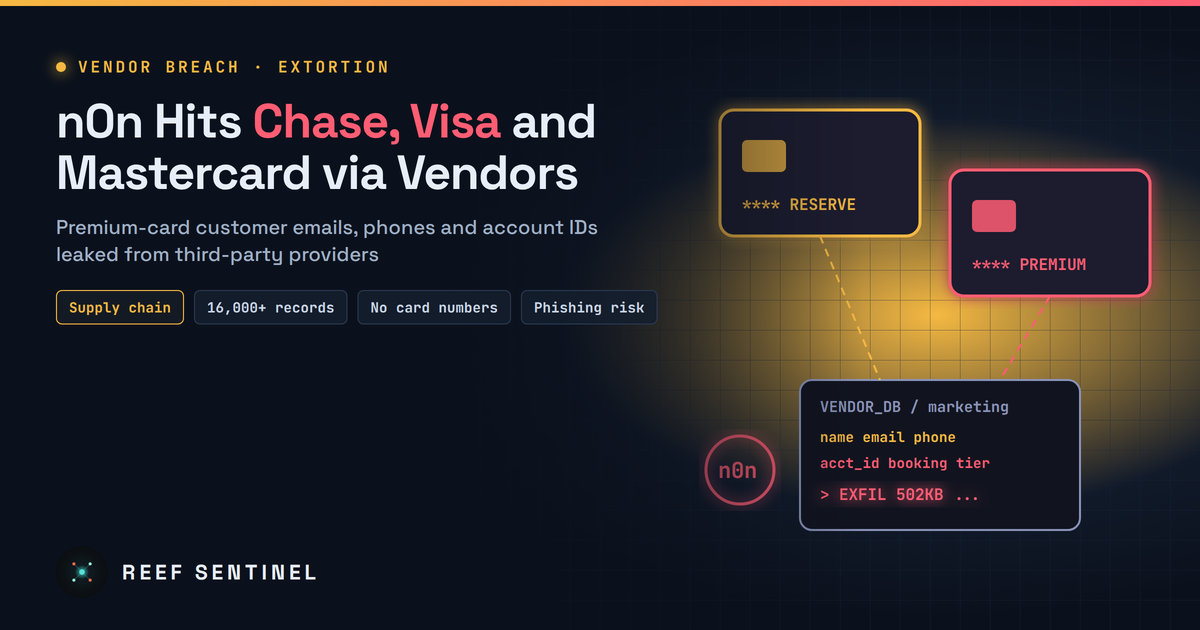
JPMorgan Chase, Visa and Mastercard say third-party providers were breached after the n0n extortion group leaked data on premium cardholders, setting up targeted phishing even though no card numbers were exposed.
JPMorgan Chase, Visa and Mastercard have each confirmed that outside service providers working for them were hit by cyberattacks, after the extortion group n0n posted customer data it says came from all three. None of the three says its own network was breached, and none reports exposed card numbers. Still, the leaked data is the kind that makes very convincing phishing possible: names, email addresses, phone numbers, account IDs and, in Visa's case, reportedly travel booking details of premium cardholders.
What Happened
n0n put JPMorgan Chase, Visa and Mastercard on its leak site and published data after a ransom deadline it set for 16 November passed. On 19 November the three companies spoke publicly for the first time.
Chase said in a post on X: "We have learned that third parties who provide services to the firm were the target of a cyber attack." It added: "Based on our investigation so far, we believe the attackers accessed certain marketing data held by those vendors, which may include some customer names and email addresses." The bank said its services were not disrupted. It also said the incident has nothing to do with the outage some customers had earlier in the week, which it blamed on a software bug in its own hardware.
Visa said the claims involve a service provider in the Asia-Pacific region. "Visa's systems were not involved and were not impacted. No payments data such as card numbers were affected," a spokesperson said.
Mastercard said an outside provider exposed a limited number of email addresses belonging to a small group of cardholders in one benefit programme. "There is no impact to the Mastercard payment network or the ability for people to use their cards," a spokesperson said. The company also said the exposure had been contained.
None of the three has named the vendors involved, said how many customers were affected or explained how the attackers got in.
What Was Leaked
The descriptions below come from security researchers who looked at the leaked files. None of the companies has confirmed these figures, and the data has not been independently verified.
- Chase: a file of about 502 KB holding roughly 16,000 customer email addresses, Chase account IDs and, for some records, phone numbers, plus 124 bank employee email addresses. Researchers say the records appear to relate to the invitation-only Chase "Reserve" card programme. It is not clear whether the file is a sample or the full haul.
- Visa: records said to cover more than 6,000 premium customers, with names, emails, phone numbers, messaging-app details and booking information such as dates and addresses.
- Mastercard: marketing information on customers in North America, the Middle East and Africa, plus a small number of Mastercard employee emails, according to reports. That sounds wider than the company's "small group of cardholders in one benefit programme". The two accounts have not been reconciled.
Researchers think the Chase and Visa data may have come from the same third-party provider. The mix of premium-card customers, bookings and messaging details suggests a concierge, dining, travel or loyalty-benefits platform rather than a payment processor. None of the companies has confirmed this.
Who Is n0n?
n0n is a new name. It was first tracked in mid-September 2026 and has moved quickly against companies that sit in other firms' supply chains. Recent claims include:
- Qubole: on 11 November n0n claimed a supply-chain attack on the cloud data-processing platform and said it took nearly a petabyte of data. That figure has not been verified. Separately, cloud security researchers reported that between 14 and 26 October an attacker used credentials from an AWS account linked to Qubole to assume roles customers had granted, including dormant ones, and download data from S3 buckets. They did not explicitly tie that activity to n0n.
- Expedia: last week the group claimed to have traveller data, after Expedia confirmed a breach through a third-party data platform.
- Samsung: this week Samsung affiliate Multicampus confirmed that about 70,000 users were exposed, while n0n leaked what it says is smart TV viewing data.
The pattern is the same each time. The attackers hit a vendor that holds a big brand's customer data, then extort the brand. The new incidents fit it, although nobody has publicly said whether the Chase, Visa and Mastercard vendors are linked to the earlier Qubole intrusion.
Who Is Affected
The Chase exposure appears to be concentrated among holders of its top-tier Reserve card. Visa's reported data covers premium cardholders served through an Asia-Pacific provider, so customers outside the US may be affected too. Mastercard says only one benefit programme was involved. If you hold a premium card from any of these issuers, assume your name, email and possibly your phone number are now in criminal hands, even if you have not been notified.
Why the "No Card Numbers" Line Doesn't Settle It
Leaked marketing and benefits data is the raw material for targeted fraud. A message that knows your name, your card tier, your account ID and perhaps a recent hotel or restaurant booking is far more convincing than generic spam. Expect:
- Emails and texts dressed up as fraud alerts or "benefit verification" requests from the bank or card network, often linking to cloned login pages.
- Phone calls from fake fraud teams who quote real account details and then ask for one-time passcodes, PINs or a "safe account" transfer.
- Messaging-app approaches (WhatsApp, Telegram, WeChat) referring to real travel or concierge bookings.
- Account-takeover attempts using reused passwords against the email addresses that were exposed.
What To Do Now
For cardholders:
- Don't use the contact details in an unexpected message. Call the number on the back of your card or open the official app yourself.
- Never read out a one-time passcode to a caller. Real bank fraud teams do not ask for it.
- Turn on transaction alerts and look over recent statements and benefit or loyalty activity.
- Change any reused password on the exposed email account and turn on app-based or passkey sign-in where you can.
- Be extra careful with messages that mention travel, dining or concierge bookings.
For security and vendor-risk teams:
- List which vendors hold customer data for marketing, benefits and loyalty programmes. These "non-payment" systems often sit outside PCI scope and get looser controls.
- Review cloud trust relationships and cross-account IAM roles granted to vendors. Remove dormant or former-vendor access, which was the reported entry path in the Qubole case.
- Ask key providers directly whether they have seen n0n activity or unusual bulk exports since October.
- Brief contact-centre staff and customers before the phishing wave arrives, not after.
Why It Matters
This is the third or fourth time in a few weeks that a well-defended household brand has lost customer data through a supplier rather than its own perimeter. The banks' own payment rails held up. The weak point was a vendor holding marketing and benefits data, which is the sort of data that turns ordinary phishing into precise social engineering. Until the vendors are named and the scope is confirmed, premium cardholders should treat any unexpected contact as hostile.
