TeamCity CVE-2026-132891 (CVSS 9.8): JetBrains Discloses 200+ Flaws at Once, Including Unauthenticated RCE via External Pull Requests and 10 Kotlin DSL Sandbox Escapes: Upgrade to 2026.2.2 or 2026.1.6
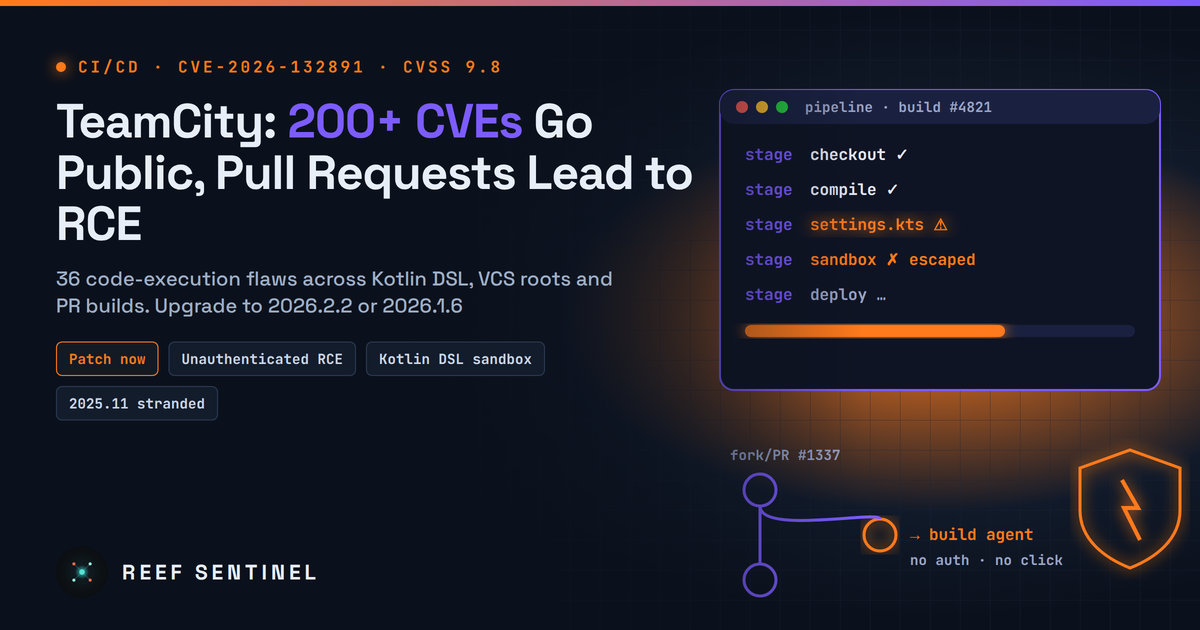
JetBrains published 202 TeamCity CVEs on 18–19 November, led by an unauthenticated pull-request RCE, so any server not on 2026.2.2 or 2026.1.6, including every 2025.11 install, should be upgraded now.
JetBrains has published about 200 CVEs for its TeamCity CI/CD server in two days. The most serious, CVE-2026-132891 (CVSS 9.8), allows remote code execution through external pull requests with no login and no user interaction. Alongside it come dozens of other code-execution flaws in the Kotlin DSL sandbox, VCS root handling and build settings.
The fixes are not brand new. They shipped quietly in the September, October and early-November releases. What is new is the public disclosure: anyone can now see exactly which TeamCity features were broken and which builds fix them. That makes every server still on an older build a much easier target.
What Happened
On 18 November, JetBrains published 21 TeamCity CVEs. Another 181 followed on 19 November, the first batch at 14:32 Mauritius time (10:32 UTC). By NVD's count, that is 202 TeamCity CVEs in two days. Of these, 36 describe remote code execution and around 90 are cross-site scripting issues. The rest cover privilege escalation, secret and token exposure, SSRF, XXE and authorization bypasses.
The CVEs line up with four rounds of bug-fix releases. JetBrains' release notes give the security count for each:
- 2026.1.3 (27 July 2026): 30 security problems fixed
- 2026.2, 2026.1.4 and 2025.11.8 (2 September 2026): 130, 94 and 76 security problems fixed
- 2026.2.1 and 2026.1.5 (5 October 2026): 41 and 27 security problems fixed
- 2026.2.2 and 2026.1.6 (3 November 2026): 40 and 38 security problems fixed
JetBrains' release notes say security bulletins are "typically published few days after the release date". This time the CVE records arrived weeks to months after the fixes.
Technical Details
According to the CVE record, CVE-2026-132891 affects TeamCity before 2026.2, 2026.1.4 and 2025.11.8. Its one-line description says remote code execution "was possible via external pull requests". The vector is CVSS:3.1/AV:N/AC:L/PR:N/UI:N, which means network access, low complexity, no privileges and no user interaction. It is classed as CWE-696 (Incorrect Behavior Order), which usually means a check runs too late or in the wrong sequence.
JetBrains has not published any further technical detail. In practice, pull-request building lets TeamCity fetch and build code from branches it does not control, often from forks on GitHub, GitLab or Bitbucket. A flaw at that boundary means a stranger who can open a pull request against a public repository may be able to reach code execution on the build infrastructure.
The other critical and high-severity code-execution bugs fall into a few groups:
- VCS root argument injection (CVSS 9.9): CVE-2026-132231, -132232 and -132234 abuse Perforce and Mercurial settings, and CVE-2026-132233 abuses build attribute injection. All four are fixed in 2026.1.3 and 2025.11.7. The vector has scope changed, so a low-privileged project user can affect the whole server.
- Kotlin DSL sandbox escapes (CVSS 7.2–8.8): 13 CVEs weaken the sandbox that runs versioned Kotlin settings, and 10 of them reach code execution. They use native code loading, class injection, public reflection, boot classpath libraries, a file write bypass, URL stream handlers, time zone and context-parameter callbacks, and security-context spoofing. The other three allow file deletion, file writes and data exfiltration over DNS. Anyone who can commit to a settings repository could turn that access into server-side code execution.
- Source control input (CVSS 7.5–8.8): Git submodule URLs (CVE-2026-133092), Git VCS root URLs, Mercurial repository contents and subrepository paths, and Subversion local repository URLs.
- Build and project configuration: Maven repository settings (CVE-2026-133080), FreeMarker notification templates, Kubernetes Executor settings, project import archives, and the pipeline YAML file path.
- Token authentication: CVE-2026-133027 (CVSS 8.8) allows privilege escalation through username handling in token authentication.
Is It Being Exploited?
No exploitation has been reported for the new CVEs. On 19 November, CISA's vulnerability enrichment for CVE-2026-132891 recorded "Exploitation: none". It also marked the flaw "Automatable: yes", with a "Technical Impact: total".
The risk is still high. TeamCity bugs have a long record in CISA's Known Exploited Vulnerabilities catalog: CVE-2023-42793 (2023), CVE-2024-27198 (2024), CVE-2024-27199 (added April 2026) and CVE-2026-63077. CVE-2026-63077 is an unauthenticated RCE in the agent polling protocol, added to the catalog on 5 August 2026. Build servers hold signing keys, cloud credentials and deployment tokens, so state-backed and criminal groups move quickly once details are public.
Who Is Affected
- Self-hosted TeamCity On-Premises servers on any build before 2026.2.2 (2026.2 line) or 2026.1.6 (2026.1 line).
- Every server on the 2025.11 line. The CVE records list 2025.11.8 as the last fixed build for that branch, and the October and November fixes give only 2026.x versions. We found no 2025.11.9 release.
- Servers that build pull requests from forks or outside contributors, or that let many users edit versioned Kotlin settings, are the most exposed.
What To Do Now
- Upgrade to TeamCity 2026.2.2 or 2026.1.6. These are the only builds that include all four rounds of fixes. Bug-fix releases within the same major version share a data format, so the upgrade within 2026.1 or 2026.2 is low-risk.
- If you are on 2025.11.x, plan a move to 2026.1.6 or 2026.2.2 now. Staying on 2025.11.8 leaves the October and November flaws unpatched.
- Until you can upgrade, disable building of external pull requests from forks, or limit it to trusted authors. Remove direct internet access to the TeamCity web UI where you can.
- Review who can edit VCS roots, project settings and Kotlin DSL settings repositories. Many of these CVEs need only "low" privileges.
- Read the 2026.2.2 upgrade notes. A security fix tightened permission checks on the
/app/rest/buildQueueREST endpoint, so integrations without the "Customize build parameters" permission may start getting HTTP 403 errors. - Check the server's version and recent audit activity:
# Version from the REST API (needs a read token)
curl -s -H "Authorization: Bearer $TC_TOKEN" https://teamcity.example.internal/app/rest/server/version

# Look for unexpected VCS root and settings changes in the audit log
curl -s -H "Authorization: Bearer $TC_TOKEN" \
"https://teamcity.example.internal/app/rest/audit?locator=count:200" | grep -iE "vcsRoot|settings|pullRequest"- After upgrading, rotate secrets held by TeamCity (cloud keys, deployment tokens, signing credentials) if the server was reachable from the internet and ran a vulnerable build.
Why It Matters
A single CI/CD server often has the keys to every production environment and software release a company ships. JetBrains fixed these bugs before publishing them, which is the right order. But more than 200 CVEs released at once give attackers a detailed map of TeamCity's weak points, with known fixed versions to diff against. Teams that skipped the September to November bug-fix releases now face the same clock as everyone else, and the attackers' analysis has already started.
