OpenAI Launches ChatGPT Wallet: Its 'Dots' AI Agents Can Now Buy Things for You With One-Time Visa, Mastercard and Amex Tokens
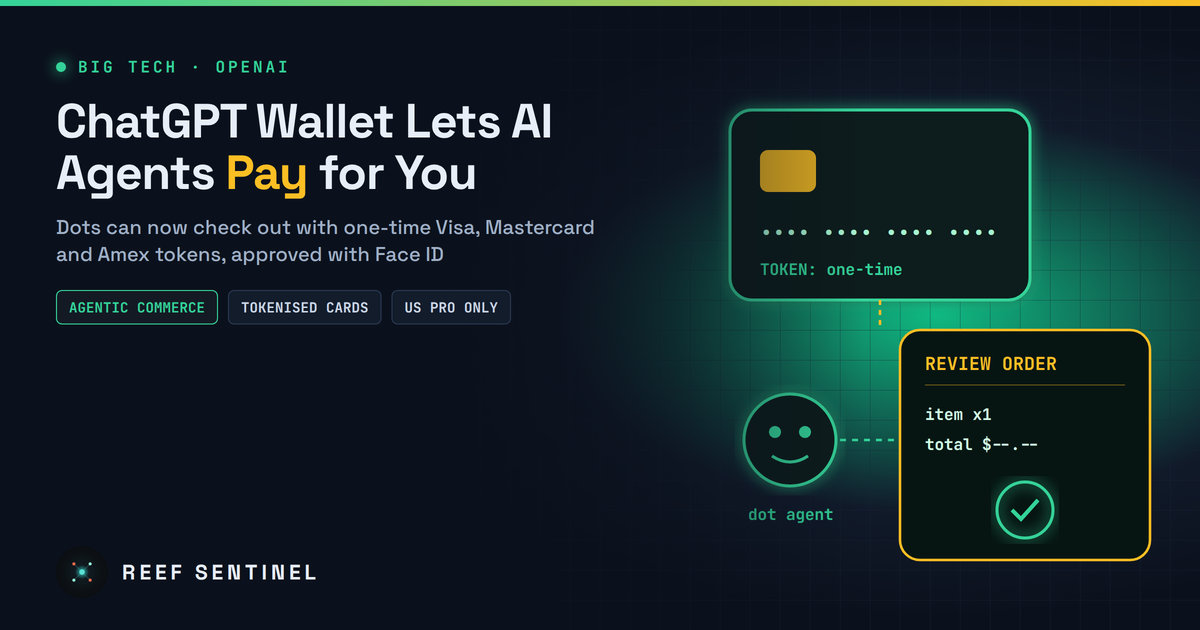
OpenAI's new ChatGPT Wallet lets US Pro users' always-on 'dots' agents check out at ordinary online stores using single-use card-network tokens approved with Face ID, which moves the security risk from stolen card numbers to agents being manipulated into bad purchases.
What Happened
OpenAI launched ChatGPT Wallet on Friday, 13 November 2026. It lets the company's "dots", its always-on AI agents, buy things online for the user. The feature was built with Visa, Mastercard and American Express. The agent pays with a one-time network payment token, so neither the agent nor the shop ever sees the real card number.
At launch the rollout is narrow:
- Only ChatGPT Pro subscribers in the United States, aged 18 or over
- An eligible US-issued Visa, Mastercard or Amex card is required, and the card network must accept it for tokenisation
- The rollout is staged, so some eligible users won't see it straight away
- No date has been given for other countries or for the Plus, Business or Enterprise plans
American Express said the limited start is deliberate. OpenAI can "turn up the volume" once the system has proven itself.
The Details
Dots were announced at OpenAI's DevDay on 29 September 2026. Each dot is a persistent agent with its own isolated cloud computer and virtual browser. It can keep working after the user closes their laptop and can connect to thousands of third-party apps. Until now, dots could research and compare products. With Wallet they can also check out.
OpenAI describes the purchase flow like this:
- One-time setup: the user adds a card to ChatGPT Wallet.
- The request: the user asks a dot to find an item, with details such as size, colour, budget or delivery date.
- Mandatory review: before each purchase, ChatGPT shows the items, the total and the card that will be charged.
- Biometric approval: the user confirms every order with a device check such as Face ID or a fingerprint scan. Each approval is saved as a record of what the agent was allowed to buy.
- Tokenised payment: after approval, the card network issues a token for that one transaction, with its own card number, security code and expiry date. The dot types it into the merchant's normal checkout form.
Merchants don't need a special integration because the token works in existing checkout pages. They receive a network token plus a Payment Account Reference that links it to the underlying account. They may not save or reuse that credential for another purchase. OpenAI is also rolling out forwarded HTTP header signals for merchants, including IP address, estimated country, locale, time zone and browser or app details. It has published a "Commerce Partner Playbook" that asks merchants to let verified ChatGPT browser traffic through their CDN and firewall rules.
To cut false declines on agent orders, OpenAI says it is working with fraud-prevention firms Forter, Riskified, Sardine and Signifyd, and with payment providers Adyen, Checkout.com and Stripe. OpenAI says it takes no cut of purchases for now.
Why It Matters
This is one of the biggest consumer launches yet of an AI agent that can spend real money on its own initiative. It also changes the security model for agentic AI.
- The card number is no longer the main target. Tokenisation means a compromised agent or a breached merchant can't leak the real card. The risk moves to what the agent is persuaded to buy, and where.
- Prompt injection gets a payout. Dots browse the open web. A booby-trapped product page, review or email could try to steer an agent towards a fake shop, a different item or an inflated basket. OpenAI's per-order review screen and biometric check are the main defence, but they only work if users actually read the review screen.
- Approval fatigue is the long-term weak spot. OpenAI says spending limits by amount, category or time period, plus pre-approved purchases with no per-order review, are planned. They have no dates yet. Once those arrive, the human check that protects users today becomes optional.
- Liability stays with the old rails. Returns and late deliveries go to the merchant, and disputed charges go to the card issuer. OpenAI says cardholders keep their rewards and eligible dispute protections. How issuers will handle a dispute where the cardholder's own agent placed an order the cardholder didn't really want is still untested.
- Merchants are being asked to open the gate. Asking sites to allowlist agent traffic in their WAF and CDN rules weakens the bot defences many shops rely on. Not everyone agrees. Amazon won a court order blocking a rival AI shopping agent, and United Airlines has said it will block agents from its booking systems.
What It Means for Users and IT Teams
For individuals using Wallet:
- Read the review screen every time. Check the merchant name and domain as well as the item and the total.
- Keep the agent's custom instructions tight: preferred stores, maximum price, no unknown sellers.
- Use a card with low limits or instant transaction alerts while the feature is new.
- When spending limits and pre-approval arrive, set the lowest limits that still work for you.
For security and IT teams:
- Policy first. The launch is consumer-only (US Pro), but dots are also offered on Business plans. Decide now whether agents may make purchases on company cards. Write it into expense and acceptable-use policies before staff try it.
- Merchants and e-commerce teams: if you allowlist agent traffic, do it narrowly. Verify ChatGPT's browser identity instead of disabling bot protection wholesale, and keep watching agent-placed orders for abuse patterns.
- Fraud teams: expect a new class of legitimate-but-automated orders. Use the forwarded signals and token metadata rather than treating every headless checkout as fraud.
- Threat modelling: add "agent manipulated into a purchase" to the threat model for any workflow where an AI agent can reach a payment step.
What Happens Next
OpenAI calls agentic commerce "early days". It hasn't published success rates or merchant acceptance figures, and it admits that some sites block agents and that fraud systems may decline or cancel agent orders. The next milestones to watch are a wider rollout beyond US Pro users and the arrival of spending limits and pre-approved purchases. Those features will show how much of the human check survives once convenience becomes the selling point.
