Apache HTTP Server CVE-2026-119618 (CVSS 9.8): mod_http2 Race Condition Allows Unauthenticated RCE in 2.4.55–2.4.70 — Update to 2.4.71 or Disable HTTP/2
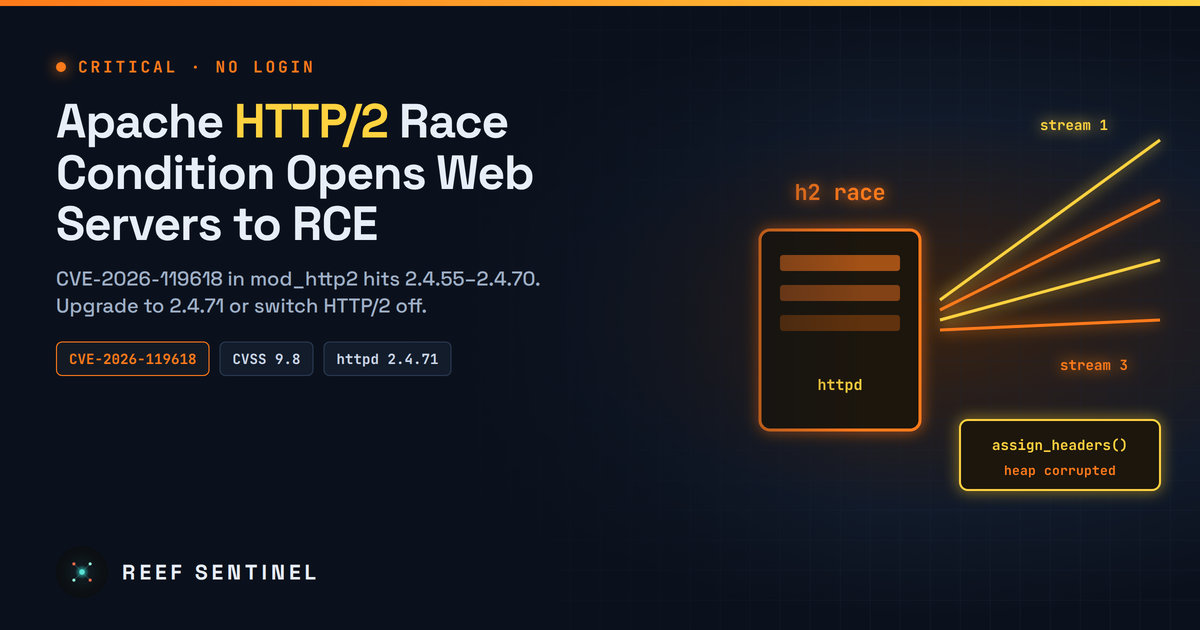
A heap-corrupting race condition in Apache's mod_http2, found separately by Anthropic's OSS Scanner and Google researchers, can let a remote attacker who needs no login run code on servers with HTTP/2 on, and 2.4.71 fixes it.
The Apache Software Foundation has released Apache HTTP Server 2.4.71 to fix CVE-2026-119618. This critical race condition in mod_http2 can let a remote attacker who needs no login corrupt server memory and run code. Every release from 2.4.55 through 2.4.70 is affected when HTTP/2 is turned on. Red Hat scores the flaw CVSS 9.8.
What Happened
Apache shipped 2.4.71 on 11 November with three security fixes. CVE-2026-119618 is the critical one. The project's advisory credits two independent discoveries:
- Anthropic's automated OSS Scanner, which reported the bug on 26 October
- Anthony Weems and Simon Scannell of Google Cloud Vulnerability Research, who reported it on 3 November
So two teams, at least one of them using automated analysis, found the same memory-safety bug in one of the world's most widely deployed web servers about a week apart.
Technical Details
The bug is in assign_headers() in mod_http2. Apache describes it as improper synchronisation on a shared resource. Under concurrent HTTP/2 streams, several threads can touch the same memory without proper locking, which corrupts the heap. Heap corruption that an attacker can trigger remotely is a classic first step towards code execution in the server worker process.
The standalone mod_h2 module on GitHub is affected too, in versions 2.0.8 through 2.0.42.
Exploitation status, as of publication:
- Red Hat says public research has shown a reliable exploit against a server with mod_http2 enabled. It has not named that research.
- A public proof of concept on GitHub reproduces the memory corruption and crashes, but does not show code execution.
- There are no confirmed reports of exploitation in the wild yet, and CISA has not listed the CVE.
The same release fixes two other bugs:
- CVE-2026-106023 (important): a NULL pointer dereference in mod_md that crashes child processes, affecting 2.4.30–2.4.70
- CVE-2026-109163 (low): a 1-byte stack overwrite in mod_vhost_alias, affecting 2.4.69 and 2.4.70
Who Is Affected
You are exposed if you run Apache 2.4.55–2.4.70 with mod_http2 loaded and h2 or h2c in a Protocols directive. Red Hat stresses that servers serving only HTTP/1.1 are not vulnerable.
HTTP/2 is common on TLS sites, and some distribution and control-panel defaults turn it on. Cloud security researchers estimate that 64% of cloud environments contain resources running an affected version, and 51% have such instances exposed to the internet. They caution that these figures ignore configuration, so not all of those servers are exploitable.
WordPress, Drupal and other CMS updates cannot fix this. The bug is in the web server itself, so hosting customers depend on their provider patching Apache.
Patch Status
- Upstream: fixed in Apache HTTP Server 2.4.71.
- Distributions: Red Hat and other vendors are shipping backported packages. Those may keep an older version number, so check your vendor's advisory for the fixed package release.
- Workaround: Apache's advisory lists none. The interim step Red Hat suggests is to disable HTTP/2.
What To Do Now
Check your version and whether HTTP/2 is on:
httpd -v            # or: apache2 -v
apachectl -M | grep http2
grep -Ri "^\s*Protocols" /etc/httpd /etc/apache2 2>/dev/null- Upgrade to 2.4.71, or your distribution's fixed package, and restart Apache.
- If you cannot patch today, remove
h2andh2cfromProtocols(leaveProtocols http/1.1), or stop loading mod_http2, then reload. Clients fall back to HTTP/1.1 without errors. - Patch reverse proxies and load balancers built on httpd as well as origin servers.
- Watch error logs for repeated child process segfaults (
AH00052) and other unusual crash loops. They can point to probing. - Ask your managed hosting provider for written confirmation that they have patched.
Why It Matters
Apache httpd sits in front of a large share of the web, often as an unmonitored reverse proxy that nobody has touched for years. A bug that needs no login in a default-capable module is exactly what mass scanning goes after once a working exploit appears, and public research already claims one is possible.
The double credit also makes a point. Automated and AI-assisted bug hunting is now finding critical memory-safety flaws in core internet software. Defenders should expect more of these disclosures, and shorter gaps between a patch and the first exploit.
