Rackspace Spot Breach: Leaked Credentials Let Attackers Read Customers' Kubernetes Secrets for 22 Hours — Rotate API Tokens, Kubeconfigs and Every Stored Secret
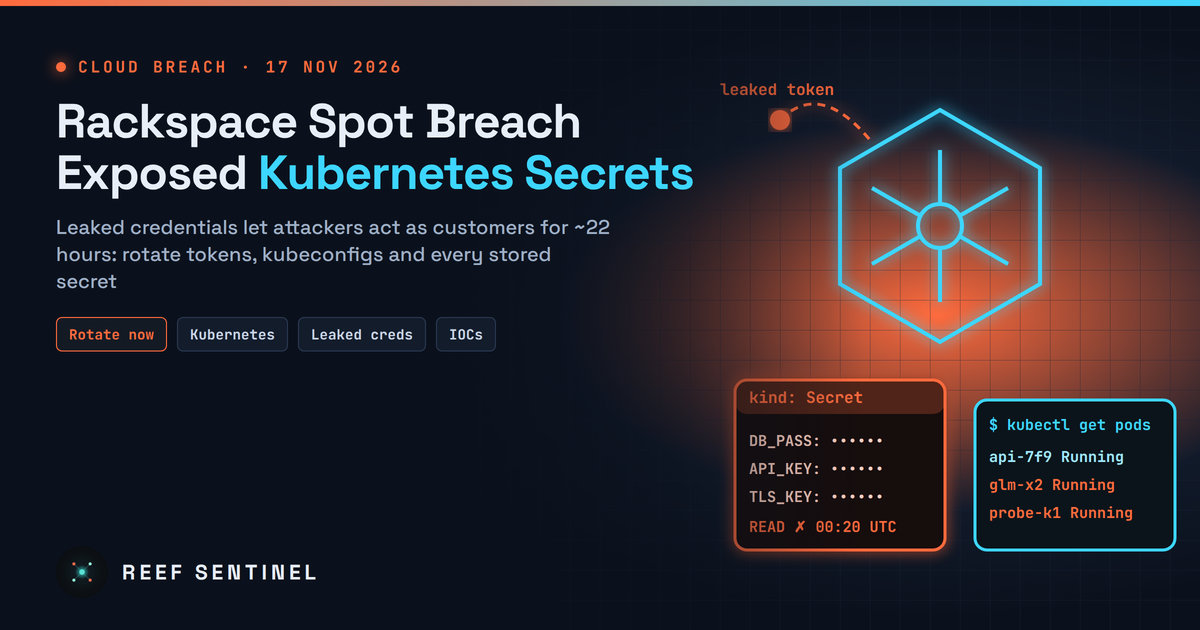
Attackers used leaked credentials to act as legitimate users in some Rackspace Spot customer organisations on 17 November, creating pods and reading Kubernetes Secrets, and customers must now rotate every token and secret.
Rackspace has told customers that attackers used leaked credentials to get into its Rackspace Spot managed Kubernetes platform. For most of a day, the intruders could act as legitimate users inside some customer organisations, start their own pods and read the Kubernetes Secrets stored in those customers' clusters. The company's customer notice says the unauthorised access ran on 17 November 2026 from about 04:20 Mauritius time (00:20 UTC) until about 02:00 Mauritius time on 18 November (22:00 UTC on 17 November). Rackspace only learned of it on 18 November, when a customer reported it.
The admin console then stayed down for days while the platform was cleaned up, so affected customers could not rotate the credentials they now had to assume were exposed. Rackspace says service was fully restored on 21 November. It has not said how many customers were affected or whether data was taken from them.
What Happened
Rackspace Spot sells spare cloud capacity through an auction and runs managed Kubernetes clusters (called cloudspaces) on top of it. It is popular with developers, start-ups and teams running batch or CI workloads cheaply. According to the notification sent to customers, "an unauthorized party used leaked credentials to access parts of Rackspace Spot."
Rackspace has not said whose credentials leaked or how. It has not said whether they belonged to a customer, a staff member or a platform service account, or where they were exposed. That matters, because the access the attacker got was broad. They were not confined to one tenant. They could act as legitimate users across "some customer organisations".
Rackspace's response, as described to customers, was to:
- revoke the affected tokens and sessions
- remove the unauthorised pods
- rotate keys
- tighten access controls and monitoring
An executive at Platform9, which built Spot together with Rackspace, explained the outage in a public community thread. He said the team chose to shut off all access and "sanitize the entire environment" to protect users, rather than leave the console running during the investigation.
Technical Details
According to the notice, the attacker could do the following inside affected organisations:
- create pods, so they could run their own workloads on customer clusters
- read Kubernetes Secrets, which typically hold database passwords, registry credentials, cloud access keys, TLS private keys and third-party API tokens
- list nodes and volumes, which maps out the cluster and its storage
- get any Spot API tokens or refresh tokens held by the users they impersonated
The ability to read Secrets is the most serious part. By default, a Kubernetes Secret is only base64-encoded in the API, not encrypted, so anyone who can read it gets the plain value. A single cluster often holds the keys to a whole company's systems: the production database, the container registry, the Git deploy key, the S3 bucket and the payment or email provider. Leaked Spot refresh tokens could also have let an attacker get back in after the first sessions were killed, which is why Rackspace is asking customers to replace them as well.
Rackspace shared indicators with customers. Defanged:
- source IP 23.224.79[.]106, within the range 23.224.0[.]0/15
- suspicious pod and object name prefixes
i1,glm-andprobe
Rackspace has not said what the unauthorised pods actually did. Unexpected pods on a hijacked cluster are often used for cryptomining, scanning or stealing more credentials, but that has not been confirmed here.
Who Is Affected
Any Rackspace Spot customer whose organisation was accessed on 17 November should treat every secret in those clusters as compromised. Rackspace has notified the affected organisations directly. If you use Spot and are unsure whether you were affected, contact Rackspace support. Given that the attacker could also read API and refresh tokens, it is safer to rotate anyway.
Rackspace's other managed hosting and cloud services are not mentioned in the notice.
What To Do Now
Rackspace asks affected customers to do the following, and they are good practice for any Spot user:
- reissue all Spot API tokens and replace the refresh tokens used by automation such as Terraform, CI pipelines and scripts
- download a fresh kubeconfig for each cloudspace and delete old copies from laptops and CI runners
- rotate every credential stored in cluster Secrets: database passwords, registry tokens, cloud keys, webhook secrets, TLS keys and SaaS API keys
- review logs back to 17 November for your databases, container registries, Git repositories, cloud storage and third-party services, looking for logins or API calls from unfamiliar IPs, especially 23.224.0[.]0/15
On the clusters themselves, look for workloads you did not deploy and for changed Secrets. The read-only commands below are a starting point:
# Pods whose names match the reported prefixes, across all namespaces
kubectl get pods -A -o wide | grep -E '\s(i1|glm-|probe)'

# Recently created pods, newest last
kubectl get pods -A --sort-by=.metadata.creationTimestamp

# Secrets and when they were last changed
kubectl get secrets -A -o custom-columns='NS:.metadata.namespace,NAME:.metadata.name,CREATED:.metadata.creationTimestamp'
If you export Kubernetes audit logs, search them for get and list requests on secrets and create requests on pods during the 17 November window. Use this incident to get a full list of where your secrets live, so that next time rotation takes minutes, not days. Longer term:
- move high-value secrets into an external secrets manager with short-lived credentials
- turn on encryption at rest for Secrets on clusters you control
- give each workload's service account access only to the Secrets it actually needs
Why It Matters
The incident shows a risk of managed Kubernetes that is easy to forget: whoever controls the platform's identity layer can read your Secrets. Customers did nothing wrong here. One set of leaked credentials at the provider was enough to reach the Secrets in their clusters. Shutting the console during cleanup also locked customers out of the console they needed to rotate those credentials.
Teams can't control a provider's credential hygiene, but they can limit the damage. Keep long-lived keys out of cluster Secrets where possible, have a tested rotation runbook ready, and keep logs for databases and cloud services long enough to look back at least a week. Rackspace still has to say how the credentials leaked, how many organisations were affected and whether any data left their clusters.
