Confluence Data Center CVE-2026-90436 Now Exploited: Unpatchable Apache Axis 1.x SOAP Flaw Gives Unauthenticated RCE When the Remote API Is On — Update to 9.2.28
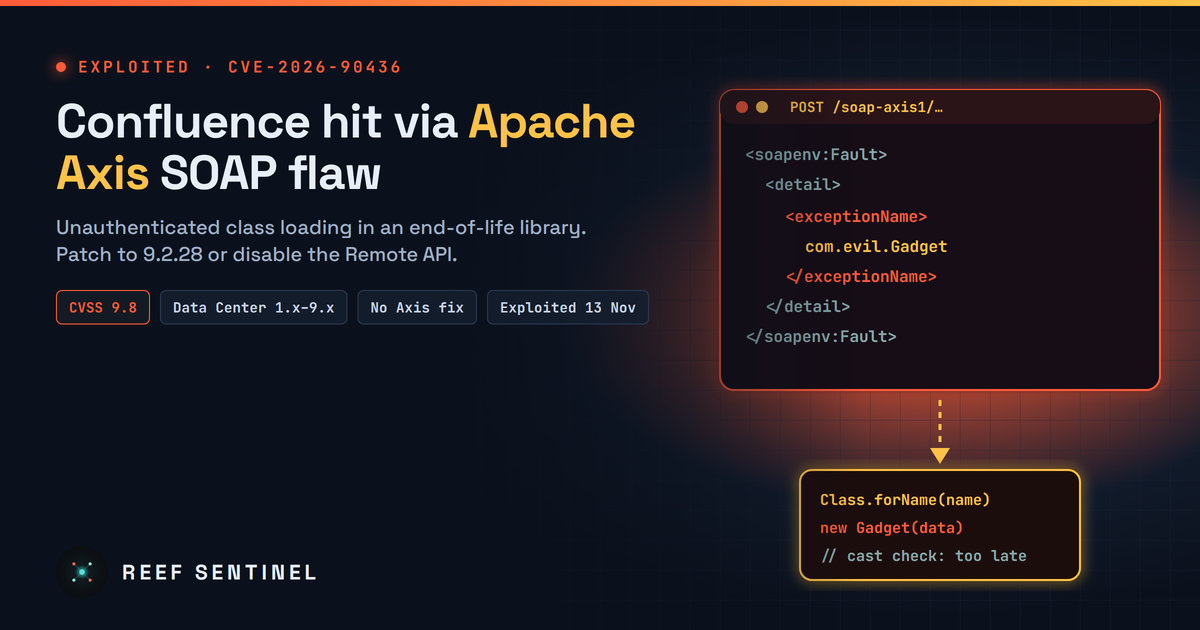
Attackers began exploiting CVE-2026-90436 in Confluence Data Center on 13 November, a week after Apache disclosed an unauthenticated SOAP-fault class-loading flaw in end-of-life Axis 1.x that it will not fix, so admins should update to 9.2.28 or disable the Remote API now.
A critical flaw in Apache Axis 1.x, an old SOAP library that went end-of-life years ago but still ships inside commercial software, is now being exploited against Atlassian Confluence Data Center. The bug, tracked as CVE-2026-90436, lets an unauthenticated attacker make the server load and instantiate Java classes of their choosing. Atlassian rates it critical (CVSS v4.0 9.3), and the CISA-supplied CVSS v3.1 score in the NVD record is 9.8.
Security researchers running a managed detection service say they saw the flaw exploited against a customer's Confluence Data Center server on 13 November. That makes Confluence the second product, after N-able N-central, where the same Axis bug has been used in real intrusions within a week of disclosure.
What Happened
The timeline has moved fast:
- 6 November: The Apache Axis project disclosed CVE-2026-90436 on the oss-security mailing list. The NVD record went live at 20:18 Mauritius time (16:18 UTC). The finder is credited as a researcher at OKIOK. Apache said it will not ship a fixed Axis 1.x release, because the branch is no longer supported. It published a source patch and recommends moving to a different SOAP engine.
- 10 November: Atlassian published its advisory at 10:00 Mauritius time (06:00 UTC), confirming that Confluence Data Center uses Axis for its XML-RPC and SOAP APIs and naming 9.2.28 as the fixed release. The same day, a public lab proof of concept for the underlying Axis bug appeared on GitHub.
- 12 November: A public exploit chain for N-able N-central, which also bundles Axis, was released. Attacks against exposed N-central servers followed. We covered that chain separately.
- 13 November: Researchers detected exploitation against Confluence Data Center in a customer environment.
- 16 November: Internet-scanning researchers counted about 1.21 million internet-facing web properties identified as Confluence. That figure counts hostname and port combinations, not confirmed vulnerable servers. It does not check version or whether the vulnerable API is switched on.
When Atlassian published, its advisory said nothing about exploitation, and as of 17 November the CVE was not in CISA's Known Exploited Vulnerabilities (KEV) catalog. CISA's own SSVC assessment in the NVD record, dated 10 November, still lists exploitation as "none" but marks the flaw as "automatable" with "total" technical impact. Don't treat the missing KEV entry as a sign that the risk is low.
Technical Details
The bug is in how Axis 1.x handles SOAP fault messages. A fault can name the exception that caused it in an <exceptionName> element. Axis takes that string as a Java class name and loads it, which runs the class's static initialiser. If a string <data> element is also present, Axis calls the class's single-string constructor, and only then checks whether the object is an AxisFault. By that point the attacker-chosen code has already run, and the resulting cast error is quietly swallowed.
Three things make this worse than an ordinary parsing bug:
- It runs before authentication. The envelope is parsed before any per-service handler chain runs. Authentication handlers on a service therefore give no protection.
- It doesn't need a real service. The public lab write-up shows the parser running even for service names that aren't deployed. Hiding a specific endpoint doesn't help.
- The impact depends on the classpath. On a stock Axis 1.4 install, the researcher showed file creation or truncation and a DNS-based out-of-band signal, but not direct code execution. Full remote code execution needs a suitable "gadget" class with a string constructor somewhere on the application's classpath. Spring's
ClassPathXmlApplicationContextis the best-known example. Large applications such as Confluence and N-central carry plenty of libraries, which is why vendors treat the bug as full RCE. Atlassian says a successful attacker can run commands as the Confluence operating-system account.
The upstream fix (commit 41f3b4e8) loads the class without initialising it, rejects anything that is not an AxisFault subclass before construction, and gates the reflective constructor call on that check.
Who Is Affected
- Confluence Data Center 1.x through 9.x with the Remote API (XML-RPC & SOAP) setting enabled. This option has been off by default for new installations since Confluence 3.0. Instances that were upgraded from old versions, or that serve legacy scripts and add-ons, often still have it on.
- Confluence 10.0 and later are not affected, because Atlassian removed the feature entirely.
- Atlassian Cloud (atlassian.net) is not affected.
- N-able N-central on-premises servers with the non-default Legacy API enabled. N-able says its 2026.4 HF3 hotfix permanently removes Legacy API access.
- Any other software that bundles Axis 1.x. Apache lists no downstream products, so each vendor has to publish its own assessment. Debian's tracker lists its
axispackage as vulnerable with no fix yet. Check your own Java applications and appliances foraxis.jar/axis-1.4.jar.
Patch Status
Atlassian's fixed Confluence Data Center release is 9.2.28. The company recommends moving to the latest version or a fixed Long Term Support release, and says critical fixes are backported to maintenance releases but no standalone binary patches will be issued. Confluence 10.x is unaffected.
For Axis itself, no official fixed release exists or is planned. Teams maintaining their own Axis 1.x builds can apply the upstream commit, but Apache's recommended path is to migrate to another SOAP stack such as Axis2/Java.
What To Do Now
- Find every Confluence Data Center instance, including forgotten internal wikis, and record its version.
- Upgrade to 9.2.28 or later (or move to 10.x). Treat any internet-exposed instance with the Remote API enabled as an emergency.
- If you can't patch today, switch the Remote API off: as an administrator, go to General Configuration › Further Configuration (or
<base_url>/admin/viewspacesconfig.action), click Edit, untick Remote API (XML-RPC & SOAP) and save. No restart is needed. Test first, as scripts and third-party apps that rely on the API will break. - Verify the mitigation with a simple request. A
403 Forbiddenresponse means the API is closed. A page that mentions the Axis service means it is still reachable.
curl -s -o /dev/null -w '%{http_code}\n' https://confluence.example.internal/plugins/servlet/soap-axis1/confluenceservice-v2- Hunt for compromise on any instance that had the API exposed since 6 November. Atlassian says it cannot tell customers whether they were affected. Review web and proxy logs for POST requests to
/rpc/soap-axis/and/plugins/servlet/soap-axis1/paths from unknown sources. Look for new or modified files under the Confluence install and home directories, unexpected child processes of the Confluence Java process (shells,curl,wget), and new outbound connections. - Check the published IOCs. Researchers shared IP addresses tied to the observed activity: 192.238.253[.]176, 5.133.47[.]243, 163.182.68[.]109 and 104.13.106[.]166. Finding none of them in your logs does not prove you are clean.
- Inventory Axis 1.x elsewhere. Search build manifests, container images and appliance filesystems for Axis 1.x JARs, and ask vendors directly for their CVE-2026-90436 status.
Why It Matters
Confluence has a long history as a ransomware entry point, and attackers move fast on its bugs. This case adds a supply-chain twist. The vulnerable code sits in a library whose maintainers have formally stopped releasing fixes, so protection depends on each downstream vendor noticing, patching and telling customers. Atlassian's answer was to delete the feature in version 10. N-able's is to remove Legacy API access in a hotfix. Everyone else that still ships Axis 1.x, including in-house applications, is on their own.
Exploitation also came fast. The CVE went public on 6 November, a working lab proof of concept followed four days later, and real attacks reached two separate product families within a week, before CISA's catalog listed it. For defenders, this is another sign that end-of-life components in the software bill of materials can't wait for the next maintenance window. Deprecated, off-by-default features that stay enabled on old installs are exactly what attackers look for first.
