Google: Hackers' AI Agents Now Turn Security Patches Into Working Exploits With No Human in the Loop — GTIG Names exploit_agent, CAIRN and PentAGI in Live Intrusions
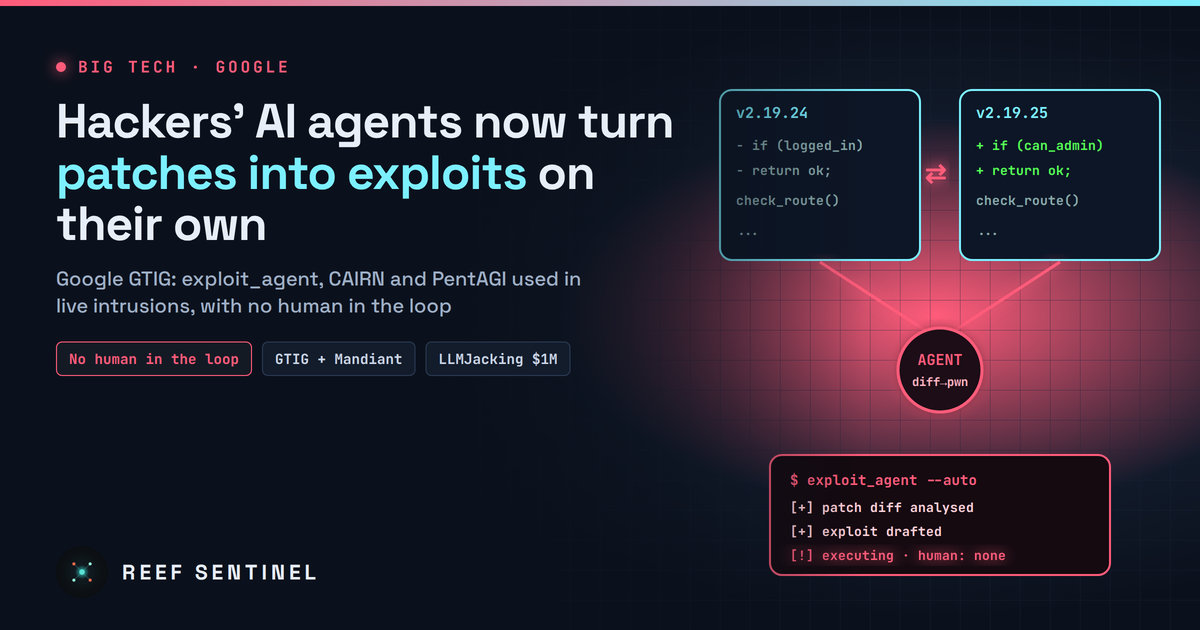
Google's threat intelligence group says attackers now run autonomous multi-agent frameworks that diff patches, write exploits and launch them without human involvement, alongside AI-tool supply chain attacks and LLMJacking bills reaching $1 million.
What Happened
Google says attackers have crossed a line that security teams have been bracing for: AI systems that find, weaponise and fire exploits with no human involved.
In its latest AI Threat Tracker, Google Threat Intelligence Group (GTIG) and Mandiant report that in the past quarter they saw threat actors "using LLM frameworks to fully automate vulnerability discovery and exploitation without a human in the loop for the first time." The report covers the cybercrime, espionage and influence-operation activity Google has tracked through Mandiant incident response, its own threat actor tracking and abuse of its Gemini platform.
Google's message is that adversarial AI has moved past people typing prompts into a chatbot. Attackers now run autonomous multi-agent frameworks that chain reconnaissance, exploitation and post-compromise steps at machine speed.
The Details
exploit_agent: from patch to exploit, automatically
The headline finding is a framework Google calls exploit_agent, which GTIG found on an exposed staging server. According to the report, it:
- connects to several frontier and locally hosted large language models
- continuously runs differential analysis on popular web application software, comparing code before and after a patch is announced
- analyses the differences to find the underlying vulnerability, drafts an exploit and then runs it automatically, with no human step in between
- comes with scripts for internal reconnaissance, brute-forcing, installing webshells and removing other attackers' webshells
The server also held data stolen from victims. Its victim telemetry suggests the operator was going after French websites in media and entertainment and in education. Google did not name the operator.
Open-source pentest agents used in live intrusions
GTIG also lists open-source offensive AI frameworks that it has seen in real attacks or in attacker testing:
- CAIRN: a multi-agent pentest framework built around an observe-orient-decide-act loop, where specialised agents share a common "blackboard". GTIG saw it used in intrusions against targets including the US aerospace sector.
- PentAGI: between late August and early October 2026, a threat actor used a customised platform built on the open-source version for systematic reconnaissance and vulnerability scanning of organisations across Asia.
- CyberStrikeAI: a Go-based orchestration and C2 backend that connects commercial and open-weight models to more than 100 security tools. GTIG saw experimentation with it.
- HexStrike AI: an MCP-based harness that wraps more than 150 offensive tools. GTIG also saw experimentation with it.
This builds on Google's late-October analysis of ARTEX, the agentic pentest framework that Mandiant had already found in incident response engagements. Google says its Security Operations platform now ships behavioural and volumetric detection rulepacks for ARTEX.
Exploits arriving faster
Google ties the automation to measurable changes in exploitation. Overall vulnerability disclosures and exploits nearly doubled between January and August 2026. Zero-days exploited in the wild rose from an average of 8 a month in 2025 to 11 a month in 2026, then reached 22 in August.
The report gives two examples. For the chained PaperCut zero-days (CVE-2026-81578 and CVE-2026-82078), researchers used LLMs to build working exploits within a day of disclosure. Four days after disclosure, a campaign hit hundreds of organisations, and in at least one case an attacker went from first foothold to domain administrator within minutes. In the PHP flaws CVE-2026-109618 and CVE-2026-109619, a proof-of-concept video and early patched code appeared before the official fixes on 21 October. Hundreds of claimed exploits followed, many of them likely LLM-generated and non-functional, which left defenders sorting real exploits from fake ones.
AI tools as the attack surface
The report also describes AI developer tooling being turned into an attack path. A suspected North Korean cluster tracked as MIDNIGHT NEPTUNE broke into crypto-sector targets using fake recruiters and ClickFix lures. It then changed .claude/settings.json files in internal repositories so that starting Claude Code would automatically download the SOMBERMEME backdoor. To hide its lateral movement, it created GitHub personal access tokens named after Microsoft Copilot.
Mandiant also handled several "LLMJacking" incidents, in which attackers stole cloud and AI-model credentials to use or resell model access. In some of them, fraudulent charges topped $100,000 in a single day, and the worst cases reached $1 million before the abuse was stopped. In one case, attackers escalated limited LiteLLM "Virtual Keys" to full admin credentials through CVE-2026-40217.
Why It Matters
This is the first time a major vendor has publicly documented a patch-to-exploit pipeline with no human in the loop running in the wild. The time between a patch announcement and mass exploitation was already short, and now it can shrink to whatever an agent needs to diff two code versions and test an exploit.
Google also points to a weakness in these tools. It says the frameworks currently "trade stealth for velocity": they create noisy forensic traffic, rely on recognisable identifiers and leave distinct code-level traces. Defenders can detect that today, but GTIG expects human involvement to fall and stealth to improve as the underlying models get better.
What It Means for Users and IT Teams
- Patch internet-facing software in hours, not weeks. Assume an exploit can exist on the day the patch is published, especially for web applications, VPNs, print servers and CMS plugins.
- Hunt for machine-speed behaviour. Bursts of scanning, exploitation attempts and post-exploitation commands within seconds of each other are a sign of an agent at work. Tune detections for volume and speed, not just signatures.
- Treat AI agent config files as code. Review changes to
.claude/settings.json, MCP configurations and other agent hook files in code review, and alert when they are modified. - Protect AI and cloud credentials. Scan repositories for leaked model API keys, set billing alerts and quotas, watch for unexpected GPU instances, quota-increase requests or short-lived service accounts, and keep LiteLLM and similar gateways patched.
- Check exploit claims before acting on them. Expect a flood of fake proof-of-concept code after big disclosures, and rely on vendor advisories and CISA's KEV catalogue.
Google's own recommended controls are standard ones: isolate the control plane, use short-lived credentials, enforce least privilege and segmentation, and add behavioural detection. Google stresses that attackers still exploit the same weaknesses as before, only faster and at greater scale.
What Happens Next
GTIG calls it "highly likely" that criminals and state actors will keep using these frameworks against organisations worldwide and move closer to fully agentic intrusions. Espionage groups that value long-term stealth may hold back from noisy tools. Cybercriminals who care less about being seen are expected to keep adopting autonomous tools. Google says it has disabled the assets linked to the Gemini misuse it found and is feeding what it learned into its model classifiers.
