Mior and Skyfall: New Attacks Let Rogue Cloud Hosts Read AMD SEV-SNP Confidential VMs, Forge Attestation and Leak Disk Keys (CVE-2026-0462, CVE-2026-40671)
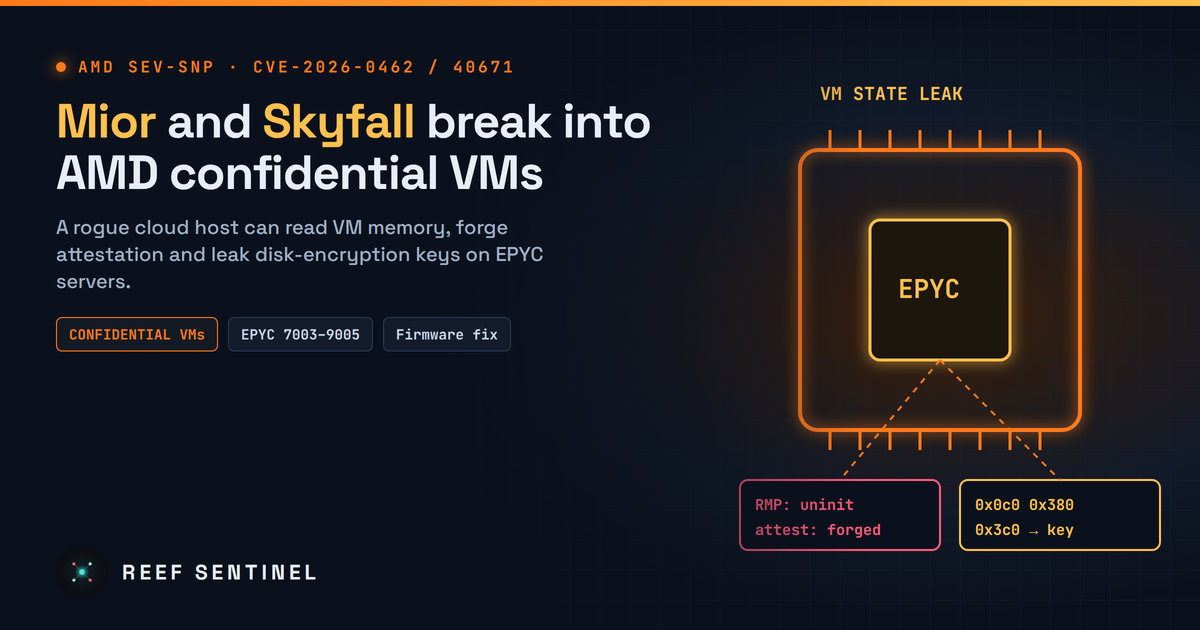
Researchers show two attacks on AMD EPYC confidential VMs: Mior leaves the RMP partly uninitialised so a malicious host can read memory and forge attestation, and Skyfall leaks registers and keys from VMs that fail to start, with platform firmware fixes due from November 2026.
Two new attacks, named Mior and Skyfall, challenge the main promise of AMD's confidential computing technology: that a cloud provider's own host can't see inside an encrypted virtual machine. Both were disclosed this week with AMD security bulletins. One lets a malicious host read and change the memory of an SEV-SNP virtual machine and forge its attestation report. The other leaks register values and encryption keys left behind when a VM fails to start.
What Happened
AMD SEV-SNP (Secure Encrypted Virtualization with Secure Nested Paging) is the technology behind many "confidential VM" offerings in the public cloud. Its threat model assumes the hypervisor, the host operating system and even the system firmware (UEFI) may be hostile. The guest is meant to stay private regardless.
- Mior comes from researchers at ETH Zurich. It is tracked as CVE-2026-0462 (CVSS 4.0 score 5.9) in AMD bulletin AMD-SB-3059. Only SEV-SNP is listed as affected, not the older SEV or SEV-ES modes.
- Skyfall comes from researchers at ETH Zurich and Google, and the paper was accepted to the IEEE Symposium on Security and Privacy. The VM data leak is CVE-2026-40671 (CVSS 4.9, AMD-SB-3061). A related leak from System Management Mode, caused by missing mitigations in EDK II firmware code, is CVE-2026-18448 (CVSS 5.6, AMD-SB-7072).
Both teams have published code. Neither AMD advisory says the flaws have been exploited in the wild.
Technical Details
Mior targets VM start-up, when the AMD Platform Security Processor (PSP) fills in the Reverse Map Table (RMP). The RMP is the data structure that records which memory pages belong to which guest. The researchers redirected some of the PSP's writes to a PCIe graphics card they controlled. Start-up finished without errors, but part of the RMP was never initialised, including the entry that protects the table itself.
With that gap, the hypervisor could rewrite the RMP's protections. The team turned on debugging for a confidential VM and used PSP debug commands to read and write its memory. This worked in all 1,000 attempts across two test runs. In a second test, they copied a harmless VM's measurement into a malicious VM, so its signed attestation report described the harmless image. Attestation is how a customer proves the VM they're talking to is genuine, so forging it means the customer can't tell they're running something else.
Mior needs control of the hypervisor and the BIOS/UEFI, plus a PCIe device. The team used a modified BIOS that leaves memory-routing settings unlocked. The researchers point out that this is still within AMD's SEV-SNP threat model, which doesn't trust UEFI. It was tested on an EPYC 9135 (Zen 5). Zen 3 and Zen 4 are considered potentially affected but weren't tested. The team says Mior is a separate issue from the earlier Fabricked and RMPocalypse RMP attacks, and that it also worked on firmware older than the Fabricked fix.
Skyfall builds on the Transient Scheduler Attacks (TSA) disclosed in July 2025. If a hypervisor deliberately makes a VM fail to start, the processor has already cached part of the VM's saved state. That data is left behind without being cleaned up, and the hypervisor can read it through TSA. The researchers recovered saved register values and a disk-encryption key from a test VM. They also read decrypted microcode updates and register values from SMM memory, which needs privileged software on the machine. Skyfall needs no hardware tampering, only a malicious host. It can read just three fixed cache lines per targeted page (offsets 0x0c0, 0x380 and 0x3c0). It worked on an EPYC 7313 (Zen 3) and on EPYC 9124 and 9334 (Zen 4), but wasn't shown on Zen 5.
Both attacks worked with SEV-SNP's ciphertext-hiding feature turned on.
Who Is Affected
- EPYC 7003, 8004, 8005, 9004 and 9005 server processors running SEV-SNP workloads.
- Customers of confidential-VM cloud services, who have to rely on their provider to install the platform fixes.
- Organisations running their own SEV-SNP hosts for sensitive workloads such as key management, regulated data or AI model protection.
Ordinary, non-confidential VMs gain nothing new from these attacks, because they already have to trust the host.
Patch Status
According to the advisories:
- Mior: SEV firmware updates dated 12 August (1.3A.03 for 7003, 1.3A.4 for 8004/9004, 1.3A.0A for 8005/9005), with platform firmware packages targeted for December 2026.
- Skyfall: microcode dated 12 August, with platform firmware targeted for November 2026. The Instinct MI300A has a patch dated 21 September.
- Embedded EPYC models get their fixes between January and April 2027.
- The EDK II project's own advisory listed no patched version at the time of disclosure.
AMD lists no workaround. Customers are told to get BIOS updates from their server maker. Some motherboard vendors also require a BMC firmware update.
What To Do Now
- If you run SEV-SNP hosts, track your server vendor's BIOS releases for these bulletins and apply both the BIOS and BMC updates as they arrive.
- Check the firmware and microcode level from inside a Linux host or guest:
# Kernel view of SEV/SNP support and firmware
dmesg | grep -i -E 'sev|snp'
# Current microcode revision
grep -m1 microcode /proc/cpuinfo- Update your attestation policies to require the minimum TCB values listed in AMD-SB-3059, so guests on unpatched hosts fail attestation.
- If you rent confidential VMs, ask your cloud provider when patched platform firmware will be live in your regions, and how you can confirm it through attestation.
- Keep the most sensitive secrets out of long-lived guest registers where you can, and rotate keys after hosts are patched.
Why It Matters
Confidential computing is increasingly sold as the way to run regulated data and proprietary AI models on infrastructure you don't control. Mior shows that a rogue host could not only read a protected VM but also convince its owner that everything is fine. Neither attack is a mass-exploitation threat. Both need a malicious or compromised host, and the CVSS scores are modest. But insider and compromised-host scenarios are exactly what SEV-SNP exists to defend against. Until the December platform firmware lands everywhere, attestation results from affected EPYC systems deserve a little less trust.
