Fake Defence Recruiters Spread GravityRAT: Pakistan-Aligned SpaceCobra Uses Airbus, BAE and Lockheed Logos and a 'Play Store Under Review' Trick to Sideload Android Spyware
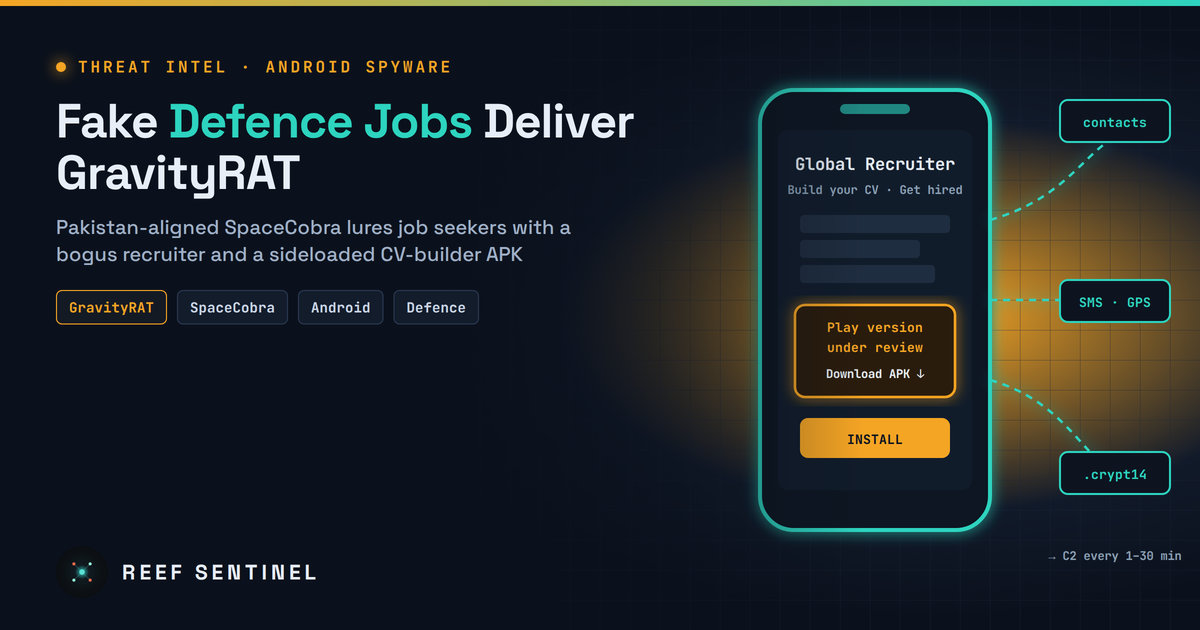
Lookout says a year-long, still-active campaign tied to Pakistan-aligned SpaceCobra uses fake defence recruitment portals such as recruitersglobal[.]net to sideload a CV-builder APK carrying GravityRAT, which steals contacts, SMS, location, documents and WhatsApp backups.
Overview
A Pakistan-aligned espionage group is using fake defence recruitment websites to get Android spyware onto the phones of people looking for jobs with Western defence and aerospace companies. Mobile security firm Lookout published the research on 17 November 2026. It says the campaign delivers GravityRAT, a surveillance framework that has been in use since at least 2015. Lookout tracks the operators under the names SpaceCobra and Cosmic Leopard.
Lookout's telemetry shows GravityRAT on 14 devices in India over the past 12 months, and the researchers say the activity is still live. That number is small because this is targeted espionage, not mass malware: each infected phone may belong to a defence engineer, contractor or serving officer. Lookout says the main targets are Indians seeking well-paid roles at foreign defence contractors. Because the lure sites are generic, it warns that defence staff in other countries could be targeted too. According to a researcher quoted in press coverage, one of the sites made no reference to India at all.
The Campaign
The main lure is a single-page site at recruitersglobal[.]net that calls itself "Global Recruiter". It offers automated CV building and introductions to employers. An "Our Clients" section shows the logos of Airbus, BAE Systems, Thales, Lockheed Martin, Rheinmetall, Northrop Grumman, Saab, Rolls-Royce and Safran. None of these companies is connected to the site. The logos are there to make an offer of help reaching a top defence employer look credible.
The payload is an APK named GlobalRecruiters.apk with the package name com.resumee.resumebuilder, presented as a CV builder. Lookout found several other live single-page portals built the same way: polished layouts, user reviews, trust badges and Google Play-style download buttons. Some pose as recruiters and others as software utilities.
Tradecraft
- The "under review" trick: clicking the Google Play button on these sites does not open Google Play. A pop-up says "The Google Play version is currently under review. Please download the APK for now." This gives victims a believable reason to sideload the app. Lookout says none of the apps it describes were distributed through Google Play. A Windows variant used the same excuse about the Microsoft Store.
- Scheduled, automatic exfiltration: the implant uploads collected data to PHP endpoints on its C2 servers every 1 to 30 minutes, with no operator action needed.
- Broad collection: the implant takes full contact lists, incoming, outgoing and missed call logs, past and live SMS messages, GPS location, external storage directory listings, and documents, images and audio (.pdf, .doc/.docx, .xls/.xlsx, .ppt/.pptx, .txt, .jpg/.jpeg, .png, .log, .xml, .opus). It also collects Wi-Fi details, device accounts and the IMEI.
- WhatsApp backups: it specifically targets encrypted WhatsApp backup databases with the extensions .crypt12, .crypt13, .crypt14, .crypt18 and .crypt32.
- Camouflaged C2: the servers sit behind Cloudflare, on subdomains that imitate Android developer libraries, such as androidannotations, androidasynclib and androidstaticserve.
- Windows sibling: by following shared name servers and registration dates, Lookout found dropdeckx[.]com. It offers "DropDeckX", an Electron-based cloud-storage utility for Windows. That malware evades virtual machines, collects system data and credentials, persists through Task Scheduler, downloads further payloads and uses web.dropdeckx[.]com as its C2. Similar variants have been reported publicly under the name HeavyLift.
Timeline
- 2015: GravityRAT is first known in use, starting as a Windows tool.
- 2020: public research documents GravityRAT's move to Android and macOS.
- June 2022: an earlier Android campaign using a fake chat app called "Chatico" is detected in India.
- August 2022 to June 2023: a fake messenger called "BingeChat" spreads GravityRAT. Researchers find that this version adds theft of WhatsApp backups and remote commands to delete files, contacts and call logs.
- About November 2025 to now: the current recruitment-themed campaign runs, according to Lookout's 12-month telemetry.
- 17 November 2026: Lookout publishes the Global Recruiter research and indicators.
Indicators of Compromise
Lure and related domains:
- recruitersglobal[.]net
- movie-date[.]net
- dock-sync[.]com
- dropdeckx[.]com
- linkuptoday[.]net
- cloudupnext[.]com
- myvaultz[.]com
- chatnplay[.]in
C2 domains and endpoints:
- androiddevpool[.]com, androidannotations[.]com, androidwebsys[.]com, androidasynclib[.]com, androidufslib[.]com, androidstaticserve[.]com
- an-east.androidannotations[.]com/vanilla/B67j96dg.php
- api.androidwebsys[.]com/delta/X25r87Nf.php
- meta.androidasynclib[.]com/azure/H54F257gd4.php
- static.androidufslib[.]com/hotel/H28j75Ft.php
- connectivity.androidstaticserve[.]com/blue/B67j96dg.php
- api.androiddevpool[.]com/mike/B67j96dg.php
Package name: com.resumee.resumebuilder (GlobalRecruiters.apk)
SHA-1 hashes published by the researchers:
ce2ce25cbe461af221cf215b3c67bf531cf74855
1567801b0614d814ea681867891d2fb4c68a5f3b
4b1c78f35510f77d896014cabbed8bfd3c5a4fdf
c48b72f248f4ffea3e2dc960331a19556acb9256
a80af5b2f0c5ff71e4384dc273822eda28068878
10a8fcb42993fa75310a4767c03d89c5aac86e10
1aba3697a090e0be0dc8dbab4987c6bc585629ef
14a2177bf319f1d592b31153ab39526312c939ae
bbbdcb8a7f25c1b1345f54c95049eb8b1cea10ab
86683d68c942326d9f547bd6878a4da43e9eceb3
9ffe46c3a2c8b3131084e881e0cd2554e2d7f93d
Detection
- DNS and proxy logs: look for lookups of the domains above, especially regular, repeating HTTPS POSTs to
.phppaths on subdomains with names like "android…lib" or "android…serve". Uploads every 1 to 30 minutes leave a distinctive beacon pattern. - Mobile fleet (MDM/EMM): search app inventories for com.resumee.resumebuilder and for any app installed from outside an approved store. Treat CV-builder or "recruiter" apps on defence staff phones as high-priority findings.
- Device check: on a phone connected for forensic review, list third-party packages together with their installer. A missing or unexpected installer means the app was sideloaded:
adb shell pm list packages -3 -i | grep -i -E "resume|recruit"- Windows endpoints: look for Electron apps calling themselves DropDeckX, newly created scheduled tasks pointing into user profile folders, and traffic to web.dropdeckx[.]com.
Recommended Actions
- Block all listed domains at DNS, proxy and mobile threat defence layers, and hunt back through at least 12 months of logs.
- On managed Android devices, use policy to block installs from unknown sources, and allow sideloading only by exception.
- Brief HR, recruitment and security-cleared staff: genuine defence employers do not ask candidates to install a CV app, and a "Play Store version under review" message is a red flag.
- If a device is confirmed infected, treat it as a full compromise. Isolate it, preserve it for forensics, reset it, and assume contacts, SMS (including one-time codes), location history, documents and WhatsApp backups have been taken. Rotate credentials for accounts used on the device.
- Tell people whose contact details or conversations were on the phone. GravityRAT data can be used to target them next.
Analyst Assessment
This campaign changes the lure, not the toolkit. GravityRAT's data collection, including its focus on WhatsApp backups, closely matches what researchers documented in the 2023 BingeChat campaign. What is new is that the decoys have moved from fake chat apps to fake defence-industry recruiters, which play on career ambitions rather than curiosity. The global defence branding and sites with no India-specific content suggest the operators are ready to target defence staff beyond South Asia. Attribution to a Pakistan-aligned group is consistent across researchers, but it rests on long-term tracking, not a public government finding. We rate the threat High for defence, aerospace and government organisations whose staff use personal or BYOD Android phones. The risk to the general public is low.
