REDCap CVE-2026-90817 Exploited and in CISA KEV: One Public Survey Link Gives Unauthenticated Code Execution on Research and Clinical Data Servers — Upgrade to 16.0.49, 17.3.10 or 17.4.4
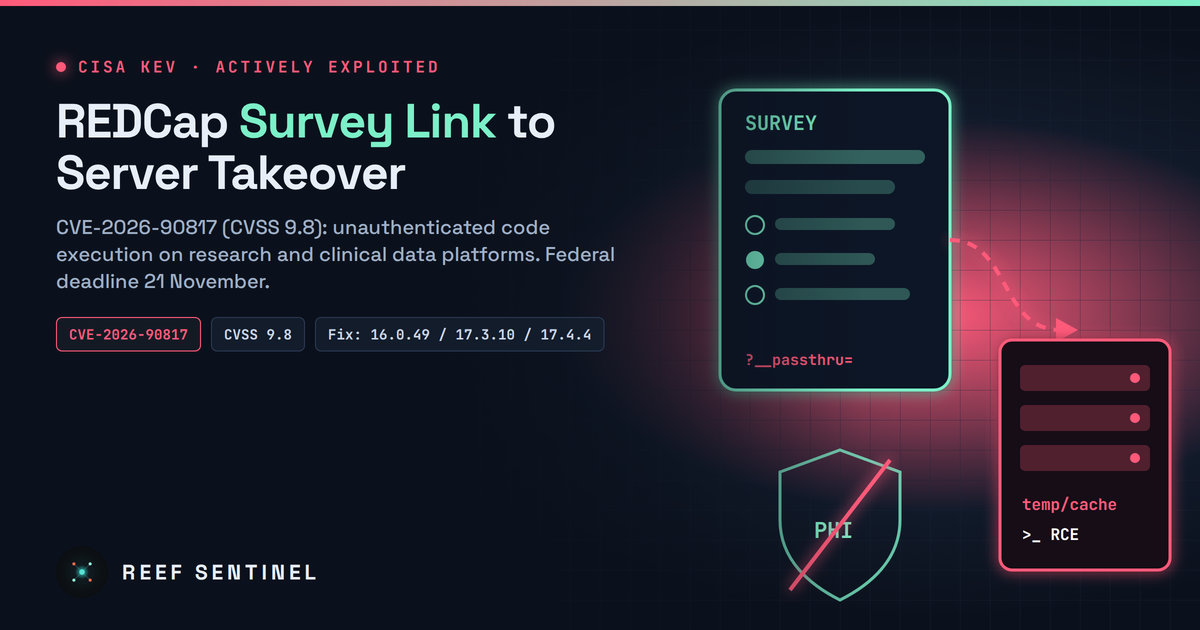
CISA has added REDCap's CVSS 9.8 survey-passthrough and Data Import flaw to KEV after active exploitation, giving anyone holding a public survey link a path to code execution on servers full of research and patient data.
Overview
CISA has added CVE-2026-90817, a critical flaw in Vanderbilt University's REDCap (Research Electronic Data Capture), to its Known Exploited Vulnerabilities (KEV) catalog. REDCap is the survey and study-database platform that universities, hospitals and research institutes use to run clinical trials, patient questionnaires and research registries. The flaw lets an attacker who has never logged in run code on the REDCap server. The only thing they need is a valid public survey link, which is exactly what institutions hand out to study participants.
The KEV entry went live on 18 November at 23:17 Mauritius time (19:17 UTC). US federal civilian agencies must mitigate by 21 November 2026, one of the shortest deadlines CISA sets. CISA also flagged the entry for forensic triage, so agencies are expected to look for signs of past compromise as well as patch. Whether ransomware groups are using it is listed as "Unknown".
The bug is not new. The CVE record was published on 20 September at 16:05 Mauritius time (12:05 UTC), and the researcher's full technical write-up followed a week later. Fixed REDCap releases have been available since then. Any instance still on an older build has now gone two months without the fix, and attackers are known to be exploiting it.
The Vulnerability
- CVE: CVE-2026-90817
- Product: Vanderbilt University REDCap, version 13.3.0 and later
- Type: code injection (CWE-94) combined with external control of a file name or path (CWE-73)
- CVSS 3.1: 9.8 Critical (AV:N/AC:L/PR:N/UI:N/S:U/C:H/I:H/A:H)
- Fixed in: 16.0.49 LTS, 17.3.10 LTS and 17.4.4 Standard
- Affected ranges (NVD): 13.3.0 up to 16.0.48, 16.1.0 up to 17.3.9, and 17.4.0 up to 17.4.3
- Precondition: knowledge of one valid public survey hash; no account, session, project role or CSRF token
- Discovered by: an independent security researcher, whose firm also assigned the CVE as the CNA
The researcher says an AI coding agent did much of the source review and helped build the proof of concept. They also stress that the survey hash is not a real barrier. Public survey links are made to be shared, and they turn up regularly in search engine results, URL-scanning services and web archives.
How the Chain Works
The researcher describes CVE-2026-90817 as five separate defects that only become remote code execution when chained together. Each one looks harmless on its own:
- Survey passthrough decoding mismatch. REDCap's public survey handler can "pass through" a small allowlist of internal files. It is supposed to reach the root dispatcher only for the PDF route. However, the allowlist lookup URL-decodes the parameter one extra time, while the route restriction compares the value as received. A double-encoded value satisfies the first check and slips past the second, so a public request reaches the general project dispatcher with a route of the attacker's choosing.
- Rights calculated in the wrong context. In this survey flow, REDCap builds the user-rights object before the survey respondent identity exists. An undefined super-user flag is treated as "super user", so the anonymous request is granted the Data Import privilege. Because the request runs as no-auth, the usual CSRF check on POST is also skipped.
- Untrusted file name in Data Import. The Data Import commit step takes a file name straight from the POST body. It passes that name to PHP file functions without checking it against a server-issued upload handle or rejecting stream wrappers such as
php://filter. - Read-modify-write in CSV cleanup. When REDCap reads the CSV, it strips any byte-order mark and writes the cleaned data back to the same resource. With PHP filter chains, the researcher turned this into a precise overwrite of any file the web server account can write to.
- Predictable template cache as the execution sink. REDCap's BladeOne template engine stores compiled views under
temp/cache, named after the SHA-1 hash of the view name. A Parcel view that the routing flaw can also reach without logging in includes that compiled file as PHP. Overwriting it gives code execution through an ordinary page request.
We are deliberately leaving out request formats and payload construction. For defenders, what matters is that every step runs through normal, publicly reachable survey URLs. The attack needs no user interaction and works the same way every time.
Timeline
- 13 September 2026: CVE-2026-90817 reserved.
- 20 September 2026, 16:05 Mauritius time (12:05 UTC): CVE published with CVSS 9.8; fixed REDCap releases identified as 16.0.49, 17.3.10 and 17.4.4.
- 27 September 2026: the researcher publishes a full root-cause analysis of the chain.
- 18 November 2026, 23:17 Mauritius time (19:17 UTC): CISA adds the flaw to KEV based on evidence of active exploitation. The same update covers Synology DSM, LiteLLM and Apache Axis.
- 19 November 2026: the NVD record is updated with the KEV data and affected version ranges.
- 21 November 2026: CISA's remediation deadline for US federal civilian agencies.
Tradecraft
CISA has not named victims, attackers or the number of compromised servers. No public report so far ties the exploitation to a particular group or payload. Based on how the chain works, a successful attacker would most likely:
- harvest public survey links from search engines, URL-scan archives or the target's own recruitment pages;
- send crafted survey requests that reach Data Import and Parcel routes;
- overwrite a compiled template in
temp/cacheand trigger it, getting code execution as the web server account; - read REDCap's database configuration, which gives direct access to study data. In many deployments that includes protected health information and identifiable research records.
One threat-intelligence brief says a working proof of concept and a fingerprinting tool are publicly available. We have not verified that independently. Because the full technique has been documented since September, it is safest to assume that capable attackers can reproduce it.
Indicators of Compromise
CISA's KEV entry and the researcher's analysis publish no IP addresses, domains or file hashes. Use the behavioural indicators in the Detection section.
Detection
Look for these signs in web server, reverse proxy and application logs:
- survey requests with encoded or double-encoded
__passthruvalues; - survey-context requests whose route points to
DataImportControllerorParcelController:show; - Data Import POST bodies where the
fnamevalue contains a URI scheme (for examplephp://) or conversion filter names, instead of a plain temp file name; - unexpected changes to files under
temp/cache(compiled.bladectemplates), especially modification times that line up with survey traffic; - child processes started by the PHP or web server account, such as shells,
curl,wgetor interpreters; - administrative data imports in REDCap's logging module that no staff member carried out.
Example triage commands for a Linux host (adjust paths to your install):
# Survey requests touching passthrough, Data Import or Parcel routes
grep -Ei '__passthru|DataImportController|ParcelController' /var/log/apache2/access.log*

# Recently modified compiled templates in REDCap's cache
find /var/www/redcap/temp/cache -type f -mtime -60 -ls

# Processes currently running as the web server user
ps -o pid,ppid,lstart,cmd -u www-data
Default access logs often leave out POST bodies, so a missing match does not prove a server is clean. Compare temp/cache and application files against a known-good backup.
Recommended Actions
- Upgrade now to REDCap 16.0.49 LTS, 17.3.10 LTS or 17.4.4 Standard, or a later release. There is no separate source patch.
- If you cannot upgrade immediately, disable public surveys and block survey-context access to the root dispatcher, Data Import controller and Parcel controller at the web server or reverse proxy. Treat this as temporary containment only.
- Assume compromise if you were exposed. Any internet-facing REDCap instance on a vulnerable build since late September should go through forensic review. Upgrading does not remove files or persistence an attacker has already planted.
- Rotate secrets stored on the server, including database credentials, API tokens, SMTP and LDAP passwords and encryption salts, if you find any sign of intrusion.
- Clear the template cache after upgrading so REDCap regenerates compiled views from trusted sources.
- Reduce exposure. Put administrative interfaces behind VPN or SSO where your study design allows. Close or expire public surveys that are no longer collecting responses.
- Notify data protection and ethics officers early. Many REDCap projects hold health or human-subject data that falls under breach notification rules.
Analyst Assessment
This is a high-impact flaw that is easy to overlook. REDCap rarely sits on the asset lists that security teams patch first. It is often run by a research IT group or a single department, sometimes on servers outside central IT management, yet it holds some of an organisation's most sensitive personal data. The "authentication required" caveat is weak in practice, because the only credential is a survey link built to be shared publicly.
The two-month gap between publication and the KEV listing suggests many institutions were slow to upgrade. The short federal deadline shows how seriously CISA views it. We rate this Critical. Any organisation running REDCap should confirm its exact version today and, if it was exposed and unpatched, start a compromise assessment rather than only patching. We expect more exploitation reports, including data theft from research and hospital environments, as scanning for exposed survey endpoints grows.
