AuditTeam Ransomware Bills Victims for a 'Forced Audit': LLM-Assisted OpsAgent Framework, GitHub Dead-Drop C2 and a Signed Driver That Kills 220 Defences Across 7+ Countries
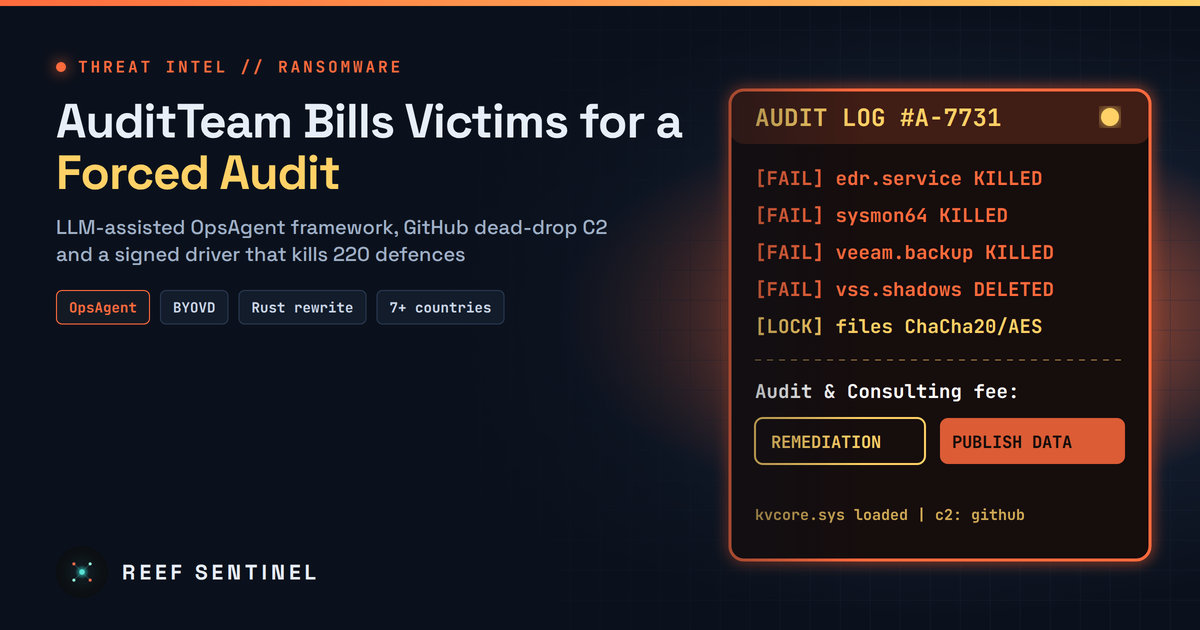
Researchers expose AuditTeam, a ransomware crew that hit dozens of organisations from January to October 2026 with OpsAgent, a likely LLM-built C2 framework rewritten in Rust, a BYOVD EDR killer and audit-themed double extortion.
Overview
A ransomware group calling itself AuditTeam has spent most of 2026 breaking into organisations and then billing them for an "audit". On 18 November 2026, security researchers at Kaspersky's Global Research and Analysis Team (GReAT) published an analysis of the group's campaign. It hit dozens of organisations in at least seven countries and territories between January and October 2026: China, Finland, Hong Kong, Italy, the Philippines, Russia and Senegal. The group's leak site also lists victims in Turkey, Thailand, Ukraine, Argentina, South Korea, Japan and Spain.
What sets the campaign apart is the toolkit behind it. AuditTeam runs a previously unknown modular post-exploitation framework that the researchers named OpsAgent. The researchers say it was probably written with help from a large language model. Over the year it went from a C++ implant at version 5.2.8 to a rewrite in Rust. It also comes with a signed-driver EDR killer that terminates about 220 processes and a file-encryption module built on X25519 key exchange.
The Campaign
AuditTeam presents itself as an organisation that "educates" companies about security. It was first mentioned in open sources in March 2026. Its ransom note is laid out like an audit log and addressed to executives and legal and compliance teams. It gives victims two options:
- "Remediation": pay an "Audit & Consulting fee". In return the group promises to delete the stolen data and hand over a report on the vulnerabilities it used.
- "Public transparency": the full data archive is published, and the victim's clients, partners and regulators are told about the breach.
Victims contact the group through a Tor site using an "Audit ID". This is double extortion with a compliance-flavoured script, written so the pressure lands on the people who own regulatory risk. The cryptor module drops the note, so by the time anyone reads it the files are already encrypted.
The report does not say how AuditTeam gets its initial access.
Timeline
- 5 January 2026: commit history in the group's GitHub repository shows when the campaign began.
- 29 January 2026: the first CloudFront C2 domain is added to the repository.
- 21 February 2026: the first victim appears on the leak site.
- 10 March 2026: OpsAgent is first detected, during an attack on an organisation in Hong Kong.
- April 2026: a C loader is seen. A .NET loader follows in June 2026.
- 19–20 August 2026: a new IP address and a second CloudFront domain are added as C2.
- September 2026: Rust loaders and the Rust implant (OpsAgent-rs) appear. The legacy C2 domain is removed from GitHub on 29 September.
- November 2026: the GitHub repository is taken down. The newest Rust implants have the GitHub lookup turned off, so the researchers expect operations to continue.
Tradecraft
Loaders. The C loader injects shellcode into msiexec.exe with the classic VirtualAllocEx / WriteProcessMemory / CreateRemoteThread sequence. The .NET loader uses APC injection instead. Both are obfuscated with OLLVM control-flow flattening. The Rust loader decrypts its payload and runs it inside its own process, without injecting into another one.
The OpsAgent implant. The C++ build looks a lot like commercial red-team software. Its commands cover shellcode injection, in-memory .NET assembly execution, Mimikatz, pass-the-hash, token theft and impersonation, getsystem, keylogging and screenshot monitoring. It can also chain agents over SMB, HTTP and TCP and run SOCKS pivots. Each job spawns a sacrificial host process (msiexec.exe by default, notepad.exe for monitoring) linked by a named pipe. One injection mode, which the researchers call "DbgInjector", starts a process in a debug state and sets a hardware breakpoint. When the breakpoint fires, it redirects execution to the shellcode, avoiding the usual remote-thread APIs. C2 traffic runs over WebSocket inside TLS.
Dead-drop C2 on GitHub. OpsAgent did not hard-code its server. It read an AES-encrypted, base64-wrapped configuration from the README of a plain-looking public repository called staticPage. The operators could swap infrastructure just by committing a new value. The Rust version moved to AES-GCM with HMAC-derived keys. It starts with HTTP POST polling and switches to a persistent WebSocket once ordered to.
Bring-your-own-vulnerable-driver. One add-on module loads kvcore.sys, a legitimately signed driver presented as a Beijing Jiangmin antivirus component. Through the driver's filter port it kills about 220 processes, including Microsoft Defender, other endpoint agents, Sysmon, Splunk and Wazuh forwarders, TeamViewer, Veeam and Acronis backup agents, and SQL Server, MySQL, MongoDB and Redis.
Encryption and anti-recovery. The cryptor uses AES-CBC or ChaCha20, chosen by a command-line flag, with a random key for each file. Each file key is protected through X25519 key exchange against a public key embedded in the binary. Before encrypting, it stops database and backup services. It then deletes shadow copies, empties the recycle bin, wipes temp folders, and overwrites files with random data before deleting them.
Signs of LLM-assisted development. The researchers point to injection commands that share almost the same code structure, differing only in argument count and target process. They also note Windows API names left in plaintext in memory even though the code resolves APIs by hash. Neither is proof, but both fit generated, lightly reviewed code. The pace of change fits too: two loader languages and a full Rust rewrite within about nine months.
Indicators of Compromise
Infrastructure:
- d19v1tntmz2i98.cloudfront[.]net
- d35htktbyt7nxc.cloudfront[.]net
- 157.20.104[.]111 (AS136557)
- hxxps://github[.]com/RonaldCMalcolm1983/staticPage (dead-drop repository, now removed)
Stager hashes (MD5):
- d3e49dceb89a25f5da4ff0c42e996857
- bd4c327ad208cb722ad25e43ea3f35fc
- 5d1425ab3dad1d2de053f69529d227e1
- f0d5752054f6b7af1325ea340c4326d0
- 83768e994c6bb72d0b430b98a71ec8d6
Abused driver (MD5, legitimate signed file): 109cdc24ccd4872a3e4bf6f2d4f3c3d4
File paths:
C:\ProgramData\Microsoft\Windows\Caches\syscache.dat%LOCALAPPDATA%\Microsoft\Windows\Caches\syscache.dat%LOCALAPPDATA%\Microsoft\CLR_v4.0\syscache.datC:\Users\Public\kv_dbg.logC:\Windows\System32\drivers\kvcore.sys
Kaspersky products detect the implant as HEUR:Backdoor.Win64.OpsAgent.gen.
Detection
- Alert on any
kvcore.sysdriver load or service creation. Add the driver hash to your vulnerable-driver blocklist (WDAC / Microsoft vulnerable driver blocklist, or your EDR's equivalent). - Hunt for
syscache.datfiles underCachesorCLR_v4.0folders, and forC:\Users\Public\kv_dbg.log. - Flag
msiexec.exeornotepad.exestarted without arguments by an unusual parent, especially with named-pipe activity or outbound TLS. - Watch for processes created in a debug state by non-developer software. This is the DbgInjector pattern.
- Look for endpoints making regular requests to raw GitHub README content or
*.cloudfront.nethosts that your business does not use. - Treat a sudden stop of Sysmon, Defender, Splunk/Wazuh agents or Veeam services on several hosts as an incident in progress, not a monitoring glitch.
A quick check for the driver and the dropped files on a Windows host:
Get-CimInstance Win32_SystemDriver | Where-Object { $_.PathName -match 'kvcore' }
Get-ChildItem -Path C:\ProgramData,C:\Users -Recurse -Filter syscache.dat -ErrorAction SilentlyContinue
Test-Path C:\Users\Public\kv_dbg.log
Recommended Actions
- Turn on Microsoft's vulnerable driver blocklist and HVCI (memory integrity) where hardware supports it, so signed-but-abused drivers cannot load.
- Enable tamper protection on endpoint agents, and send telemetry off-host so a mass process kill still leaves a trail.
- Keep at least one backup copy offline or immutable, and separate backup administration credentials from the domain.
- Restrict credential theft paths: Credential Guard, LSASS protection and tiered admin accounts all reduce Mimikatz and pass-the-hash value.
- Block or monitor GitHub and CDN egress from servers that have no reason to reach them.
- Sweep for the indicators above, and keep patching and phishing training current. The initial access route is still unknown.
Analyst Assessment
AuditTeam is not technically new in what it does: injection, BYOVD and double extortion are all standard for ransomware. What matters is how fast a small crew built and rebuilt a full C2 framework. If the researchers' LLM assessment is right, a group that once would have rented or cracked Cobalt Strike can now produce its own implant, change languages mid-campaign and leave existing signatures behind. Defenders should rely less on tool-specific detections and more on behaviour that every rewrite still needs: driver loads, sacrificial processes, mass service kills and shadow-copy deletion. The "audit" framing is psychological pressure aimed at boards and compliance officers. Victims should treat it as extortion and nothing more: paying an "audit fee" gives no assurance that the data is deleted.
