Java4Shell (CVE-2026-114938): Leaked Java RCE in OpenJDK's Base64 Decoder Is Still RESERVED, With No Official Advisory
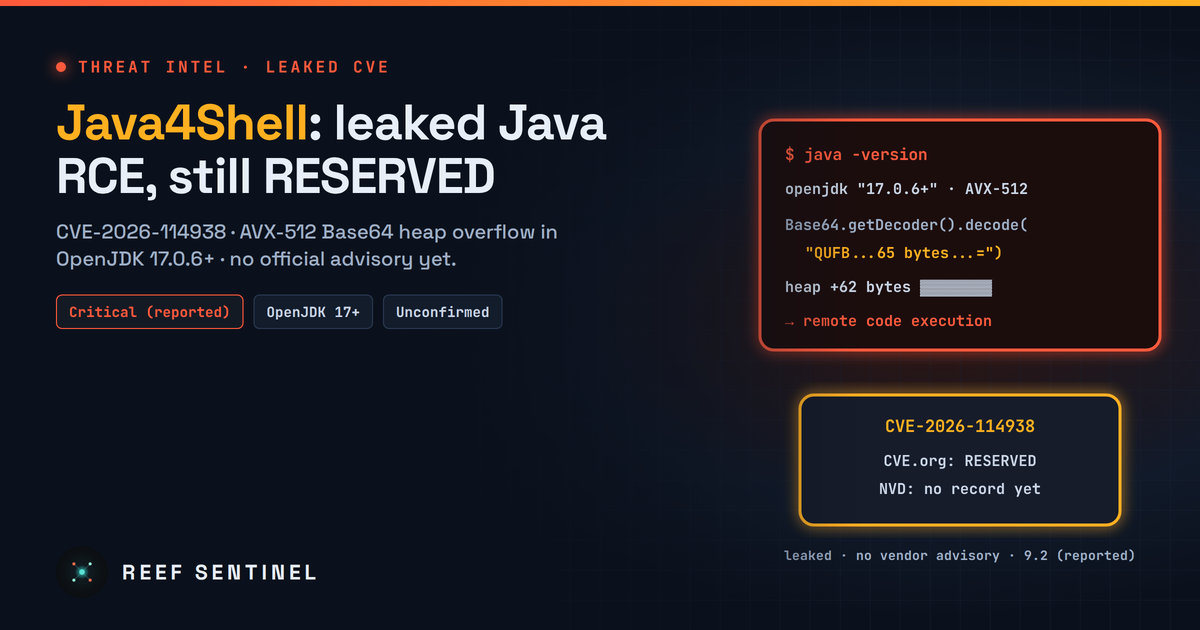
Details of an unauthenticated remote code execution flaw in OpenJDK 17.0.6+ have leaked before disclosure: the CVE is only reserved, NVD has no record and Oracle has named no fix yet.
Overview
A critical Java flaw has gone public before its owners were ready to talk about it. CVE-2026-114938, nicknamed "Java4Shell", is being described as an unauthenticated remote code execution bug in the Java runtime (OpenJDK and Oracle Java SE builds based on it). It is not yet officially disclosed. The researchers who say they found the bug and reported it to Oracle confirmed that the vulnerability had leaked, and promised to publish their technical write-up only after Oracle ships a patch.
At the time of writing, 21:50 Mauritius time (17:50 UTC) on 17 November 2026:
- The CVE record at CVE.org is RESERVED: the number exists, but there is no public description, no affected-product list and no score.
- NVD has no entry for CVE-2026-114938.
- There is no public announcement from Oracle or OpenJDK naming this CVE. Oracle's pre-release notice for its November 2026 Critical Security Patch Update lists 11 new Java SE fixes, but does not say which CVEs they are.
- No public exploit code and no exploitation in the wild have been reported.
Everything below about how the bug works comes from the leaked and researcher-reported details. It has not been confirmed by Oracle or OpenJDK and may change once the official advisory is out.
The Vulnerability
According to the reported details, the flaw sits in the hardware-accelerated Base64 decoder inside the HotSpot JVM. On x86-64 CPUs with AVX-512, the JVM replaces the normal Java code behind java.util.Base64 decoding with a fast hand-written machine-code routine (an "intrinsic").
- The bug: an integer underflow in how that fast path handles padding.
- The trigger: a crafted Base64 string of just 65 bytes.
- The effect: the decoder writes about 62 bytes past the end of its buffer on the Java heap, corrupting neighbouring objects. Researchers say this can be turned into code execution inside the Java process.
- Reported score: 9.2 (CVSS 4.0). This score is not on any official record yet. For comparison, Oracle's pre-release notice gives 8.1 (CVSS 3.1) as the highest Java SE score in this month's update, but does not say whether this bug is part of it.
Why this matters: Base64 decoding is everywhere in server-side Java. It is used for HTTP Basic authentication headers, JSON Web Tokens, SAML assertions, API payloads, file uploads and message queues. Any service that decodes Base64 from an untrusted user on an affected JVM and CPU could be reachable without logging in.
Affected Versions
Reported (not confirmed by the vendor):
- OpenJDK 17.0.6 and later, which includes the builds shipped by most Java vendors, since they are built from OpenJDK. Reports point to Java 17 as the first affected release line. Later lines that carry the same decoder code are expected to be affected too.
- Only on x86-64 hardware with AVX-512 where the JVM uses the accelerated Base64 path. ARM servers and CPUs without AVX-512 should not take this code path, according to the reports, but nobody has officially confirmed that yet.
Officially listed by Oracle as affected by some of the 11 Java SE fixes in the November 2026 update (not mapped to individual CVEs):
- Oracle Java SE 8u511, 8u511-perf, 11.0.33, 17.0.21, 21.0.13, 25.0.5 and 27.0.1
- Oracle GraalVM for JDK 17.0.21 and 21.0.13; GraalVM Enterprise Edition 21.3.20.0.3
Timeline
- January 2023: OpenJDK 17.0.6 is released. It is the earliest version said to contain the vulnerable code.
- Before 17 November 2026: the bug is reported privately to Oracle, and CVE-2026-114938 is reserved.
- 17 November 2026: details leak. The finders confirm the leak publicly and say their full technical details will follow after Oracle's patch, by 01:00 Mauritius time on 18 November (21:00 UTC on 17 November).
- 17 November 2026: Oracle's Critical Security Patch Update for November 2026 is scheduled, with 11 Java SE fixes.
- 21:50 Mauritius time (17:50 UTC), 17 November 2026: CVE record still RESERVED, no NVD entry, no vendor advisory naming the CVE.
Tradecraft
There are no public reports of attacks yet. Based on the reported mechanics, attackers would most likely:
- Find internet-facing Java services, often through version banners and admin or monitoring endpoints that reveal the JDK version.
- Send the 65-byte Base64 payload wherever an application decodes attacker input: login headers, tokens, API fields and file uploads.
- Use the heap corruption to take over the JVM, then pivot from the server like any other remote code execution.
Failed attempts are likely to crash the JVM, which helps defenders.
IOCs
No indicators of compromise have been published. There are no public exploit samples, payload hashes or attacker infrastructure for this CVE yet.
Detection
- Inventory first. Find every Java runtime, including the ones bundled inside products, appliances and container images:
java -versionfind / -type f -name release 2>/dev/null | xargs grep -H JAVA_VERSION 2>/dev/null- Check the CPU. On Linux,
grep -o -m1 'avx512[a-z]*' /proc/cpuinfo. If nothing is printed, the reported vulnerable path should not be used on that host. - Check the JVM flags.
java -XX:+PrintFlagsFinal -version | grep -E 'UseAVX|UseBASE64Intrinsics' - Watch for crashes. Unexpected JVM crash files (
hs_err_pid<pid>.log) or containers exiting with code 134 or 139 on internet-facing Java services could mean someone is trying to exploit the bug. Investigate them rather than just restarting. - Look at the input. Unusually short, malformed Base64 strings in authentication headers or API fields, appearing just before a crash, deserve a closer look.
Recommended Actions
- Patch as soon as the official fix is out. Apply Oracle's November 2026 Critical Security Patch Update builds, or your vendor's matching OpenJDK update (Red Hat, Eclipse Temurin, Amazon Corretto, Azul, Microsoft and others). Confirm against the official advisory that CVE-2026-114938 is listed.
- Rebuild container images. Patching the host does not update the JDK inside your images.
- Prioritise internet-facing services running Java 17 or later on AVX-512 x86-64 servers.
- Temporary mitigation only after testing:
- Disable the Base64 intrinsic with the JVM option
-XX:-UseBASE64Intrinsics. - Or cap vector instructions with
-XX:UseAVX=2, which stops the AVX-512 code paths. - Both are standard HotSpot options.
UseAVX=2can reduce performance on some workloads. Neither has been officially confirmed as a fix for this CVE, and neither replaces the patch. - Reduce exposure. Take admin and monitoring endpoints that reveal version information off the internet (for example Spring Boot Actuator, Solr admin and Elasticsearch/OpenSearch APIs).
- Track the official sources below. Expect the CVE record and NVD entry to be filled in after the patch release and the researchers' disclosure.
Analyst Assessment
Java4Shell is a classic leaked-before-disclosure situation. The name, the CVE number and enough detail to start hunting are already public, while the official records are still empty. That gap is the risk: skilled attackers can work from a 65-byte trigger and a known code location, while defenders cannot yet point to a vendor advisory or a fixed version number.
Until Oracle and OpenJDK publish, treat the technical details and the 9.2 score as credible but unconfirmed. What you can do now is make the inventory, check AVX-512 exposure, stage the patch and prepare the JVM option as a fallback. When the advisory lands, the job is simply to roll out the update.
Reef Sentinel will update this item when the CVE record, the NVD entry or the vendor advisories are published. Severity: Critical (reported, pending official scoring).
