AI Agents Found a Zero-Day in 11 Minutes: China-Linked Cairn Operator Rooted a University Server via MONAI Label CVE-2026-133968 (CVSS 9.8), and the First Fixed Release, 0.8.6, Shipped Today
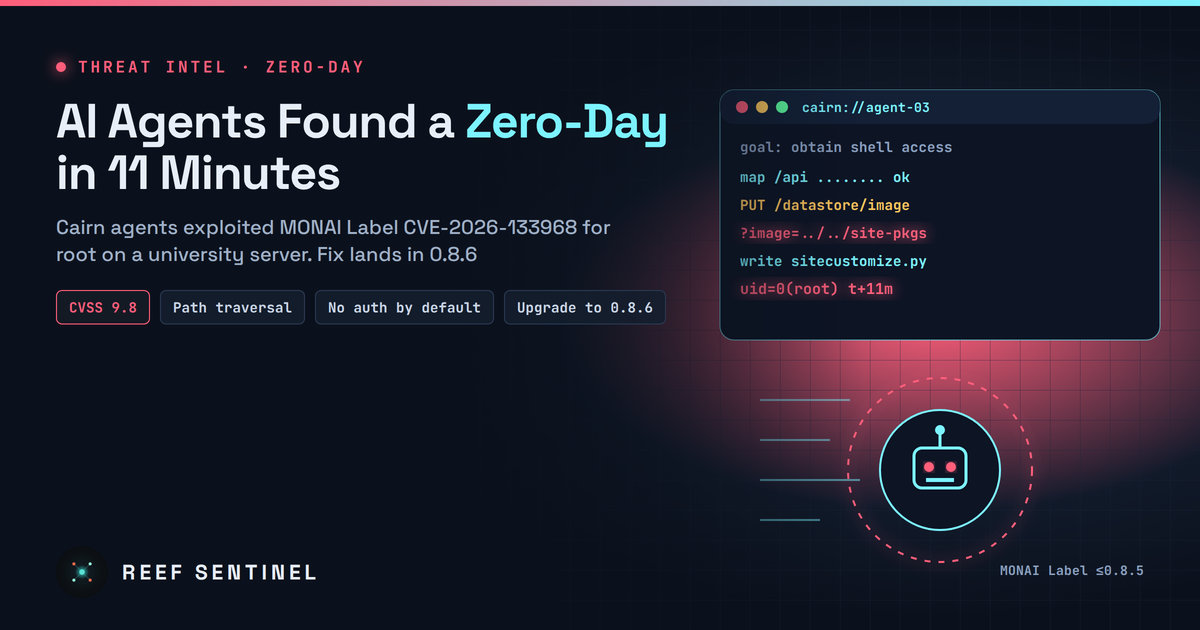
Amazon says autonomous Cairn AI agents found and exploited an unauthenticated path traversal in the MONAI Label medical-imaging server to get root on a university server, and the first patched package, 0.8.6, was released on 22 November.
Overview
Amazon Threat Intelligence has published the first detailed account of autonomous AI agents finding a previously unknown vulnerability during a live intrusion campaign and then using it to take over a server. The flaw is in MONAI Label, an open-source server that research hospitals and universities use to label medical images and train AI models on them. It is now tracked as CVE-2026-133968 (CVSS 9.8). The agents were run through Cairn, an open-source AI penetration-testing framework, by an operator Amazon links to China with moderate confidence. Their brief was simply to "obtain shell access".
The new development today: the MONAI Label maintainers shipped version 0.8.6 at 05:29 Mauritius time on 22 November (01:29 UTC 22 November). It is the first packaged release on PyPI and Docker that contains the fix. Until then, the code fix had been sitting on the project's main branch since October, but anyone who installed the server with pip install monailabel was still getting the vulnerable 0.8.5, which dates from 2023.
The Vulnerability
The project's security advisory (GHSA-qc22-rmgc-vg94) describes a path traversal (CWE-24) in the datastore upload endpoints:
PUT /datastore/imagetakes a caller-suppliedimagequery parameter and uses it as the image ID without validation. The server appends a file extension, joins the ID onto the datastore directory and copies the uploaded file to that path. Nothing checks that the final path is still inside the datastore, so a value containing../sequences writes the file anywhere the server process is allowed to write.PUT /datastore/labelbuilds its destination path from the image ID and label tag in the same unsafe way.- A second, related flaw fixed in 0.8.6 affects
PUT /session/?uncompress=true. It extracted uploaded tar archives without checking member names and used session IDs as paths without validating them.
All versions up to and including 0.8.5 are affected. The flaw is especially dangerous because MONAI Label ships with authentication disabled by default (MONAI_LABEL_AUTH_ENABLE=False). Any client that can reach the port can therefore reach both bugs, with no credentials and no user interaction.
The Campaign
According to Amazon, the operator left their Cairn server online without authentication. That exposed project settings, prompts and the agents' output to anyone who found it. Prompts were written in Simplified Chinese and script timestamps were set to China Standard Time. Over roughly 48 hours, the campaign targeted IP ranges belonging to universities in East Asia outside mainland China.
Most operations failed, but they show how persistent agents can be:
- Against an unauthenticated Redis server, the agents ran 148 sequential actions over about 16 hours. They tried replication abuse, Lua sandbox escapes, config-file writes and memory corruption, plus Log4Shell against a co-located service. They then mapped the internal Docker network through an SSRF in a Qdrant instance and sprayed credentials at PostgreSQL and SSH. None of it worked.
- Against a university GPU cluster, the agents collected about 80 real usernames from faculty directories, lab pages, web archives and papers. They then tried more than 30,000 credential combinations against SSH, a VPN, a NAS, an admin dashboard and the campus portal, again without success.
The medical-imaging target was different. The agents fingerprinted the framework, mapped its API and spotted an upload endpoint with a filename parameter. They tested it for path traversal and had arbitrary file write about 11 minutes after they started mapping the API.
Timeline
- 8 September 2026: the campaign begins and runs for about 48 hours.
- 10 September 2026: Amazon Threat Intelligence finds the exposed Cairn instance.
- 19 October 2026: the datastore path fix (pull request #1915) is merged into MONAI Label's main branch at 17:37 Mauritius time (13:37 UTC). There is no packaged release yet.
- 18 November 2026: GitHub advisory GHSA-qc22-rmgc-vg94 is published at 19:45 Mauritius time (15:45 UTC).
- 20 November 2026: Amazon publishes its report at 21:30 Mauritius time (17:30 UTC). The CVE record appears in NVD at 23:18 Mauritius time (19:18 UTC), describing exploitation in the wild since September.
- 22 November 2026: MONAI Label 0.8.6 is released at 05:29 Mauritius time (01:29 UTC), also fixing the session-archive traversal.
Tradecraft
To turn the file write into code execution, the agents wrote a Python reverse shell into sitecustomize.py, a file the Python interpreter imports automatically every time it starts. They then called MONAI Label's training API, which starts a new Python process. That process loaded the payload and connected back to the attacker as root, which shows the server was running with full privileges.
The human operator then stepped in. They gave the agents a proxy that tunnelled into a second university network. Amazon infers that the proxy ran on another MONAI Label server the operator had already compromised with the same bug, and the agents were told to attack other machines from there. Amazon also notes that a separate, financially motivated group has been documented using Cairn against online retailers, which suggests the framework is being adopted for both espionage and crime.
Indicators of Compromise
Amazon published two addresses seen in records dated 8–10 September 2026:
- 142[.]4.98[.]145
- 142[.]4.107[.]34
These are months old and were probably short-lived infrastructure, so treat them as useful for retro-hunting rather than blocking.
Detection
- Search reverse-proxy and application logs for
PUT /datastore/image,PUT /datastore/labelorPUT /session/requests whose parameters contain../,..%2for%2e%2e. - Look for unexpected
sitecustomize.pyorusercustomize.pyfiles, and for recent changes in site-packages, cron,.ssh/authorized_keysand the application's own code. - Alert when the MONAI Label process, or Python children started by training jobs, make outbound connections to unfamiliar hosts.
- Check whether the server is reachable from the internet at all. That exposure is what the agents found.
pip show monailabel | grep -i ^version
python3 -c "import site,sys; print(site.getsitepackages(), sys.prefix)"
find / \( -name 'sitecustomize.py' -o -name 'usercustomize.py' \) -mtime -90 -ls 2>/dev/null
grep -E 'PUT /(datastore|session)' /var/log/nginx/access.log | grep -Ei '\.\./|%2e%2e|\.\.%2f'
Recommended Actions
- Upgrade to MONAI Label 0.8.6 (
pip install -U monailabel==0.8.6ordocker pull projectmonai/monailabel:0.8.6). Note that 0.8.6 requires Python 3.11 or newer. - Take MONAI Label servers off untrusted networks and put them behind a VPN or an authenticating reverse proxy.
- Turn authentication on and grant roles only to trusted users.
- Run the service as an unprivileged account that can write only to the datastore, never as root.
- If a 0.8.5 or older server was reachable from an untrusted network, treat it as possibly compromised. Review it for unexpected file changes before you return it to service, and rotate any credentials it held.
- Inventory other research-lab services such as Redis, vector databases, notebooks and GPU dashboards, which the same agents probed without authentication.
Analyst Assessment
The bug itself is a classic path traversal. What makes this case significant is who found it. An unattended agent framework discovered and weaponised a real zero-day in minutes, and then kept working tirelessly through targets that didn't give way. Research software built for trusted lab networks, with authentication off by default, is exactly the kind of under-watched target these agents will keep finding.
The patch timeline also deserves attention. Users who relied on PyPI or Docker had no fixed build for more than two months after the code fix landed, and for four days after the advisory was published. Defenders should expect agent-driven discovery to shorten the time between "unknown" and "exploited" further. That makes exposure reduction and automated detection more valuable than waiting for a patch.
