Deep-TEMPEST: How AI Reads Your Screen From the Radio Signals Leaking Out of an HDMI Cable
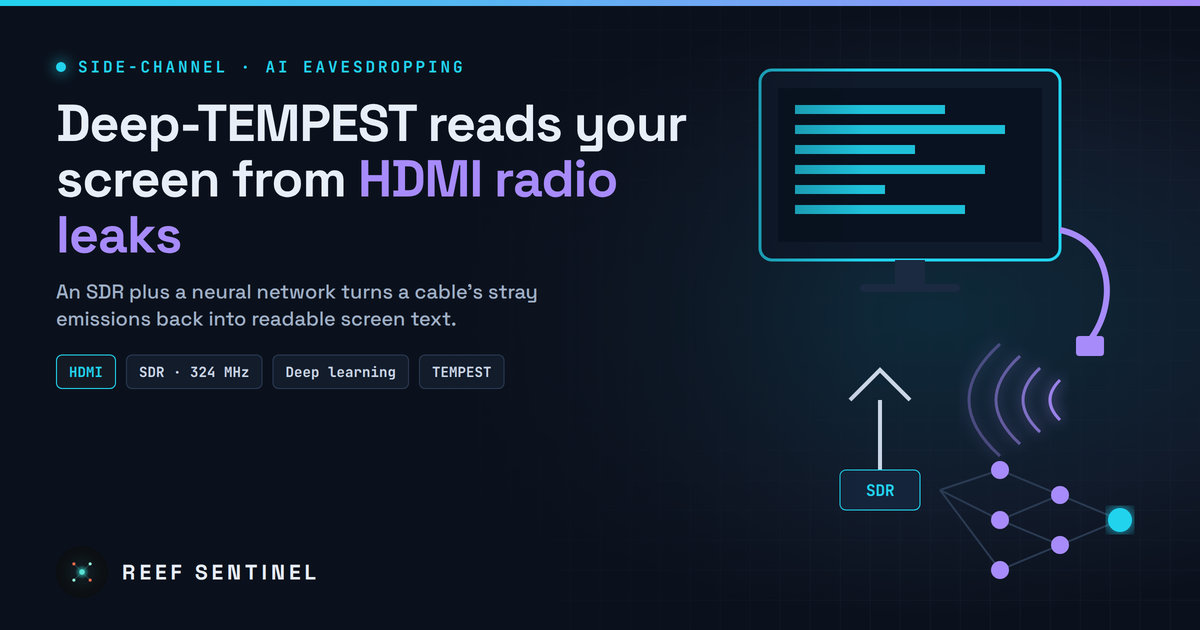
Researchers pair a software-defined radio with a neural network to rebuild screen text from HDMI emissions, cutting the character error rate from about 90% to under 30%.
What Deep-TEMPEST is
Deep-TEMPEST is a research attack that reads what is on a computer screen without touching the computer, the network or the screen itself. It listens to the faint radio signals that an HDMI cable and connector leak while carrying video, then uses a neural network to turn that noisy signal back into a readable picture of the display.
The work comes from a team at the Universidad de la República in Montevideo, Uruguay: Santiago Fernández, Emilio Martínez, Jorge Varela, Pablo Musé and Federico Larroca. It was published in 2024 and presented at the 13th Latin-American Symposium on Dependable and Secure Computing (LADC '24). The code and the full training dataset are open source.
An old idea, made practical for HDMI
Spying on screens through their electromagnetic leakage is not new. "TEMPEST" is the long-standing name for this class of eavesdropping, and the technique is also known as Van Eck phreaking, after a 1985 demonstration against CRT monitors. For analog VGA cables the attack has been well understood for years: the leaked signal maps fairly directly onto pixel brightness.
HDMI is much harder. The video is digital and uses 10-bit encoding with far more bandwidth, so the leaked signal no longer resembles the image in a simple way. Earlier open-source tools such as gr-tempest could pick up HDMI leakage with a software-defined radio (SDR), but the result was a grainy grey image in which text was mostly unreadable.
How the attack works
Deep-TEMPEST keeps the classic radio front end and adds machine learning at the end:
- Capture: an SDR receiver tuned to a harmonic of the display's pixel rate picks up the cable's unintended emissions. In the published dataset the screen ran at 1600×900 and the radio was tuned to the third pixel-rate harmonic, 324 MHz.
- Raw reconstruction: gr-tempest, built on the GNU Radio framework, turns the captured signal into a rough image of the screen.
- Deep learning clean-up: a convolutional neural network based on the DRUNet image-restoration architecture treats the problem as an "inverse problem". It learns how HDMI leakage distorts an image and works backwards to the screen content.
The network was trained on simulated captures plus more than 1,000 real captures. The whole system is integrated into GNU Radio and runs on commodity hardware.
How well it works
The researchers focused on recovering text, since that is what an attacker most wants: passwords being typed, emails, documents, chat windows. Using an optical character recognition test, they report that the character error rate fell from about 90% with the unmodified gr-tempest to under 30% with their deep-learning module, an improvement of more than 60 percentage points. In practice that is the difference between a grey smear and text a person or an OCR engine can read.
The team has published a demo video of the full system in operation, alongside the code and a 7 GB dataset of synthetic and real captures.
Who should worry
This is not an attack for everyday cybercriminals. It needs physical proximity to the target, radio equipment, an antenna placed so it picks up the signal, and tuning for the specific screen resolution and refresh rate. Results depend heavily on the environment and on how much the cable and devices leak.
It does matter for:
- Governments, defence and intelligence: TEMPEST eavesdropping is a known espionage technique, and these organisations already run shielding programmes for this reason.
- High-value corporate targets: trading floors, board rooms, R&D labs and any office where sensitive data is shown on screens near shared walls, corridors or car parks.
- Air-gapped systems: isolating a machine from the network does nothing against an attack that reads the cable going to its monitor.
The broader lesson is that AI lowers the bar for side-channel attacks. Signals that were "too noisy to be useful" a few years ago can now be cleaned up by a trained model, and the tools to do it are public.
Countermeasures
The researchers suggest some simple software defences alongside the classic physical ones:
- Add low-level noise to the displayed image. A pattern of noise too faint for users to notice significantly degrades the reconstructed image.
- Use colour gradients in the background. This also hurts reconstruction, but is more visible to users.
- Shield cables and connectors. Good-quality shielded HDMI cables and well-shielded monitors reduce leakage. TEMPEST-rated equipment exists for the highest-risk settings.
- Control the space around sensitive screens. Keep them away from outside walls, shared ceilings and public areas, and treat the room as part of the security boundary.
- Prefer short cables and direct connections for systems that handle secrets, and avoid long cable runs through shared spaces.
The bottom line
Deep-TEMPEST shows that the cable to your monitor can be a data leak in its own right, and that deep learning can turn a weak, messy radio signal into readable screen text. For most people the risk is low. For anyone who handles classified, financial or highly sensitive information on screen, electromagnetic emissions belong in the threat model alongside networks, endpoints and people.