Fireworks AI Breach Widens: Attackers Took Customer Datasets, Secrets and Partial Model Weights After Pivoting Through a Hacked Cloud Provider
AI · 2026-11-11 · By H.A

Fireworks AI Breach Widens: Attackers Took Customer Datasets, Secrets and Partial Model Weights After Pivoting Through a Hacked Cloud Provider

Fireworks AI's updated disclosure says a second October intrusion through a breached third-party cloud provider reached customer datasets, billing data, secrets and some partial model weights, and Notion has cut ties with the service.

AI inference platform Fireworks AI has expanded its account of a breach it first disclosed in October. The company now says attackers stole customer datasets, account and billing data, secrets and internal data. For some customers, they also took partial model weights. The latest update, published on 9 November 2026, describes a second intrusion through a third-party cloud provider that was much more serious than the first.

Fireworks has hired Palo Alto Networks' Unit 42 for the forensic investigation and has notified law enforcement.

What Happened

Fireworks hosts and fine-tunes open-weight AI models for enterprises and has more than 10,000 customers. According to its notice, there were two separate incidents.

Incident one (discovered 6 October): attackers stole environment variables and secrets, including API keys and tokens, from evaluation jobs belonging to a limited number of customer accounts. Unit 42's investigation attributes this first breach to a financially motivated cybercriminal group.

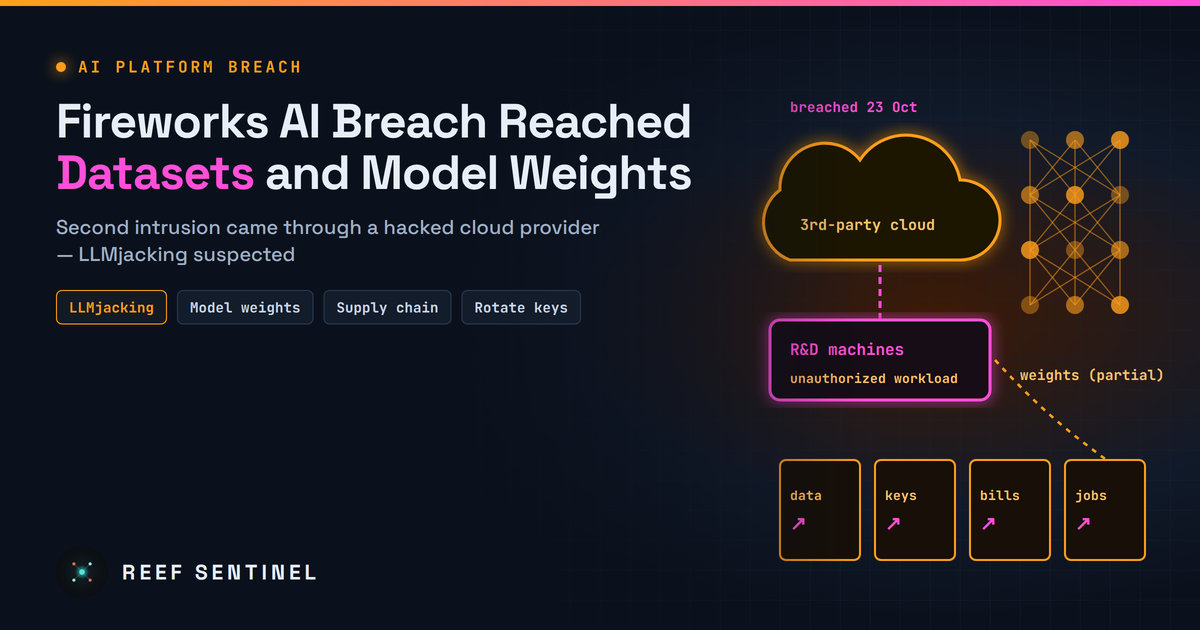
Incident two (late October): on 23 October, a third-party cloud provider that hosted Fireworks' research and development machines was itself attacked. On 24 October, the attacker used that foothold to reach Fireworks development machines and run an unauthorized workload there. Fireworks says this caused "additional customer data impact".

What Was Taken

Fireworks lists the following data as accessed or stolen:

The company says it has no confirmed theft of complete production models. It also says payment card numbers were not stored and were not affected. Its Inference, Training SDK and Nexus products, which are zero-data-retention by default, were not affected either.

Fireworks says a "limited number of customer accounts" were affected and that all of them have been notified. It has not published a count.

Customer Fallout

Productivity company Notion said Fireworks notified it of the incident on 2 November and told it on 6 November that its customers' data may have been accessed. Notion had used Fireworks for classification jobs behind its Insights feature and to serve open-weight models. In response it has:

Separately, at least two Fireworks customers say they have moved substantial business elsewhere over concerns about security and communication.

The LLMjacking Connection

Fireworks attributes the activity to LLMjacking: stealing access to AI models and compute, then using or reselling it. Google's threat intelligence and Mandiant teams have described the same trend this year. They say attackers mainly target tokens and credentials, some groups sell initial access to others, and fraudulent model charges in single incidents have exceeded $100,000 in one day.

The Fireworks case shows LLMjacking moving beyond running up bills on stolen keys. Platforms that store fine-tuning datasets and custom weights hold valuable intellectual property. An attacker who gets into training infrastructure can take that too.

Who Is Affected

What To Do Now

If your organisation uses Fireworks, or any hosted fine-tuning or inference provider:

  1. Rotate keys and credentials stored with the platform, including Fireworks API keys and any third-party secrets passed in as environment variables, such as cloud, database or SaaS tokens.
  2. Review access logs for unfamiliar IP addresses, new API keys, unexpected deployments or jobs you did not start.
  3. Audit training and evaluation jobs and datasets for unauthorized reads, copies or changes.
  4. Assess model-weight exposure. If custom fine-tunes were affected, consider what a competitor or attacker could learn from them, and whether training data could be extracted.
  5. Minimise what you upload. Use zero-data-retention modes where available, and avoid putting long-lived production secrets into evaluation or training environments.
  6. Watch AI spend for sudden usage spikes, the classic sign of stolen model access.

Why It Matters

AI platforms are becoming concentrated stores of customer data, credentials and proprietary models, and their supply chains include their own cloud providers. In this case, the attacker reached Fireworks through a breach at a provider it relied on, then pivoted into development machines that held customer material.

For enterprises, the lesson is that AI vendors need the same third-party risk review as any other processor of sensitive data. That review should cover where fine-tuning data and weights live, which sub-processors host them, and how quickly the vendor will say what was taken. Fireworks' disclosure grew over five weeks, from leaked secrets to datasets and model weights, and Unit 42's work is not finished.

COMPUTE NODE · · --:--:--

Fresh cybersecurity news,
daily threat intelligence.

Daily cyber news, live threat intel and exploited CVEs.

Everything in one place

Self-hosted, hardened, and yours.

RUN IT

Local AI console

Chat with a model on your own hardware via Ollama or any OpenAI-compatible server. No cloud, no key.

DEFEND

Cyber threat feed

Automatic daily intel from CISA KEV, NVD & GitHub advisories, a live cyber threat map, and your own notes.

NEWS

News & videos

Articles and updates on pentesting, AI, and cyber — with embedded video, including YouTube. Post your own.

DIRECTORY

Registry

Runtimes, models, MCP servers, agents, and a full security & pentest tooling section.

PUBLISH

Posts

Write, edit, publish, and share articles backed by a real database and your account.

COMMUNITY

Forum

Threads and replies across categories from Models to Hardware to Security.

CODE

Repos

Curated AI and security GitHub repos, plus a shelf for pinning your own.

DOWNLOAD

Skill packs

Agent starters, RAG scaffolds, and defensive security & VAPT report templates.

Registry

Runtimes, models, MCP servers, agent frameworks, and a security & pentest tooling section — all links out to the real projects.

Local AI console

Talk to a model running on your own machine through Ollama or an OpenAI-compatible server — your prompts and the model's replies always go straight from your browser to your local model, never through a Reef server. Attach files for context, and pick up saved chats where you left off.

Type /image a prompt in the box below to generate
Not connected

Local AI hardware benchmark

A spec-based compatibility advisor — tells you which local models your hardware can run well, which will be slow, and which to skip. Connect to Ollama below for a real, measured speed test instead of an estimate.

1. Your hardware

2. Live check against your local model server (optional)

If a local model server is running, this cross-references the table above with what you've actually got loaded — and runs a real, measured speed test instead of an estimate.

AI Database

A browsable catalog of AI models across providers — context windows, pricing, and capabilities.

Loading…

Cyber threat feed

Latest threats pulled automatically every day from CISA's Known-Exploited-Vulnerabilities catalog and NVD — plus threat intel you post yourself.

⇩ Export STIX
Loading threat feed…

Cyber threat map

Attacks happening right now, all over the world.

Connecting…
LIVE · MAURITIUS TIME--:--:--
attack route, country to country attack route into Mauritius attacker reported worldwide
Loading live data…
attackers reported per minute · click to rewindnow

Top attack routesweb

Attackers based inlast hour

Networkslast hour

Click any dot, feed row or table row to see that IP's profile.

Mauritius

Who attacks Mauritius

Loading…

Web attacks malicious requests to Mauritian websites that were blocked
Network DDoS floods meant to knock Mauritian servers offline

    Mauritius · last 24 h

    How Mauritius is attacked

    Network-level attacks (DDoS) aimed at Mauritius, by method. They try to knock servers and networks offline by sheer volume.

    • Loading…

    The ports or services these floods aimed at aren't published.

    Mauritius · last hour

    Attackers located in Mauritius

    0attackers located in Mauritius were reported in the last hour

    This counts attacks coming from Mauritius, not attacks on it: IPs in Mauritius that servers elsewhere reported for attacking them. Usually zero or one; when it rises, it's often a hacked local server or router.

    Worldwide today

    What attackers are knocking on

    Ports most targeted across a worldwide network of sensors .

    Worldwide today

    Most active attackers

    Ranked by how many separate sensors they hit. Click a row for its profile.

    IPCountryNetworkSensors hitReports
    What you're looking at
    Blue routes

    Share of attack traffic from one country to another. Thicker, faster streams carry more. Particles show volume, not one per attack.

    Every 15 min · published 1–2 h behind
    Amber flashes

    An attacking IP that servers around the world reported in the last minute, placed where the IP is. Its targets aren't published, so there's no line.

    Every minute · shown about 1 min behind
    Locations

    IP locations are approximate (city level at best) and show where the machine is hosted, not who controls it.

    Approximate · city level at best

    News

    Articles, guides and updates on pentesting, AI, and cybersecurity — with embedded video. Add your own, including YouTube.

    Loading…

    Posts

    Loading…

    Loading posts…

    Forum

    Questions, answers, and talk about running AI locally.

    Loading forum…

    GitHub repositories

    Curated AI and security repos, plus your own pinned shelf.

    Command board

    One-liners, configs, and advice worth keeping — shared by everyone here.

    ⚠ Commands are shared with all users. Never include credentials, tokens, or internal hostnames. Review anything before you run it.
    Loading commands…

    Skill packs

    Starter files served from the API — AI agent scaffolds plus defensive security & VAPT reporting templates. Click to download.

    Loading skills…

    Threat Library

    Threat actors, malware and tools — their attack techniques, Reef Sentinel coverage and indicators of compromise.

    Loading…

    Threat Intelligence

    Curated threat write-ups, advisories and analysis — with cover media.

    Loading…

    Tutorials

    Step-by-step guides for running local AI, using the console, and tracking threats. Admins can add their own.

    Loading…

    Downloads

    Direct links to the official homepage/download page for well-known cybersecurity, penetration-testing, and local-AI software. Always verify checksums/signatures from the vendor before running anything.

    Loading…

    Terms & Conditions

    Loading…

    Help & FAQ

    Answers to common questions about Reef Sentinel, plus a formatting guide for posts, articles, and comments.


    Formatting guide

    Commands you can type into the body of a post, comment, or reply — no HTML needed. Comments and short replies only support bold, italic, and inline code.

    Contact us

    Questions, feedback, or a security disclosure? Reach us directly, or send a message and we'll get back to you by email.

    Loading…

    Send a message

    VAPT Report Generator

    Build an engagement, add findings with a live CVSS calculator, and generate a branded, print-ready report.

    Recon Toolkit

    Passive OSINT lookups for the recon phase of an engagement, plus offline hash identification and a payload cheatsheet.

    Website Checker

    Reads a website's HTTP response headers to identify its framework and server, shows any known CVEs for the exposed versions with details, and recommends what to do.

    Control panel

    Manage everything shown on the site — news & videos, posts, homepage headlines, and subscribers. Admin only.

    Overview
    Content
    Site
    Account & Security

    Email settings

    SMTP on ports 25/465/587 is blocked outbound by some hosts (e.g. DigitalOcean droplets by default) — Resend and Brevo send over their HTTPS API instead, so they work even then. Only the selected provider is used to send; the others stay saved but idle, so you can switch back any time without losing settings.

    Get a key from resend.com/api-keys. Uses the "From address" below as the sender — it must be on a domain you've verified with Resend.

    Get an API key (not an SMTP key) from app.brevo.com/settings/keys/api. Uses the "From address" below as the sender — it must be a verified sender in your Brevo account.

    "From address" and "Site name/URL" are shared by SMTP, Resend, and Brevo — they control what recipients see, regardless of which provider is active.

    Send a test email

    Sends through whichever provider is currently active above. Save your settings first if you just changed them.