N-able Takes N-central Offline After Researcher Publishes 33 Alleged Zero-Days: 'Able2Shell' Chains Reach RCE and Root, No Hotfix Yet
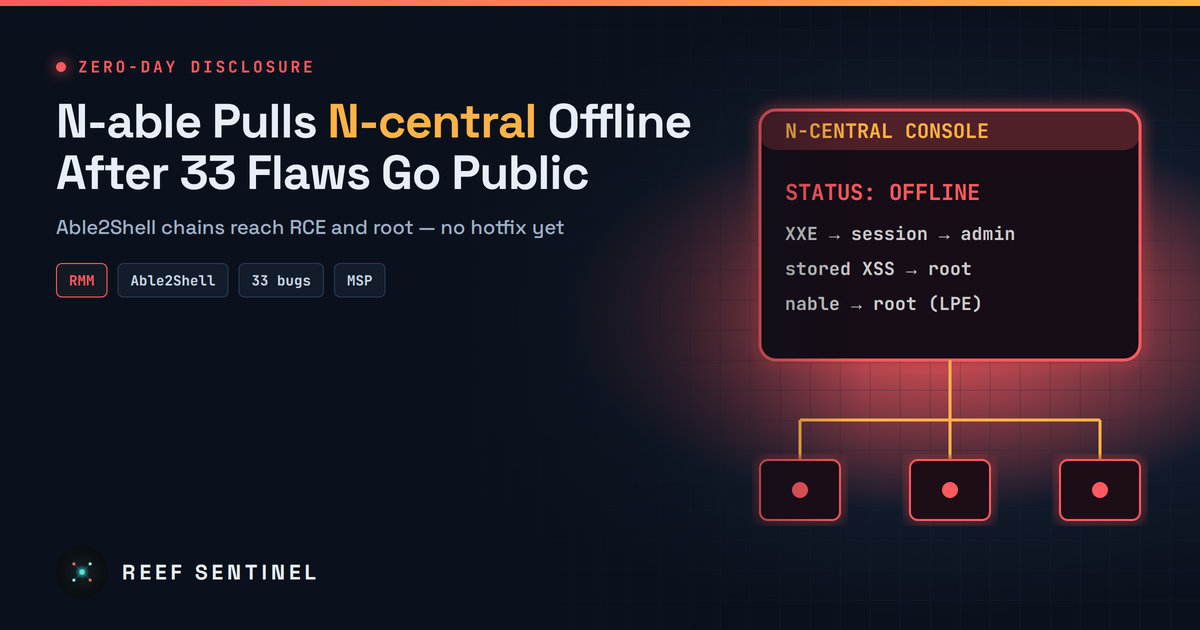
N-able shut down hosted N-central and told on-premises customers to switch off their servers after a researcher published Able2Shell exploit chains for 33 alleged flaws in the RMM platform without prior notice.
N-able has taken its hosted N-central platform offline worldwide and told on-premises customers to switch off their own N-central servers, after a researcher published proof-of-concept exploits for 33 alleged vulnerabilities in the remote monitoring and management (RMM) product without warning the vendor first.
The disclosure, collected in a GitHub repository called Able2Shell, landed late on Sunday 8 November 2026. By Monday N-able had shut down hosted N-central in the Americas, Europe and Asia-Pacific and was working on a hotfix. No CVE identifiers have been assigned yet.
What Happened
Researcher Sean Bales published details of more than 30 flaws in N-central and said the discovery was AI-assisted. The bugs are chained into four exploits: three end in remote code execution and one gives root on the appliance.
Bales said he did not notify N-able before publishing. He told reporters that he had reported two unrelated remote code execution flaws and a privilege escalation in a different N-able product five to six months ago, that follow-up emails over four to six weeks went unanswered, and that those bugs are still unpatched. He said N-able's CEO and CTO later contacted him and asked him to take the repository down and work with the company, and that they did not threaten him.
N-able's statement says: "At this time, we have not observed active exploitation of these vulnerabilities." A later status update said the company was developing and validating a hotfix and had found no evidence of unauthorized data access. Services reached through N-able Login (the Ecoverse platform) were still running.
Technical Details
Bales tested against N-central Appliance 2026.4.0.31, a pre-release build, and believes most or all of the flaws also affect earlier versions. The published issues span:
- authentication bypasses and credential disclosure
- arbitrary file writes and directory traversal
- cross-site scripting (XSS) and XML external entity (XXE) injection
- remote code execution and local privilege escalation
The most serious chain, according to the researcher, starts with an unauthenticated XXE flaw in the service-import feature. It can steal a trusted local session, reset an account password and run commands as the nable user, and the same exploit can create an enabled "Default Administrator" account with credentials chosen by the attacker. Other chains include a stored XSS that runs commands as root when an administrator views malicious patch metadata, and a privilege escalation from nable to root.
Not every claim has been independently verified, but N-able's decision to build a hotfix and take its cloud service offline indicates that at least some of them are real.
Why an RMM Bug Is Different
N-central is used by managed service providers (MSPs) and internal IT teams to push scripts, patches and remote sessions to thousands of endpoints. Whoever controls the console controls every machine it manages, so an RMM flaw becomes a supply-chain problem for every downstream customer.
This is not N-central's first rough year. Security researchers point out that N-able patched CVE-2026-18556, a critical flaw giving unauthenticated full console access, in August, followed by CVE-2026-18577 for an incomplete fix. In September it patched CVE-2026-86218, a pre-auth remote code execution zero-day (CVSS 10.0) that was exploited in the wild, during which attackers "sprayed" remote-access tools into downstream client networks.
Who Is Affected
- Hosted N-central customers: the service is offline until N-able restores it. Expect an outage of your RMM tooling.
- On-premises N-central customers: your server is exposed to public exploit code until a hotfix ships. N-able has asked you to shut it down temporarily.
- MSP clients: any organisation managed through N-central is indirectly exposed if its provider's server was reachable from the internet.
Patch Status
As of 10 November there is no hotfix and no restore date. N-able says it is posting status updates at least every four hours. Researchers note the fixed build may keep the same version number, because N-able does not always change it for live hotfixes, so follow the vendor's confirmation rather than the version string.
What To Do Now
- Take on-premises N-central servers offline and keep them offline until N-able confirms a fix is available and safe to apply.
- Review logins and authentication activity from 8 November onward, looking for unknown sessions, password resets or new administrator accounts (especially an enabled "Default Administrator").
- Audit what the console pushed: newly deployed scripts or tools, unexpected remote-access sessions, new automation policies.
- Check downstream endpoints for remote-access software you did not install. If you find signs of misuse, bring in incident response and assume managed client networks may be affected.
- Plan for the outage: have an alternative way to reach critical systems and patch them while the RMM is down.
- When the hotfix arrives, keep the management interface off the public internet and behind VPN or an allow-list where possible.
Why It Matters
Able2Shell shows two trends colliding. AI-assisted research is making it faster to find large batches of bugs in complex products, and frustrated researchers are increasingly willing to publish without coordination. For RMM vendors, whose consoles are among the most valuable targets on the internet, that leaves almost no time between disclosure and possible exploitation. For now, the safest N-central server is one that is switched off.
