CVE-2026-98276: Linux Kernel Timestamp Race Turns UDP bind() Into a Use-After-Free
Cyber · 2026-11-07 · By H.A

CVE-2026-98276: Linux Kernel Timestamp Race Turns UDP bind() Into a Use-After-Free

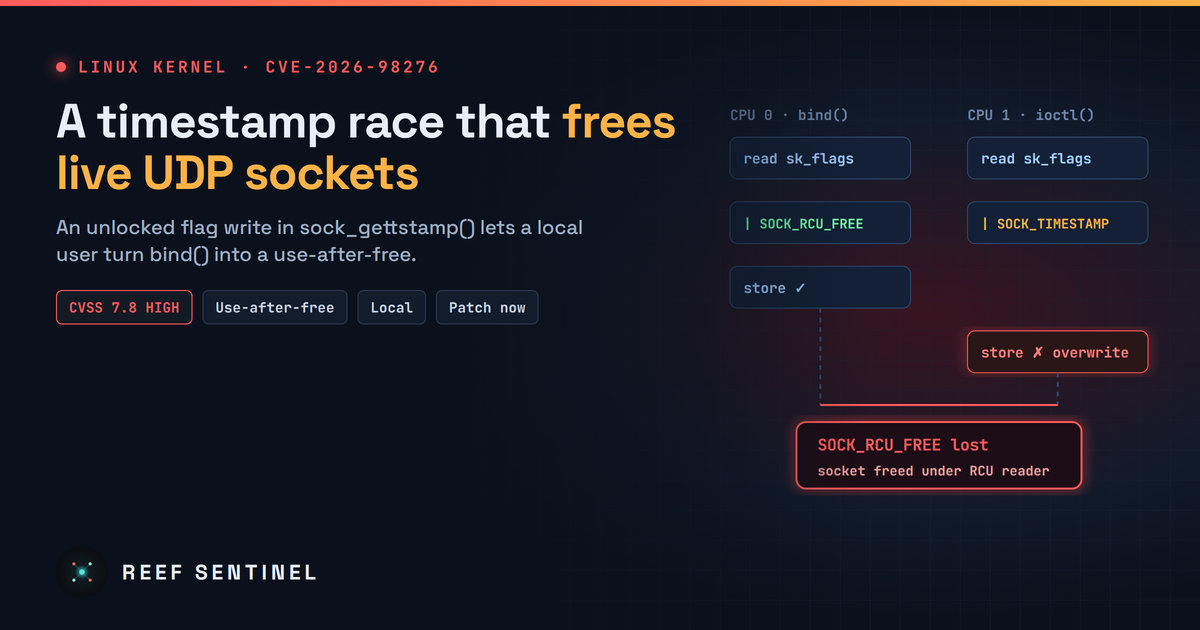
An unlocked flag write in sock_gettstamp() lets a local user strip SOCK_RCU_FREE from a UDP socket and trigger a kernel use-after-free (CVSS 7.8).

A newly assigned Linux kernel vulnerability, CVE-2026-98276, shows how a single unprotected bit flip in the networking stack can turn an ordinary bind() call into a use-after-free. It carries a CVSS 3.1 base score of 7.8 (High). A local, unprivileged user can trigger it by racing two system calls against the same UDP socket.

What Went Wrong

Every kernel socket keeps a word of option bits in sk->sk_flags. The helpers that change those bits, sock_set_flag() and sock_reset_flag(), use non-atomic __set_bit() and __clear_bit() operations. They are only safe while the caller holds the socket lock.

sock_gettstamp() was one of the last places where a syscall changed sk_flags without that lock. When a program asks for a packet timestamp with the SIOCGSTAMPNS_NEW ioctl, the kernel calls sock_enable_timestamp(sk, SOCK_TIMESTAMP) and does a read-modify-write on the flags word while holding no lock at all.

How the Race Becomes a Use-After-Free

Binding a UDP socket goes through udp_lib_get_port(). That function sets SOCK_RCU_FREE before it publishes the socket into the hash table that lockless receive lookups use. The flag tells the kernel to wait for an RCU grace period before freeing the socket, so readers on the receive path that hold a pointer without a reference stay safe.

If the timestamp ioctl runs on a second CPU at the same moment, both threads read the same original flags value. Each sets its own bit and writes the whole word back. When the ioctl's store lands last, it erases SOCK_RCU_FREE. The socket is now visible to lockless receive lookups, but it is marked to be freed immediately. When it is closed, sk_destruct() releases the memory at once while an incoming packet may still be using it.

The researchers who found the flaw showed the result with a KASAN report: a slab use-after-free read in ipv4_pktinfo_prepare(), reached through the normal UDP receive path. Their proof of concept ran as an ordinary user (UID 1000), not as root.

Who Is Exposed

The bug lives in core socket code, not in an optional driver, so it affects mainstream distribution kernels until they ship the fix. The trigger needs nothing special: a UDP socket, bind() and a timestamp ioctl, all available to any local process. Systems that run untrusted local code are most at risk, including shared hosts, CI runners, multi-tenant containers and developer workstations.

The current EPSS estimate is low, and there are no reports of exploitation in the wild. Even so, kernel use-after-free bugs reachable by unprivileged users are classic building blocks for privilege escalation and container escape. Major distributions are tracking the issue, and live-patch vendors have fixes in progress for releases such as Debian 12 and 13.

The Fix

The upstream patch makes sock_gettstamp() take the socket lock before it changes sk_flags. To keep the common path fast, the lock is only taken when SOCK_TIMESTAMP actually needs to be set. Once the timestamp flag is on, later calls do not pay for the lock.

The kernel maintainers also pointed out that sk_set_memalloc() and sk_clear_memalloc() change sk_flags without the socket lock. Their callers include nbd, iscsi_tcp, nvme-tcp, sunrpc and WireGuard. Those paths will get their own audit and a separate patch, so more fixes in this area are likely.

What To Do

Bottom Line

CVE-2026-98276 is a quiet bug with a sharp edge: two threads write back one word of flags and a socket loses its RCU protection. It is not remotely exploitable, but for any machine that runs code from more than one trust level, it belongs on this month's patch list.

COMPUTE NODE · · --:--:--

Fresh cybersecurity news,
daily threat intelligence.

Daily cyber news, live threat intel and exploited CVEs.

Everything in one place

Self-hosted, hardened, and yours.

RUN IT

Local AI console

Chat with a model on your own hardware via Ollama or any OpenAI-compatible server. No cloud, no key.

DEFEND

Cyber threat feed

Automatic daily intel from CISA KEV, NVD & GitHub advisories, a live cyber threat map, and your own notes.

NEWS

News & videos

Articles and updates on pentesting, AI, and cyber — with embedded video, including YouTube. Post your own.

DIRECTORY

Registry

Runtimes, models, MCP servers, agents, and a full security & pentest tooling section.

PUBLISH

Posts

Write, edit, publish, and share articles backed by a real database and your account.

COMMUNITY

Forum

Threads and replies across categories from Models to Hardware to Security.

CODE

Repos

Curated AI and security GitHub repos, plus a shelf for pinning your own.

DOWNLOAD

Skill packs

Agent starters, RAG scaffolds, and defensive security & VAPT report templates.

Registry

Runtimes, models, MCP servers, agent frameworks, and a security & pentest tooling section — all links out to the real projects.

Local AI console

Talk to a model running on your own machine through Ollama or an OpenAI-compatible server — your prompts and the model's replies always go straight from your browser to your local model, never through a Reef server. Attach files for context, and pick up saved chats where you left off.

Type /image a prompt in the box below to generate
Not connected

Local AI hardware benchmark

A spec-based compatibility advisor — tells you which local models your hardware can run well, which will be slow, and which to skip. Connect to Ollama below for a real, measured speed test instead of an estimate.

1. Your hardware

2. Live check against your local model server (optional)

If a local model server is running, this cross-references the table above with what you've actually got loaded — and runs a real, measured speed test instead of an estimate.

AI Database

A browsable catalog of AI models across providers — context windows, pricing, and capabilities.

Loading…

Cyber threat feed

Latest threats pulled automatically every day from CISA's Known-Exploited-Vulnerabilities catalog and NVD — plus threat intel you post yourself.

⇩ Export STIX
Loading threat feed…

Cyber threat map

Attacks happening right now, all over the world.

Connecting…
LIVE · MAURITIUS TIME--:--:--
attack route, country to country attack route into Mauritius attacker reported worldwide
Loading live data…
attackers reported per minute · click to rewindnow

Top attack routesweb

Attackers based inlast hour

Networkslast hour

Click any dot, feed row or table row to see that IP's profile.

Mauritius

Who attacks Mauritius

Loading…

Web attacks malicious requests to Mauritian websites that were blocked
Network DDoS floods meant to knock Mauritian servers offline

    Mauritius · last 24 h

    How Mauritius is attacked

    Network-level attacks (DDoS) aimed at Mauritius, by method. They try to knock servers and networks offline by sheer volume.

    • Loading…

    The ports or services these floods aimed at aren't published.

    Mauritius · last hour

    Attackers located in Mauritius

    0attackers located in Mauritius were reported in the last hour

    This counts attacks coming from Mauritius, not attacks on it: IPs in Mauritius that servers elsewhere reported for attacking them. Usually zero or one; when it rises, it's often a hacked local server or router.

    Worldwide today

    What attackers are knocking on

    Ports most targeted across a worldwide network of sensors .

    Worldwide today

    Most active attackers

    Ranked by how many separate sensors they hit. Click a row for its profile.

    IPCountryNetworkSensors hitReports
    What you're looking at
    Blue routes

    Share of attack traffic from one country to another. Thicker, faster streams carry more. Particles show volume, not one per attack.

    Every 15 min · published 1–2 h behind
    Amber flashes

    An attacking IP that servers around the world reported in the last minute, placed where the IP is. Its targets aren't published, so there's no line.

    Every minute · shown about 1 min behind
    Locations

    IP locations are approximate (city level at best) and show where the machine is hosted, not who controls it.

    Approximate · city level at best

    News

    Articles, guides and updates on pentesting, AI, and cybersecurity — with embedded video. Add your own, including YouTube.

    Loading…

    Posts

    Loading…

    Loading posts…

    Forum

    Questions, answers, and talk about running AI locally.

    Loading forum…

    GitHub repositories

    Curated AI and security repos, plus your own pinned shelf.

    Command board

    One-liners, configs, and advice worth keeping — shared by everyone here.

    ⚠ Commands are shared with all users. Never include credentials, tokens, or internal hostnames. Review anything before you run it.
    Loading commands…

    Skill packs

    Starter files served from the API — AI agent scaffolds plus defensive security & VAPT reporting templates. Click to download.

    Loading skills…

    Threat Library

    Threat actors, malware and tools — their attack techniques, Reef Sentinel coverage and indicators of compromise.

    Loading…

    Threat Intelligence

    Curated threat write-ups, advisories and analysis — with cover media.

    Loading…

    Tutorials

    Step-by-step guides for running local AI, using the console, and tracking threats. Admins can add their own.

    Loading…

    Downloads

    Direct links to the official homepage/download page for well-known cybersecurity, penetration-testing, and local-AI software. Always verify checksums/signatures from the vendor before running anything.

    Loading…

    Terms & Conditions

    Loading…

    Help & FAQ

    Answers to common questions about Reef Sentinel, plus a formatting guide for posts, articles, and comments.


    Formatting guide

    Commands you can type into the body of a post, comment, or reply — no HTML needed. Comments and short replies only support bold, italic, and inline code.

    Contact us

    Questions, feedback, or a security disclosure? Reach us directly, or send a message and we'll get back to you by email.

    Loading…

    Send a message

    VAPT Report Generator

    Build an engagement, add findings with a live CVSS calculator, and generate a branded, print-ready report.

    Recon Toolkit

    Passive OSINT lookups for the recon phase of an engagement, plus offline hash identification and a payload cheatsheet.

    Website Checker

    Reads a website's HTTP response headers to identify its framework and server, shows any known CVEs for the exposed versions with details, and recommends what to do.

    Control panel

    Manage everything shown on the site — news & videos, posts, homepage headlines, and subscribers. Admin only.

    Overview
    Content
    Site
    Account & Security

    Email settings

    SMTP on ports 25/465/587 is blocked outbound by some hosts (e.g. DigitalOcean droplets by default) — Resend and Brevo send over their HTTPS API instead, so they work even then. Only the selected provider is used to send; the others stay saved but idle, so you can switch back any time without losing settings.

    Get a key from resend.com/api-keys. Uses the "From address" below as the sender — it must be on a domain you've verified with Resend.

    Get an API key (not an SMTP key) from app.brevo.com/settings/keys/api. Uses the "From address" below as the sender — it must be a verified sender in your Brevo account.

    "From address" and "Site name/URL" are shared by SMTP, Resend, and Brevo — they control what recipients see, regardless of which provider is active.

    Send a test email

    Sends through whichever provider is currently active above. Save your settings first if you just changed them.