Samsung Data Breach: Affiliate Multicampus Confirms ~70,000 Users Exposed as N0n Gang Leaks Alleged Smart TV Viewing Data
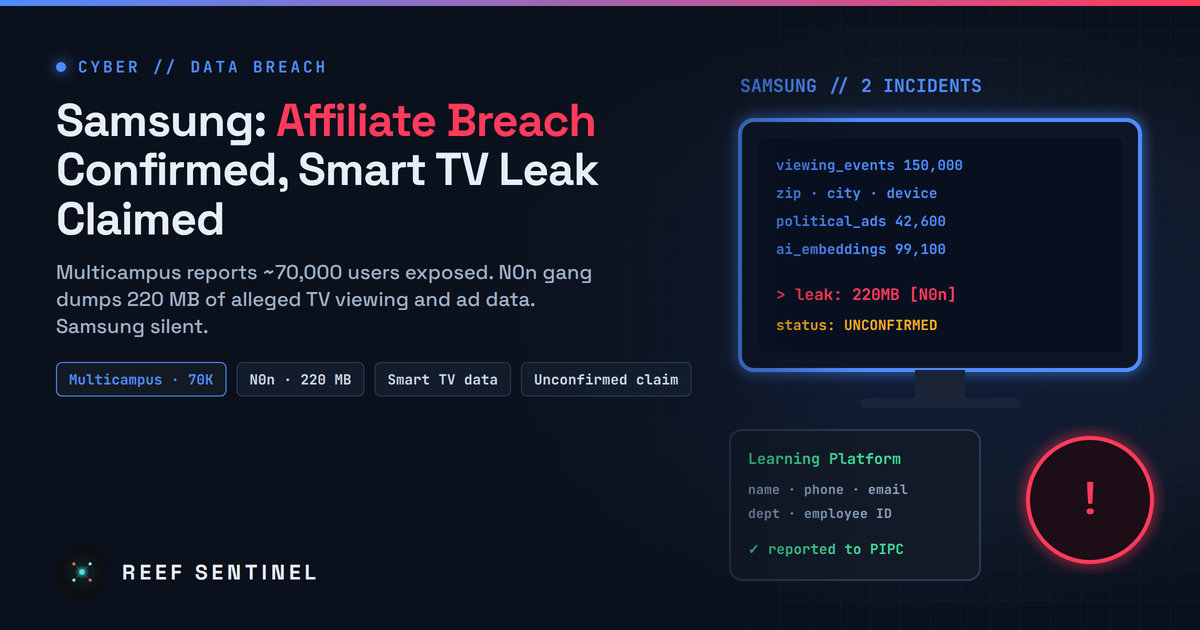
Samsung affiliate Multicampus reported a learning-platform breach to Korea's PIPC, while the N0n ransomware group dumped 220 MB of alleged Samsung smart TV and political-ad data that Samsung has not confirmed.
Two incidents in one month
Samsung is dealing with two separate data incidents this November, and they are not equally certain.
- Confirmed: Multicampus, a Samsung Group affiliate that runs employee training, reported a breach of its online learning platform to South Korea's privacy regulator. Around 70,000 users are believed to be affected.
- Claimed, not confirmed: a ransomware group called N0n has published about 220 MB of data it says it stole from Samsung Electronics, including smart TV viewing data and political advertising records. As of 20 November 2026, Samsung had not confirmed the breach or commented publicly.
Here is what is known about each, and what Samsung users should do.
Multicampus: breach reported to the regulator
Multicampus is Samsung Group's education affiliate. It provides training for companies and also runs the OPIc English speaking test in Korea. Its online platform, called Learning Platform, suffered "unauthorized external access" on 9 November 2026.
The company said it became aware of the breach on 11 November. It reported the incident to the Personal Information Protection Commission (PIPC) around 16:00 Mauritius time (12:00 UTC, 21:00 in Korea) that day and notified its corporate clients. The PIPC is reviewing the report.
Exposed data, according to the report:
- Names
- Phone numbers
- Email addresses
- Department names
- Employee ID numbers
Resident registration numbers (Korea's national ID numbers) were reportedly not exposed, and no financial losses have been reported. The figure of about 70,000 users is an early estimate. Multicampus says the exact scale will be known after its investigation. No attacker has been named.
Because Multicampus trains staff for thousands of client organisations, the stolen details are mostly work contact details. That makes them useful for targeted phishing: a message that knows your name, employer, department and staff number looks far more convincing.
Smart TV data: the N0n leak claim
On 14 November 2026, N0n listed "Samsung Electronics Co., Ltd." as a victim on its dark web leak site. Threat-monitoring services recorded the listing that day. N0n is a relatively new ransomware operation that first appeared in September 2026.
The group then published about 220 MB of files. Researchers who reviewed the dump describe:
- About 150,000 smart TV viewing events from 2024, with timestamps, viewing durations, device details, city locations, US ZIP codes and TV service providers. The programmes watched were reportedly not included.
- About 42,600 political advertising records from September and October 2026, including campaign issues, sponsors, estimated ad spend and broadcast times, plus one political ad video.
- About 99,100 records linked to 2021 AI advertising model training, mostly embedding vectors.
- Two internal documents: a September 2026 data-use agreement containing one Samsung employee's name and email, and an access questionnaire for what is described as Samsung's "Content Data Warehouse", with employee and infrastructure details.
The records mostly relate to US TV audiences. It is not yet clear how many unique households or devices are in the data.
What is still unknown
- Whether Samsung was breached at all. Samsung has not confirmed the claim. The data could come from Samsung's own systems, from an advertising or analytics partner, or be a mix of older material.
- Whether TVs were hacked. Nothing in the leak suggests the televisions themselves were remotely compromised. The data looks like back-end analytics, not something taken from devices.
- Whether consent settings were bypassed. Samsung has said before that its Automatic Content Recognition (ACR) viewing-data feature is opt-in and can be turned off. The leak does not show that those controls were bypassed. It does show how much viewing data smart TV advertising systems can hold.
- Any link between the two incidents. There is no sign that the Multicampus breach and the N0n claim are connected.
What you should do
If you use Multicampus or took training through your employer on its platform:
- Expect phishing emails, texts and calls that use your name, company and department. Be careful with any message about "course certificates", "training renewals" or "account verification".
- Change your Learning Platform password, and change it anywhere else you reused it.
- Report suspicious messages to your IT or security team.
If you own a Samsung smart TV:
- Review the privacy settings. On recent models, look under Settings › General & Privacy › Terms & Privacy (menu names vary by model and year) and turn off Viewing Information Services and Interest-Based Advertisements if you do not want viewing data collected.
- Reset the TV's advertising ID if your model offers it.
- Keep the TV's software updated.
For security teams:
- Treat leaked work contact details as phishing material. Warn staff who used affected training platforms, and watch for spear-phishing that mentions your company's training programmes.
- Review what customer and device data your own advertising and analytics partners hold, and who can reach it.
We will update this story if Samsung comments on the N0n claim or the PIPC publishes its findings.
Sources
- Samsung Affiliate Multicampus Reports Data Breach Affecting 70,000 (Seoul Economic Daily)
- Samsung Electronics Co., Ltd. — claimed by N0n (Ransomware.live)
- Hackers leak 150,000 Samsung smart TV viewing records and political advertising data (InfoSec Today)
- N0n Ransomware Strikes Samsung Electronics (DeXpose)
