Apache Roller CVE-2026-129448 (CVSS 9.8) Exploited: Unauthenticated XML-RPC Deserialization Gives Remote Code Execution on Every Release From 4.0.0, Not Just 6.1.5 — Upgrade to 6.1.7
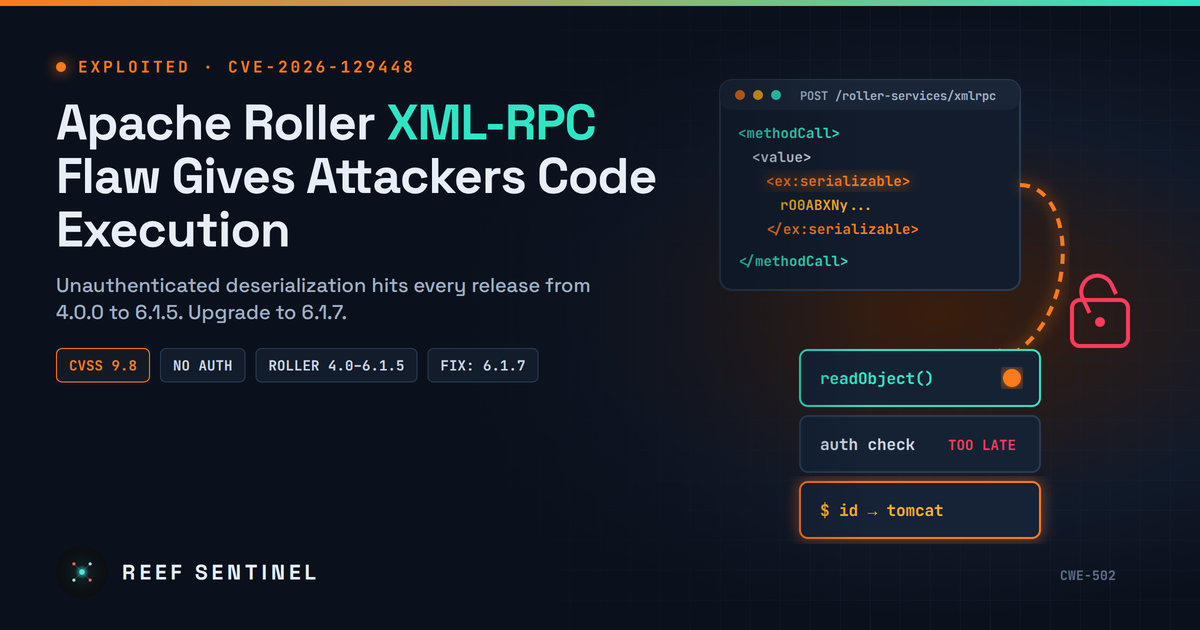
The ASF confirms attackers are exploiting CVE-2026-129448, an unauthenticated XML-RPC deserialization flaw that the September advisory under-reported, which lets anyone run code on Apache Roller 4.0.0 through 6.1.5 even when XML-RPC is switched off.
The Apache Software Foundation has confirmed that attackers are exploiting a critical flaw in Apache Roller, the Java blogging platform. Anyone on the internet can use it to run code on the server without logging in. The bug, CVE-2026-129448 (CVSS 9.8), is not new. It is the same XML-RPC deserialization bug the project fixed in September as CVE-2026-82384. That first advisory listed only Roller 6.1.5 as affected, so admins running older 4.x, 5.x and 6.0.x installs may have assumed they were safe. They were not, and attackers are now going after them.
What Happened
The ASF published the new advisory at 15:02 Mauritius time (11:02 UTC) on 17 November 2026. It says Roller versions 4.0.0 through 6.1.4 can be hit by an unauthenticated remote code execution attack. It also states plainly: "This issue is being actively exploited."
The new record corrects the earlier one. CVE-2026-82384 was published at 00:12 Mauritius time on 26 September (20:12 UTC on 25 September). It described the same root cause but named only Roller 6.1.5. In practice, every Roller release from 4.0.0 onward accepted the dangerous input. The September record left out roughly a decade of releases.
The vulnerability was found by a researcher credited as n0mi1k. Matt Raible is credited as the reporter of the new record. The ASF has not said who is behind the attacks, what they install, or how many servers have been hit.
Technical Details
Roller exposes an XML-RPC endpoint at /roller-services/xmlrpc. It serves the old Blogger and MetaWeblog publishing APIs that desktop blogging clients used. The servlet behind it is built on the Apache XML-RPC library, which supports optional "vendor extension" data types. One of these lets a request carry a serialized Java object. If extensions are enabled, the library turns those bytes back into a live Java object while it is still parsing the request.
According to the advisory, two design choices combined to make this exploitable:
- Extensions were switched on. Roller's servlet configuration enabled the library's vendor extension types, even though Roller only uses standard XML-RPC values.
- Parsing happened before authentication. The request body was deserialized before Roller checked the caller's credentials. Because the servlet was mapped unconditionally, this happened even when an admin had turned XML-RPC off in Roller's settings.
The result is classic Java deserialization (CWE-502). An attacker sends one crafted POST request carrying a serialized object chain ("gadget chain") built from classes on Roller's classpath. Deserializing it runs code as the account that runs the servlet container, usually Tomcat. No account, no user interaction and no special configuration are needed. The CVSS vector is AV:N/AC:L/PR:N/UI:N.
The fix, merged in pull request 171 on 6 September (20:43 UTC on 5 September), does two things. It disables the vendor extension types, and it closes the endpoint when the webservices.enableXmlRpc setting is off, instead of relying on checks inside each handler.
Public Exploit Code
A public GitHub repository describing a proof of concept, scanner, exploit and test lab for CVE-2026-129448 appeared at 01:58 Mauritius time on 19 November (21:58 UTC on 18 November). Reef Sentinel has not tested it. Public tooling usually lowers the bar for opportunistic mass scanning, so any internet-facing Roller instance should be treated as a likely target from now on.
Who Is Affected
- Apache Roller 4.0.0 through 6.1.5, regardless of whether XML-RPC is "disabled" in the admin UI.
- Typically long-running blogs and intranet "news" sites at universities, government departments and enterprises that adopted Roller years ago and never moved off it. These are exactly the installs most likely to be stuck on old 5.x or 6.0.x builds.
- Products or internal portals that bundle Roller as a component. Check your software inventory for
rollerWAR files androller-servicespaths.
As of the CISA catalogue update at 23:17 Mauritius time on 18 November (19:17 UTC), the flaw was not listed in CISA's Known Exploited Vulnerabilities catalogue. CISA's enrichment data on the CVE record still marked exploitation as "none". The confirmation of attacks comes from the vendor, the ASF, not from US authorities.
Patch Status
Roller 6.1.6 (released 24 September 2026) is the minimum version that fixes this bug. Don't stop there, though. Roller 6.1.7, released on 11 November 2026, fixes 15 more CVEs. They include CVE-2026-123374, a separate deserialization flaw in update-ping responses, and CVE-2026-105153, an XML external entity bug in AtomPub parsing. Version 6.1.6 itself fixed 18 issues, including XXE, SSRF, CSRF bypass and a Velocity sandbox escape. Upgrade to 6.1.7. Release candidates for 6.1.8 and 7.0.0 are visible in the project's repository but have not been announced as releases.
What To Do Now
- Upgrade to Roller 6.1.7 from the official Apache download page. Check the release signatures.
- If you can't upgrade today, edit
WEB-INF/web.xmland set the XML-RPC servlet'senabledForExtensionsinit-param tofalse. Or remove the/roller-services/xmlrpcservlet mapping completely. Then restart Roller. The ASF warns that turning XML-RPC off in the admin UI is not enough on vulnerable versions. - Block the path at the edge. Few people still post through XML-RPC clients, so deny
/roller-services/xmlrpcat your reverse proxy or WAF unless you know you need it. - Look for signs of compromise, especially on servers that were exposed before you patched:
# Check whether extensions are enabled in the deployed Roller config
grep -n -A2 "enabledForExtensions" /path/to/tomcat/webapps/roller/WEB-INF/web.xml

# POST requests to the XML-RPC endpoint (most installs see almost none)
grep -E '"POST [^"]*/roller-services/xmlrpc' /var/log/nginx/access.log* /path/to/tomcat/logs/localhost_access_log* 2>/dev/null

# New or modified JSP/class files in the webapp since the advisory window
find /path/to/tomcat/webapps -type f \( -name '*.jsp' -o -name '*.class' -o -name '*.jar' \) -newermt '2026-09-01' -ls

# Unexpected child processes of the servlet container
ps -ef --forest | grep -A3 '[c]atalina'- If you find unexplained POSTs to the endpoint, new JSP files, or shell processes spawned by Tomcat, treat the host as compromised. Isolate it, rotate the database credentials stored in
roller-custom.properties, rotate any secrets the service account could read, and rebuild from a known-good image rather than cleaning in place.
Why It Matters
This case shows a quiet risk in vulnerability management: an advisory with an incomplete affected-version list. Many organisations triage by comparing their installed version with the CVE record. A September notice that named only 6.1.5 told anyone on 5.2 or 6.0 that they had nothing to do. It took about seven weeks, and attacks in the wild, before the record was widened to cover a decade of releases.
It is also another reminder that Java deserialization keeps coming back. Old protocol endpoints that nobody uses, like XML-RPC on a blog engine, often stay mapped, reachable and processing input long after the feature is "off". If a service doesn't need an endpoint, remove it at the servlet mapping and at the proxy, not just with a checkbox.
