Over 1 Million Credit and Debit Cards Stolen From Hacked Shop Tills in 20+ Countries Through a Two-Year-Old Windows Bug
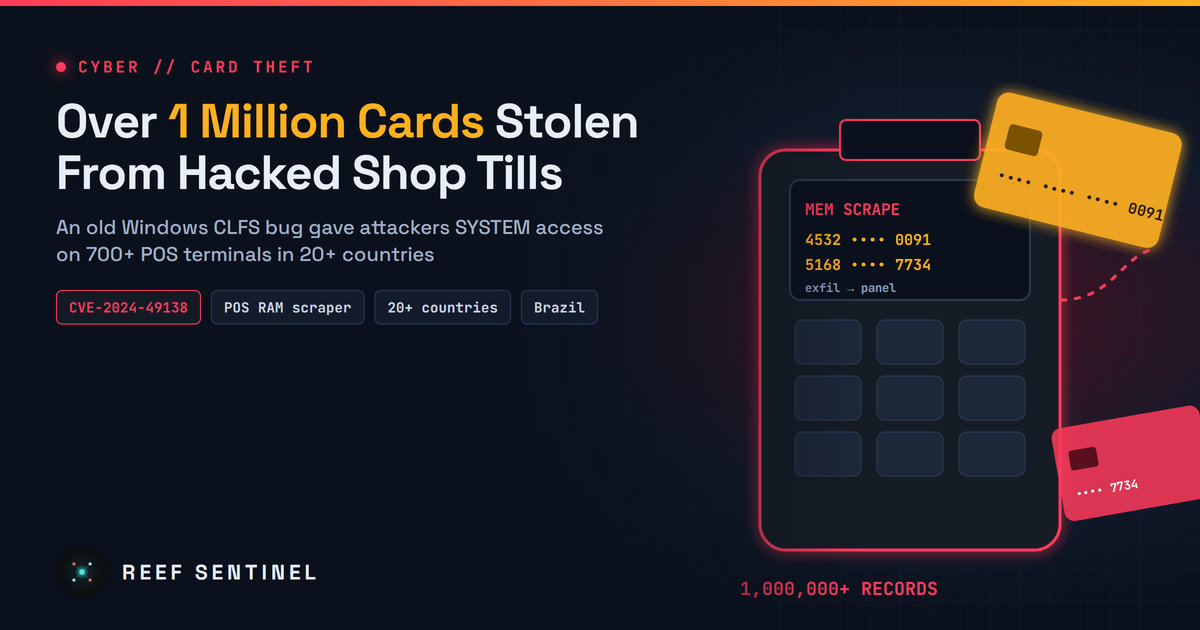
An exposed attacker server reveals 700+ point-of-sale terminals infected via the patched Windows CLFS flaw CVE-2024-49138, with a RAM-scraping RAT feeding over a million card records into a carding panel; Brazil hit hardest.
Researchers have found an exposed attacker server that held more than one million unique credit and debit card records. The cards were stolen from point-of-sale (POS) terminals in shops and businesses in more than 20 countries. The attacker got onto the tills through a Windows flaw that Microsoft fixed almost two years ago.
What Was Found
The server was left open on the internet. It held the whole operation in one place:
- malware source code and the exploitation tools used to break into the terminals
- the attack infrastructure that controlled the infected machines
- a carding panel called "Viny Junior Trilhas", where the stolen cards were stored and could be browsed
- technical records for 782 compromised systems, more than 700 of them confirmed POS terminals, each listed with its Windows version, city and country
The researchers say the dataset was probably still growing. The infected terminals were in daily use, so every card swiped or tapped on them could be captured.
How the Attack Worked
The attacker used CVE-2024-49138, a privilege-escalation bug in the Windows Common Log File System driver (clfs.sys). Someone who already has a low-privilege foothold on a Windows machine can use it to gain full SYSTEM control. Microsoft patched it in the December 2024 Patch Tuesday updates. On 10 December 2024, the US Cybersecurity and Infrastructure Security Agency (CISA) added it to its Known Exploited Vulnerabilities catalogue, because it was already being used in real attacks.
The attacker did not write a new exploit. The recovered files show they adapted a public proof-of-concept that appeared on GitHub within weeks of the patch. With SYSTEM access, they installed a remote access trojan (RAT). It read card data from the terminal's memory while each payment was being processed. This "RAM scraping" method is the same one behind the big retail breaches of the 2010s.
The reports do not say how the attacker first got onto the terminals. Stolen remote-support logins, a compromised POS integrator or physical access are all possible. The RAT family, the POS software and the vendors involved have not been named.
What Was Stolen
The carding panel stored the following for each card:
- the full card number (PAN) and its expiry date
- the BIN, issuing bank and issuing country
- the card brand and type (credit or debit)
- the date the card was captured
CVV2 security codes are not listed. That makes the data most useful for cloning physical cards, and for fraud at merchants that do not check the CVV. It is less useful for ordinary online shopping fraud.
Who Was Hit
Brazil was hit hardest. Most of the infected terminals were there, and most of the stolen cards were issued by Brazilian banks. Language in the attacker's own reports and documents suggests the operator is Brazilian, but that has not been confirmed. No group or alias has been linked to the campaign.
The researchers found that the server had gone offline on 31 August 2026. They reported their findings to Brazil's national CERT (CTIR Gov) on 8 September 2026. It is not yet public what action followed, or whether affected banks have reissued cards.
Why Old Bugs Still Work on Tills
Tills and other POS systems are some of the hardest machines to patch:
- updates mean downtime at the checkout, so they keep getting pushed back
- many terminals run locked-down Windows builds that need re-certification with the payment processor before an OS update can go live
- small merchants often depend on an integrator who rarely visits
- terminals are left running for years, long after their software was last updated
Here, the terminals had gone at least a year and nine months without the CLFS fix.
What Businesses Should Do
- Patch POS systems. Install the December 2024 cumulative update (or anything newer) on every Windows-based terminal and back-office server, and check the build number to confirm it is installed.
- Lock down remote access. Remove remote-support tools you don't need, require MFA for integrators and vendors, and allow logins only from known IP addresses.
- Use point-to-point encryption (P2PE). If card data is encrypted inside the card reader, a RAT that scrapes the till's memory only sees unreadable data.
- Watch the terminals. Run EDR on POS endpoints, and alert on new services, unexpected outbound connections and processes reading the memory of the payment application.
- Separate the POS network. Keep tills on their own network segment with outbound traffic limited to the payment processor.
What Cardholders Should Do
- Check your bank and card statements for transactions you don't recognise, especially small "test" charges.
- Turn on transaction alerts in your banking app.
- If anything looks wrong, call your bank right away and ask for a replacement card.
- Use contactless or mobile wallet payments where you can. They use one-time tokens instead of your real card number.
