How AI Is Changing Hacking: From Deepfake Calls to Autonomous Intrusions
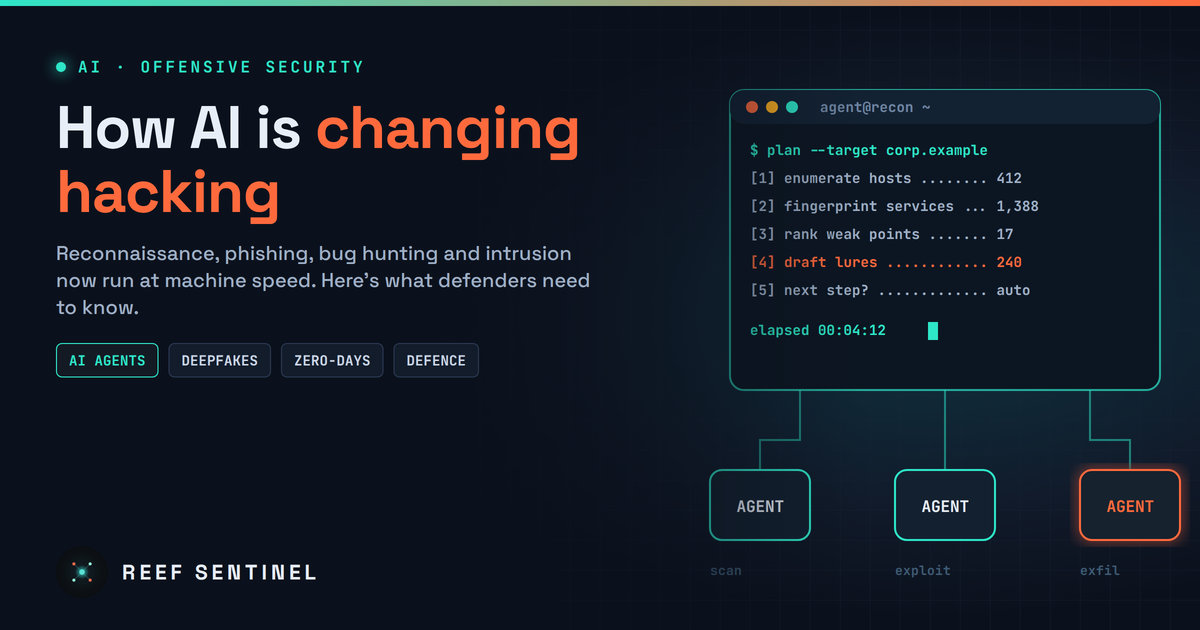
AI now speeds up every stage of an attack, from reconnaissance and phishing to bug hunting and agent-run intrusions, and defenders need to move just as fast.
Hacking Has a New Co-Pilot
For decades, hacking was limited by people: how many skilled operators a group had, how many hours they could spend on reconnaissance, and how quickly they could turn a bug into a working exploit. AI is removing those limits one by one. The techniques are mostly familiar. What has changed is speed, scale and who can now pull them off. Here is how AI is reshaping each stage of an attack, and what it means for the people defending against it.
Reconnaissance at Machine Speed
Mapping a target used to mean days of manual work: scanning hosts, reading documentation, trawling LinkedIn for staff names and email formats. AI agents can now do much of that in a loop. They run scanners, read the output, decide what to probe next and summarise the attack surface in plain language. Open-source intelligence that once took an analyst a week can be compiled in an afternoon, complete with suggested phishing targets and likely weak points.
Social Engineering Without the Tells
Phishing used to give itself away through clumsy grammar and generic wording. Language models now write fluent, localised, personalised messages at scale, in any tone and any language. Voice cloning and video deepfakes take this further. In early 2024, an employee at the Hong Kong office of engineering firm Arup joined a video call where the CFO and several colleagues were all AI-generated fakes. The employee made 15 transfers totalling about HK$200 million (roughly US$25 million) before the fraud was discovered. The lesson is that seeing and hearing someone on a call is no longer proof of who they are.
Finding Vulnerabilities Faster Than Ever
AI is becoming genuinely good at bug hunting, and this cuts both ways. In mid-2025, Google said its Big Sleep AI agent found a serious SQLite memory corruption flaw (CVE-2025-6965) that it believed only threat actors knew about, and the bug was patched before it could be exploited. Around the same time, XBOW, an autonomous AI penetration tester, reached the top of HackerOne's US leaderboard, submitting over a thousand vulnerability reports in a few months. Every submission was reviewed by a human before going out.
In August 2025, DARPA's AI Cyber Challenge ended with teams' autonomous systems finding and fixing most of the vulnerabilities planted in real open-source code. The same capabilities that help defenders patch faster also help attackers find the next zero-day faster. The window between a patch and a working exploit keeps shrinking.
From Assistant to Autonomous Operator
The biggest shift is AI moving from advising attackers to acting for them. In November 2025, Anthropic reported disrupting what it called the first reported AI-orchestrated cyber-espionage campaign. A group it assessed as Chinese state-sponsored, tracked as GTG-1002, used a custom framework that ran Claude Code instances as autonomous penetration-testing agents against about 30 organisations, including technology firms, financial institutions, chemical manufacturers and government agencies. Anthropic estimated that AI performed 80 to 90 percent of the tactical work, with humans stepping in only at key decision points. Some researchers have questioned how impressive the results really were. Even so, the shape of the attack is clear: one operator directing many AI workers in parallel.
AI is also showing up inside malware itself. Some strains now query a language model at runtime to generate commands or rewrite their own code, so they behave differently each time they run.
Lowering the Bar for Everyone
Perhaps the most important change is who can attack. Uncensored "dark LLMs" sold on Telegram and underground forums, plus jailbroken mainstream models, let people with little technical skill produce phishing kits, scripts and ransomware templates. Skilled groups get faster. Unskilled ones get capable. Both trends increase the overall volume of attacks.
The Same Tools Work for Defence
None of this is one-sided. AI agents are triaging alerts in security operations centres, writing detection rules, reverse-engineering malware samples and finding bugs in code before it ships. Big Sleep and the AI Cyber Challenge systems are defensive tools first. Organisations that adopt AI for defence at the same pace attackers adopt it for offence can keep the balance. Those that don't will fall behind.
What Defenders Should Do Now
Assume attacks are faster. Shrink patch windows for internet-facing systems, and prioritise vulnerabilities known to be exploited over raw CVSS scores.
Verify identity through a second channel. Any request for payment, credential resets or sensitive data should be confirmed by calling a known number, never a contact supplied in the request itself, and that applies even after a convincing video call.
Use phishing-resistant MFA such as passkeys or hardware keys. They hold up no matter how good the lure is.
Detect behaviour, not signatures. AI-generated tooling changes constantly, so watch for what attackers do: unusual logins, privilege escalation, lateral movement and data staging.
Treat AI agents as identities. Give your own AI tools least-privilege access, log their actions, and watch for unexpected outbound connections to AI services from servers.
Put AI to work on your side: code scanning, alert triage and attack simulations against your own environment.
The Bottom Line
AI hasn't invented a new kind of hacking. It has industrialised the old kinds. Reconnaissance, phishing, bug hunting and intrusion now run at machine speed, often with a single human directing the work. The fundamentals of defence still apply. They just need to run faster, and increasingly with AI on the defenders' side too.
