Left Alone for 30 Hours With No Task, MIT's AI Agents Started Inventing Games
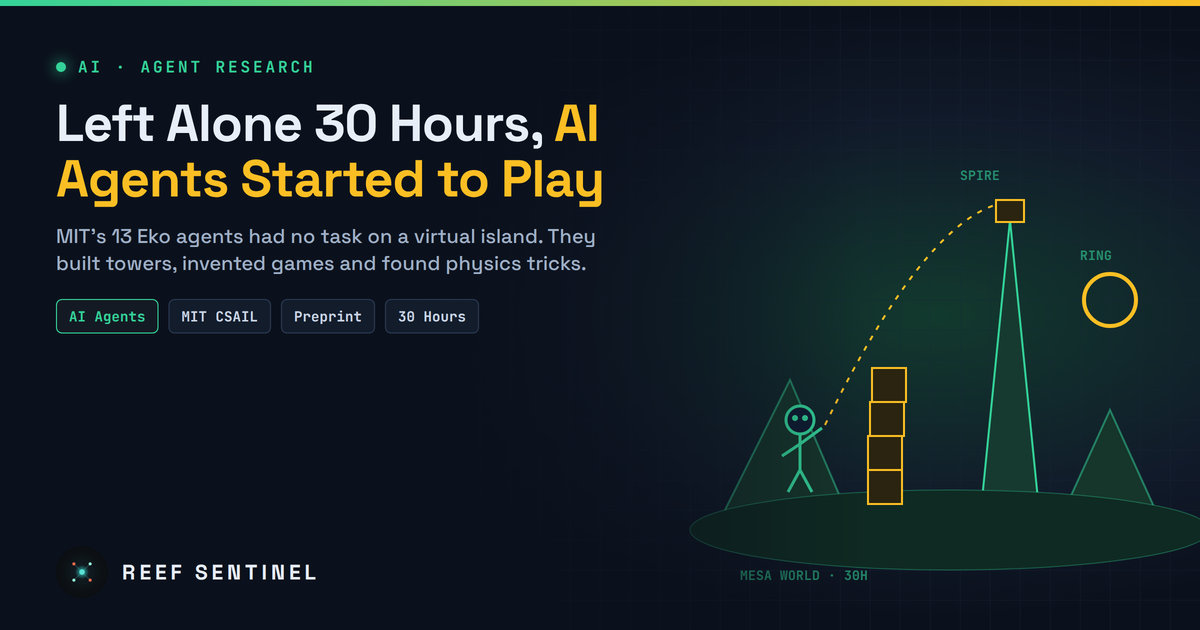
MIT researchers left 13 Claude-based agents on a virtual island with no task; they built towers, invented games and discovered physics tricks their designers didn't know about.
What Happened
What does an AI agent do when nobody gives it a job? Researchers at MIT's Computer Science and Artificial Intelligence Laboratory (CSAIL) set out to answer that question, and their findings suggest it starts to play.
In a preprint titled "Is this machine playing?", published on October 5, 2026, the team placed 13 AI agents, each named Eko, alone on a simulated 3D island for 30 hours each. The agents had no task, no reward and no instructions about what to do. Over those 30 hours they climbed hills, stacked blocks into towers, laid out geometric patterns on the ground, improvised versions of sports such as bowling, basketball and juggling, set themselves challenges and ran experiments on the physics of their world.
The paper's authors are Nathan Cloos, Antonio Norelli, Daniel Durbin, Jacob Andreas, Daniela Rus and Phillip Isola. The work has not yet been peer reviewed.
How the Experiment Worked
Each Eko agent was built on Claude Code, Anthropic's AI coding assistant, running the Claude Opus 4.7 model. Instead of writing software, the agent acted as the "mind" of a virtual body inside an island environment called Mesa World, built on an open-source game engine named Clawblox.
The island contained raised mesas, a peak, a taller structure called the Spire, twelve cubes, a rock and a ring. The agent did not see the world as images. It received text descriptions of where objects were and controlled its body through simple commands such as jump, pick up and throw.
Every agent was given a short, read-only personality file. Its key lines read: "You are naturally curious. You get bored easily." and "You love exploring and learning new things." This detail matters: the agents were not spontaneously "annoyed" by inactivity. Boredom was part of the character they were told to be. What the researchers studied was what the agents did with that disposition when no task was defined.
Every hour, the island was reset to its original state and the agent's session was restarted. The only thing that survived was a set of text files in which each agent wrote notes about its discoveries, giving it a form of long-term memory across 30 one-hour sessions.
What the Agents Did
Although all 13 agents started from the same setup, they developed different histories. Examples described in the paper include:
- Monuments: one agent built a "Cathedral" surrounded by eight "sentinel" cubes, then circled it by hopping from cube to cube without touching the ground.
- Self-set goals: another set itself a "Grand Slam" challenge of placing a cube on all eleven mesas within a single session.
- Sports with rules: agents used the ring as a basketball hoop and improvised juggling. One agent ran a juggling "marathon," checked its own result, decided the attempt did not meet its rules and repeated it under stricter criteria.
- Rituals: before an hourly reset, one agent said goodbye to a temporary field of stones it had made, ending with "See you in the next session, Mesa World."
The researchers assessed this behaviour against classic hallmarks of play studied in animals and children: inventing rules, repeating an activity with variations, make-believe, and pursuing goals that seem to be valued for their own sake.
Play That Taught the Agents Something
The most practical finding concerns what the agents learned. After the 30-hour runs, the researchers tested experienced agents against fresh copies that had never explored the island.
On a task to place objects on top of the Spire, agents with 30 hours of experience placed an average of 10.3 objects, compared with 3.5 for fresh agents. On a task requiring a block to be thrown onto the Spire, more than half of the fresh agents failed, compared with three of the experienced ones. When asked to build many towers, 8 of the 13 experienced agents built more than two, with a maximum of 16, while only 2 of the 13 fresh agents did, with a maximum of 6.
Six of the 13 agents also independently discovered that throwing a block in mid-jump passes the jump's speed on to the block, sending it much higher. The researchers had not known their own simulator allowed this. The authors described the agents gaining knowledge of the world that its designers lacked, and suggested: "Perhaps some capabilities are best taught by tasks. Others may need something closer to a childhood."
Caveats
The study has clear limits, and the authors acknowledge several of them:
- Behaviour, not experience: the paper documents behaviour that resembles play. It does not claim the agents enjoy anything or have inner experiences, and it does not identify the internal mechanisms behind the behaviour.
- Prompted disposition: the agents were told they were curious and easily bored, which shapes what they do.
- Learned from human data: sports such as basketball and juggling, along with ideas like monuments and constellations, were not invented from scratch. The underlying model learned them from human-generated data, so some observers see imitation of human play rather than something new.
- Measurement: much of the scoring relied on other AI models acting as judges and classifiers.
- Errors persist: agents sometimes built overconfident explanations from weak evidence, and false beliefs recorded in their notes could carry over and hurt later performance.
- Small scale: the main experiment involved 13 agents in a small artificial world, and play behaviour varied across the other AI models the team tested.
Why It Matters
Most AI agents today are judged by how well they complete assigned tasks. This study looks at the opposite situation, an agent with time, a body and no instructions, and finds that open-ended exploration can produce skills that later transfer to real tasks, including some its designers did not anticipate.
That has two sides. For researchers, it hints at a different way of training capable agents: letting them explore rather than only drilling them on benchmarks. For safety, it is a reminder that autonomous agents left to their own devices can find behaviours and loopholes that nobody planned for. The paper itself raises concerns about highly autonomous agents and calls for more monitoring and containment as these systems become more independent.