eMudhra Revokes 16 Intermediate CAs and Quits Public TLS After a Botched HSM Migration Left Eight CA Private Keys Below 256 — One Was Literally the Number 4
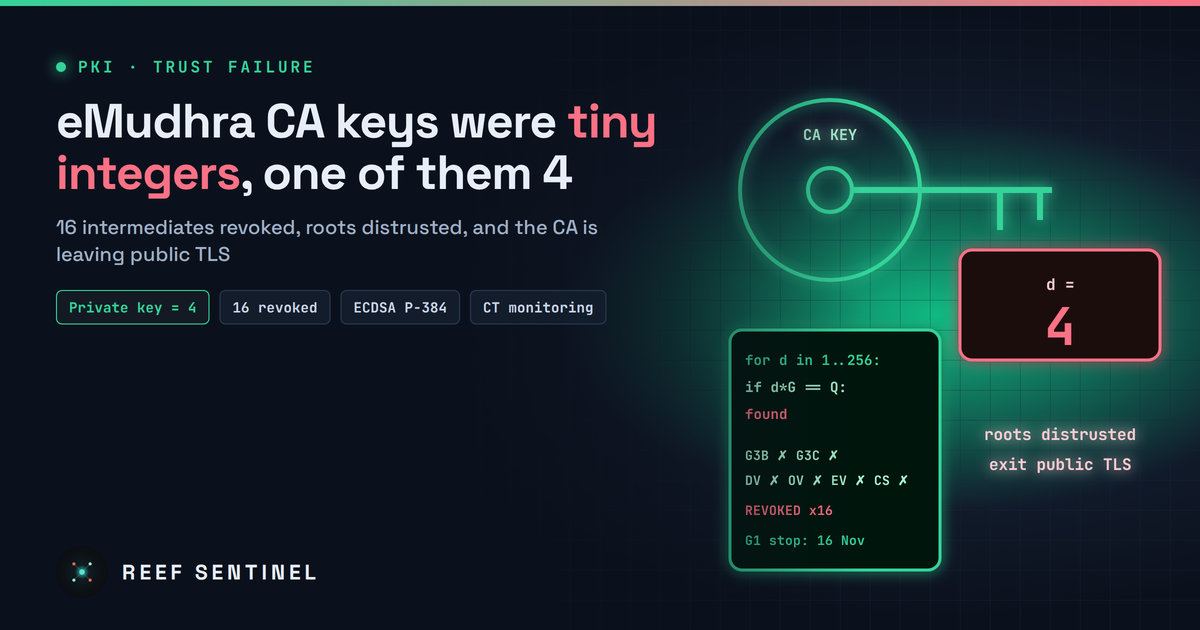
A buggy key-migration script shrank eight ECDSA intermediate keys to a single byte, forcing browser distrust, 16 revocations and a G1 issuance stop on 16 November, though eMudhra reports no evidence of misuse.
Overview
Indian certificate authority eMudhra has now revoked 16 intermediate CA certificates and will leave the publicly trusted TLS certificate business. The trigger was the discovery that eight of its ECDSA P-384 intermediate private keys were tiny integers below 256. That made them recoverable by trying just 256 values. One of them, belonging to the "EM OV TLS CA - G3C" intermediate, was the number 4.
Anyone who recovered these keys could have issued TLS certificates for any website, or code-signing certificates, that browsers and operating systems would trust. eMudhra says most of the affected intermediates were never used in production, and it has found no evidence the keys were abused. But the weak keys existed from April 2025 until October 2026, so the window for silent misuse was long.
The Vulnerability
In April 2025, hardware delays forced eMudhra to move CA private keys between hardware security modules (HSMs) from different vendors. It used a custom Python script during the key ceremony. eMudhra's investigation found the script had two problems:
- Eight ECDSA keys were reduced to a single byte, so their private values were trivially guessable from the public key
- Eight RSA keys were handled in host memory instead of staying inside the HSM. They were not weakened, but eMudhra could not show that they met its certificate policy, so they were revoked too
eMudhra never checked the strength of the generated keys, or that the keys used to create certificate signing requests matched the ones created in the HSM. There was an early warning: in mid-2025, certificate revocation lists for some intermediates were signed with keys that did not match the CA certificates. eMudhra fixed that symptom without finding the cause.
Affected ECDSA intermediates, revoked for CA compromise: EM DV TLS CA - G3B and G3C, EM EV TLS CA - G3B and G3C, EM OV TLS CA - G3B and G3C, and the code-signing EM OV CS CA - G3B and G3C. Sectigo also revoked its cross-signatures for the same CAs.
Timeline
All times are Mauritius time (UTC+4), with UTC in brackets.
- 30 April 2025: Key ceremony creates the flawed keys
- May–June 2025: Mismatched CRL signatures are seen and corrected without root-cause analysis
- 17 October 2026, 22:05 (18:05 UTC): A security researcher reports the recoverable keys to Apple, Google Chrome, Microsoft, Mozilla and eMudhra
- 18 October 2026, 01:48 (17 October, 21:48 UTC): Mozilla independently recovers the keys
- 18 October 2026, 02:59 (17 October, 22:59 UTC): Firefox distrusts the intermediates through OneCRL
- 18 October 2026, 13:24–13:38 (09:24–09:38 UTC): eMudhra revokes the eight ECDSA intermediates
- 19 October 2026: Sectigo revokes the cross-signed intermediates
- 21 October 2026: eMudhra stops issuing from everything under the emSign ECC Root CA - G3. Mozilla later removes that root in an emergency, and Chrome moves to match
- 26 October 2026: Microsoft ships out-of-band Windows updates to remove trust in the affected chains on systems that don't receive automatic trust updates
- 7 November 2026: eMudhra revokes eight RSA intermediates. Some had issued TLS and code-signing certificates since May 2026, the last on 3 November
- 16 November 2026: eMudhra's deadline to stop issuing certificates under its remaining G1 hierarchy
- 4 December 2026: An independent external review is due to report its findings
Tradecraft
This is not an attack campaign. It is a trust-infrastructure failure that an attacker could have exploited quietly. Abuse would have looked like this:
- Recover an intermediate key offline from public certificate data, with no access to eMudhra needed
- Issue certificates for chosen domains and use them for interception, or sign malware with an eMudhra code-signing chain
- Clients would have accepted such certificates without warning until the October distrust actions
Detection
- Check whether any of your sites, appliances or signed binaries chain to the G3 intermediates listed above or to emSign ECC Root CA - G3. If so, they will already be failing validation in up-to-date clients.
- Search Certificate Transparency logs for certificates issued for your domains by eMudhra intermediates you never used.
- On Windows systems without automatic root updates, confirm the October out-of-band trust update is installed.
# Show the issuer chain presented by a server
openssl s_client -connect example.com:443 -servername example.com -showcerts </dev/null 2>/dev/null | grep -E "s:|i:"
# Check a local certificate file
openssl x509 -in cert.pem -noout -issuer -subject -dates
# Windows: look for emSign/eMudhra certificates in the machine stores
Get-ChildItem Cert:\LocalMachine -Recurse | Where-Object { $_.Issuer -match "emSign|eMudhra|EM (DV|OV|EV)" } | Select Subject, Issuer, NotAfter, ThumbprintRecommended Actions
- eMudhra TLS customers should finish migration now. eMudhra says about 30,000 certificates need moving, mostly through ACME. Its exit from public TLS means you will need a new CA for renewals.
- Re-sign software that was signed under the revoked code-signing intermediates, and tell your users. Old signatures may now fail.
- Keep browsers, operating systems and trust stores updated. Make sure managed or offline fleets receive root-store and CRL updates.
- Monitor Certificate Transparency for your domains as a standing control.
- CA operators and anyone running internal PKI: verify key strength and public/private key correspondence after every ceremony or HSM migration, and investigate signature mismatches to root cause.
Analyst Assessment
There is no evidence of exploitation. But a publicly trusted CA key equal to 4 is one of the most serious trust failures in years. The browser root programmes responded within hours of the report, which limited exposure. The eighteen months the weak keys existed beforehand is the uncomfortable part.
eMudhra's exit from public TLS is the likely outcome, and root-store operators will probably tighten requirements on key-ceremony verification. For most organisations the practical risk is now operational: migrating certificates and re-signing code before the 16 November and later deadlines catch them out.
