Optimizely Web Hijacked to Serve Malware on 178 Brands' Sites: Injected Project JavaScript Swapped Crypto Wallets, Skimmed Cards and Sent iPhones to Coruna and DarkSword
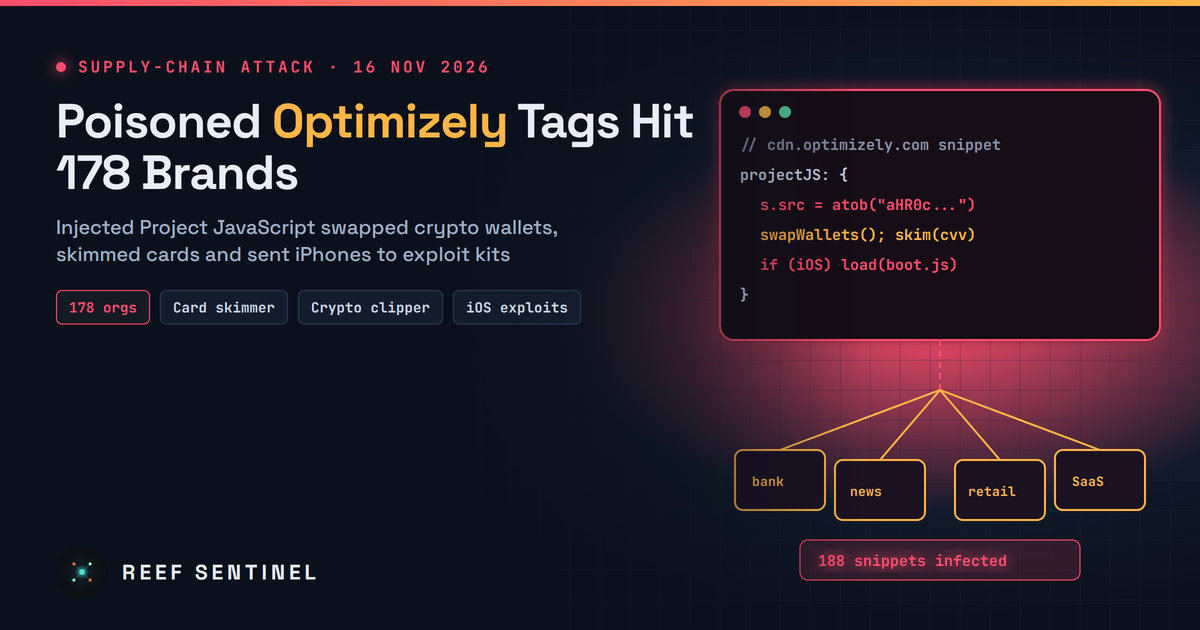
An attacker abused a flaw in Optimizely Web Experimentation to plant a crypto clipper, card skimmer and iOS exploit router in 188 customer snippets, reaching visitors of Zoom, BBC, CNN, HSBC, Equifax and 173 other organisations on 16 November.
Overview
On 16 November 2026, malicious JavaScript was served to visitors of at least 178 organisations through Optimizely Web Experimentation, the A/B testing platform that many large brands load on every page. The attacker did not compromise the websites themselves. Instead, they wrote a loader into the Project JavaScript field of customer Optimizely projects. The rest of each snippet was left untouched, so the code still came from Optimizely's own CDN, with Optimizely's domain and certificate, and every site that trusted that script ran it.
Researchers who swept the platform during the attack checked 1,611 Optimizely snippets and found 188 infected snippets belonging to 178 organisations. Named victims include Zoom, BBC, CNN, Salesforce, GitLab, IKEA, HSBC, Equifax, Air France-KLM, Ledger and Peacock, and Optimizely's own sites, including its login page. Banking and finance was the most affected sector (32 organisations), followed by technology and SaaS (23) and retail (20). The researchers say the real number is probably higher, because they could only check snippets they found in time.
The payload did three things: it swapped cryptocurrency wallet addresses, skimmed payment cards typed into on-page forms, and sent iPhone visitors to known iOS exploit kits. Optimizely says an unauthorised party "exploited a vulnerability in Experimentation" to add the code. The company says it has fixed the flaw and removed the injected code, but has not said publicly what the vulnerability was.
The Campaign
The injected loader came in three variants:
- A plain
<script>tag pointing to1688360[.]cc/track.js(most snippets) - The same URL hidden in base64 and decoded with
atob() - A full inline copy of the payload, run through
eval, used when the attacker's domain is blocked
Sites that self-host or proxy their Optimizely snippet were affected too, because the content still came from the same compromised project configuration. Researchers ruled out CDN cache poisoning. They could not work out how one attacker got write access to many unrelated customer projects, and that points to a flaw in the platform itself rather than stolen credentials for each customer.
The track.js payload was rebuilt 26 times during the day. Each build added features and wallets, and none were removed. Its capabilities:
- Crypto address swapping (clipper): finds Bitcoin, Ethereum/EVM, TRON, Solana, TON, Litecoin, Bitcoin Cash and Dogecoin addresses in page text, form fields, the clipboard, outgoing requests and the iOS share sheet, and replaces them with attacker addresses.
- Card skimming: watches form submissions for card number, expiry date and CVV and POSTs them to
1688360[.]cc/card.php. Cards entered in hosted payment iframes (for example Stripe or Adyen fields) were out of reach. Cards typed into a site's own form fields were not. - Session and page theft: sends the page URL, any cookies readable by JavaScript (non-HttpOnly), the swapped addresses and an html2canvas screenshot to
1688360[.]cc/hit.php. - iOS exploitation: loads a router script (
boot.js) from.icudomains that picks an exploit chain by iOS version. It uses Coruna for iOS 13–17 and DarkSword for iOS 18. For iOS 26 it only fingerprints the device for now. On iOS 18.6 and earlier the page reloads every 60 seconds to retry. The kit's own comments say iOS 18.7.3+ and 26.3+ are patched.
Google's threat intelligence team documented both kits earlier this year. DarkSword chains six vulnerabilities in JavaScriptCore, ANGLE, dyld and the XNU kernel, and all of them are fixed by iOS 26.3. Reef Sentinel covered the same two kits earlier this month in a separate campaign that bought expired analytics domains (DeadTag). The new element here is the delivery route: a trusted first-party tag on major brand websites.
Timeline
- 17 September: the
webshell[.]lolinjector first appears on Turkish websites through an SEO backlink panel. - 13–16 November: an earlier wave injects
webshell[.]lol/get.jsthrough Kissmetrics, StorifyMe and Minute Media scripts. - 16 November, 08:21 Mauritius time (04:21 UTC): first Optimizely injection seen, on BBC.
- 12:10 Mauritius time (08:10 UTC): first build of
track.js. - 15:20 Mauritius time (11:20 UTC): Zoom's snippet is modified.
- 17:03 Mauritius time (13:03 UTC): the attacker sweeps stolen crypto to exchanges.
- 17:43 Mauritius time (13:43 UTC): the card skimmer is added.
- 21:13–21:57 Mauritius time (17:13–17:57 UTC): a second iOS host and the Coruna iframe are added.
- 23:24–23:59 Mauritius time (19:24–19:59 UTC): researchers' sweep finds the infected snippets.
- 17 November, about 00:40–01:10 Mauritius time (16 November, 20:40–21:10 UTC): mass clean-up of snippets.
- 01:52 Mauritius time (21:52 UTC on 16 November): one snippet (TalkTalk) is still infected.
- 05:02 Mauritius time (01:02 UTC): Optimizely posts a "Web Experimentation Security Incident" notice saying the vulnerability is fixed and the injected code removed. Status: monitoring.
Tradecraft
- Trusted-tag abuse: hiding inside a vendor's legitimate script means the code passes most allow-lists and looks normal in browser developer tools.
- Multiple fallbacks: base64 and inline
evalvariants keep the payload running where the attacker's domain is blocked by policy. - Fast iteration: 26 builds in one day suggests an operator adding capabilities live while the access lasted.
- Monetisation spread: clipper, skimmer, cookie theft and spyware-grade iOS chains on one page. Attacker wallets received about $7,040 in roughly nine hours. The TRON wallet has been in use since March 2026, so the actor is not new.
Indicators of Compromise
1688360[.]cc— 136.113.106[.]136 (C2: track.js, card.php, hit.php)5vobauua3ojpklx[.]icu— 34.96.213[.]201 (iOS router, boot.js)eil786npto9u5bq[.]icu— 34.87.36[.]58 (iOS router, Coruna pages)l7bcsnwc7nzr3uo[.]icu(Coruna telemetry)webshell[.]lol(injector, earlier wave)linkforge[.]cc- SHA-256 of the latest
track.jsbuild:f7b84b9a94f749f8ced3f0112d0a66894e8bbc3b4aa5592021d1b8976a9bad40
Detection
- Search every Optimizely Project JavaScript field and every experiment's custom code for
1688360,atob(,eval(and any script tag your team did not write. - Review Optimizely's change history for the project. It records Project JavaScript edits and whether each came through the REST API or the web interface. Look for edits on or around 16 November.
- Search proxy, DNS and CSP violation-report logs for the domains above:
grep -E '1688360\.cc|5vobauua3ojpklx\.icu|eil786npto9u5bq\.icu|l7bcsnwc7nzr3uo\.icu|webshell\.lol|linkforge\.cc' /var/log/squid/access.log- In mobile device management, list iPhones and iPads below iOS 18.7.3 or 26.3 whose users browse affected brands' sites.
Recommended Actions
- Optimizely customers: audit and clean all project-level and experiment code, review users, API tokens and integrations, and rotate credentials. Treat cards entered in your own form fields and non-HttpOnly session cookies from 16 November as exposed. Invalidate those sessions and talk to your payment provider.
- Harden third-party script trust: deploy a restrictive Content Security Policy with reporting enabled. Among organisations the researchers checked, 68 had no CSP and only 24 fully blocked the payload. Policies with
'unsafe-eval'or'strict-dynamic'let it run, and 17 sites stopped the data theft only throughconnect-src. - Payment pages: keep card entry inside hosted payment iframes and load as few third-party scripts as possible on checkout pages.
- Users: update iPhones and iPads to iOS 18.7.3+ or 26.3+ (or turn on Lockdown Mode if you cannot update). Check crypto addresses character by character before sending, and watch card statements for 16 November.
Analyst Assessment
This is one of the largest client-side supply-chain incidents seen so far: one platform flaw turned a tag trusted by banks, retailers and news sites into a delivery network for theft and iOS exploits. The direct crypto loss so far is small, but the card and session exposure is not yet measured, and the iOS chains raise the impact well beyond fraud for anyone on an unpatched device. Optimizely has not said what the vulnerability was, how long it was exploitable, or whether other products were exposed. Until it does, customers should treat their own audit logs as the authority. The low share of sites whose CSP blocked the payload is the lesson for everyone else: a vendor's script runs with your site's privileges, so restrict what it is allowed to load and where it is allowed to send data.
