Expedia Confirms Breach Through a Third-Party Data Platform as New Extortion Group n0n Claims Nearly One Billion Traveller Records — Researchers Point to Stale Qubole Vendor Access
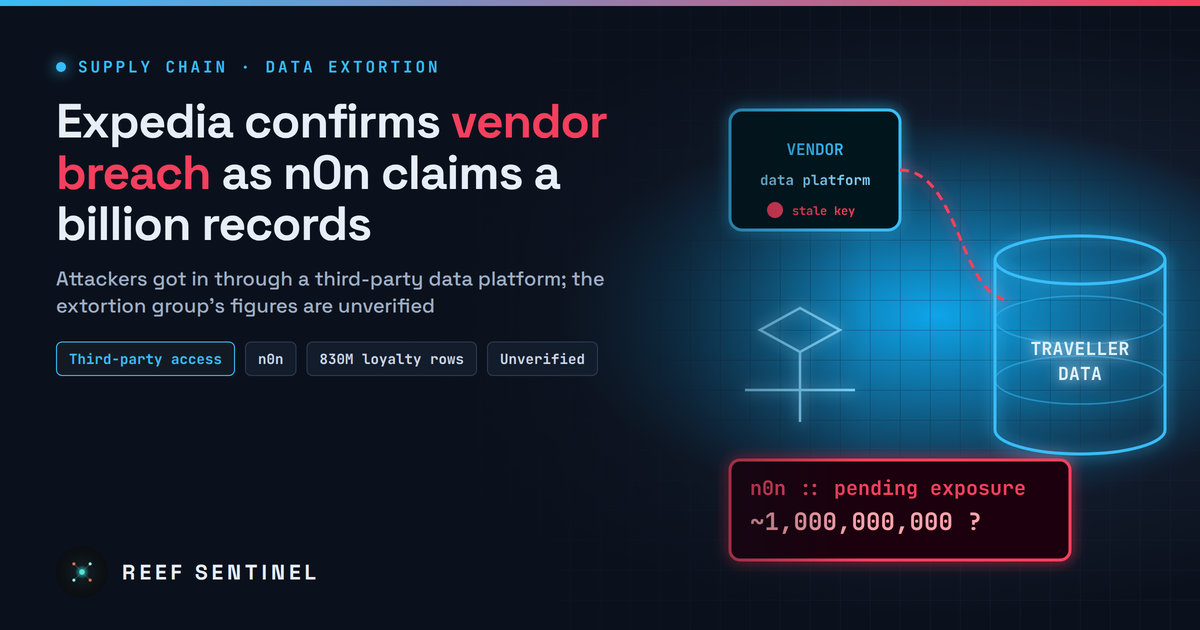
Expedia says attackers reached its systems through a compromised data platform provider, while the ransomware-free extortion crew n0n claims 830 million loyalty rows and 333 million account records, figures Expedia has not confirmed.
Overview
Expedia Group has confirmed that attackers reached its systems through a compromised third-party data platform provider. A new Russian-speaking extortion group calling itself n0n now claims it took nearly one billion traveller records.
Expedia confirmed the intrusion on Thursday 12 November 2026. It described the incident as a supply chain attack: attackers compromised a data platform provider and used that trusted access to get into Expedia's environment. The company has not named the provider. It has not confirmed what data was taken or how much, and it has not tied the incident to n0n. It says its investigation is ongoing, the attack was contained once detected, outside experts were brought in, and its platforms remain safe for travellers and partners.
What is new: on 11 November we covered the wider risk of former Qubole customers leaving that vendor's cloud access roles in place. Since then Expedia has confirmed a breach through a third-party data platform, and an extortion group has put a scale on the alleged theft. Cloud security researchers link the Expedia intrusion to the stolen Qubole vendor credentials. Expedia has not confirmed that link, and reports differ on how firmly the researchers have established it.
The Campaign
According to cloud security researchers, attackers used compromised Qubole credentials between 14 and 26 October 2026 to enter several customers' cloud environments and download data. Qubole was once a data platform vendor to Expedia. The researchers found that many former Qubole customers had never revoked the cross-account permissions they granted while using the service. That left a trusted path into big-data platforms long after the business relationship ended.
n0n is a data-theft-and-extortion operation that does not use ransomware. Threat intelligence researchers say it appeared in mid-September 2026. Its leak site claims 224 attacks since then. Victims are listed as numbered entries with a countdown labelled "pending exposure", and the group names a company only if it refuses to pay.
n0n's claims about Expedia, none of them independently verified:
- More than 830 million loyalty programme records from 35 programmes, including email addresses, membership IDs and points balances
- 58 million traveller profiles, including home airports and account details
- More than 333 million consumer account and credential records containing "password-like tokens"
- Nearly 2.5 million credit card spending records linked to hashed email addresses
- 72 million consumer matching records and 500,000 guest records with accommodation details
- Source code, which the group says it pulled using live credentials
When n0n first listed Expedia it published no sample records, screenshots or other technical evidence. Treat the volumes as extortion claims until data surfaces or Expedia reports its own findings.
Timeline
All times are Mauritius time (UTC+4), with UTC in brackets.
- Mid-September 2026: n0n appears and starts listing victims
- 14–26 October 2026: Researchers observe attackers using stolen Qubole credentials to reach multiple customer cloud environments and download data
- 11 November 2026: Reef Sentinel covers the risk of leftover Qubole trust relationships
- 12 November 2026: Expedia confirms a supply chain attack through a third-party data platform provider
- 13–14 November 2026: n0n's claim of nearly one billion records spreads. Expedia does not confirm the figures
Tradecraft
- Trusted third-party access: the attackers did not need to break Expedia's perimeter. A vendor credential, or a cross-account role trusting the vendor, gave them authenticated access to data stores.
- Stale trust: the central weakness was access that outlived the contract. Roles, keys and service principals granted to a former supplier were still valid.
- Bulk exfiltration from analytics platforms: big-data and lakehouse environments hold joined, enriched copies of customer data: loyalty, profiles, payments and matching tables. That explains the breadth of n0n's claimed categories.
- Extortion without encryption: like other data-theft crews, n0n relies on leak-site pressure and staged disclosure, not on disrupting operations.
Detection
No indicators of compromise have been published for this incident. Organisations that used Qubole, or any decommissioned data platform, should look for activity from vendor identities:
- List IAM roles, service accounts and service principals whose trust policies name external accounts. Flag any tied to vendors you no longer use.
- Review cloud audit logs (AWS CloudTrail, GCP Cloud Audit Logs, Azure Activity Logs) from 1 October 2026 onwards. Look for AssumeRole calls, token issuance or storage reads by vendor identities.
- Hunt for unusually large reads or exports from data lakes, warehouses and object storage, especially bulk GetObject or table export jobs outside normal pipeline schedules.
# AWS: list roles that trust an external account (review each one)
aws iam list-roles --query "Roles[].{Name:RoleName,Trust:AssumeRolePolicyDocument.Statement[].Principal}" --output json
# AWS: recent AssumeRole events for a specific role
aws cloudtrail lookup-events --lookup-attributes AttributeKey=ResourceName,AttributeValue=<role-name> --max-results 50
Recommended Actions
- Expedia, Hotels.com, Vrbo and loyalty-programme customers: watch for travel-themed phishing that uses real booking or points details. Change reused passwords and turn on multi-factor authentication. Don't trust unsolicited "points expiry" or "account verification" messages.
- Security teams: offboard vendors fully. When a contract ends, revoke cross-account roles, rotate any keys the vendor held and remove OAuth grants.
- Inventory every third-party identity with access to production data. Assign an owner and an expiry date to each.
- Restrict third-party roles to the minimum datasets and add alerts on bulk reads.
- If you were a Qubole customer, assume your exposure window starts no later than 14 October 2026. Review logs from that date.
Analyst Assessment
Expedia's confirmation turns a vendor-hygiene warning into a confirmed incident at a major consumer brand. The data-volume claims are unproven and come from a group that profits from inflating them. Even so, a confirmed path through a data platform is enough to put large, enriched customer datasets at risk.
The wider lesson is that decommissioned vendors are an attack surface. Expect more victims from the same October activity to come forward. Expect n0n and similar groups to keep targeting analytics platforms, where one trusted identity can open years of aggregated customer data.
