2,700-Password Brute-Force Campaign Breaks Into Exposed Microsoft SQL Servers, Then Uses xp_cmdshell to Install a Monero Miner and a Gh0st RAT Variant
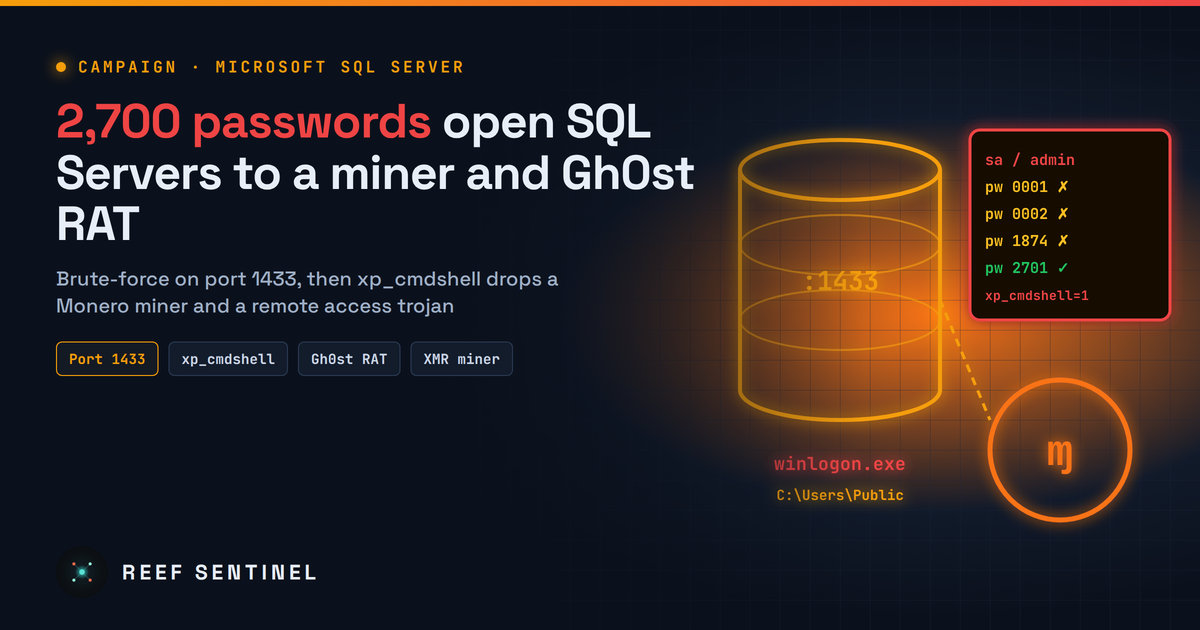
A self-spreading campaign active since early October scans for open port 1433, guesses sa and admin passwords, enables xp_cmdshell and installs a disguised XMR miner plus a Gh0st RAT with keylogging and remote shell.
Overview
A campaign running since at least early October 2026 is breaking into internet-facing Microsoft SQL Server instances by guessing passwords. It then uses SQL Server's own command shell to install a Monero miner and a variant of the Gh0st RAT remote access trojan. Researchers who published the analysis on 12 November 2026 rate the threat as high. No software flaw is involved: the attackers rely on exposed port 1433, the sa account and weak passwords.
The campaign has not been attributed to a known group.
The Campaign
The operation runs as an automated, self-feeding pipeline:
- Scanning. The first stage,
dllhost.exe, is a UPX-packed Go binary named after a legitimate Windows process. It embeds the open-source Naabu port scanner. It asks the attackers' server for a target IP range, expands it into /16 blocks and checks random addresses for open TCP 1433. Hits go intoResult.txt, and the tool asks for the next range. - Brute force. A .NET tool named
dwm.exetries usernames such assaandadminagainst a list of more than 2,700 passwords, with up to 500 threads at once. - Execution. On a successful login, the tool runs a T-SQL script called
2018.sql. It enablesxp_cmdshellso SQL Server can run Windows commands, then downloads payloads intoC:\Users\PublicasGoogle.exeorpayload.exe. - Downloader.
Secs.execonnects to an attacker FTP server, fetches more executables into Temp, and registers the victim by sending its public IP, country, Windows version, CPU, RAM, user name and host name. - Miner.
MicrosoftEdgeUpdate.exeis not a browser update. It is a Monero (XMR) miner, packed with Themida and a custom LZSS packer, mining through public pools and reporting its status back. - RAT.
winlogon.exeis a Gh0st RAT variant with more than 30 commands: keylogging, file management, a remote shell, event-log wiping and theft of QQ messenger data. Plugins add screen capture and remote desktop. It checks for 78 security-product process names.
Timeline
All times are Mauritius time (UTC+4).
- Early October 2026 – campaign activity first observed.
- 12 November 2026 – researchers publish the analysis and indicators. The RAT's C2 servers were already offline during testing.
Tradecraft
- Masquerading. Every file borrows a Windows or Microsoft name:
dllhost.exe,dwm.exe,winlogon.exe,MicrosoftEdgeUpdate.exe. They run fromC:\Users\Publicand Temp, not System32. - Living off the database.
xp_cmdshellturns a database login into OS command execution under the SQL Server service account. - Layered persistence. A daily scheduled task named
Microsoft_UPDATES;Secs.exein the Startup folder; tasks every 30 minutes disguised as Edge updates; and for the RAT, a Run key, a Windows service and a scheduled task. - Worm-like growth. Each compromised server can scan and attack new ranges, which spreads the work across victims.
Indicators of Compromise
Infrastructure (defanged):
site.vietnam852[.]com:88– file server, target lists (/ip.php),/2026/2018.sql,/2026/dwm.exe,/down.exeftp.vietnam852[.]com:88– FTP and host registration (/post.php), miner downloadserver.vietnam852[.]com:8000– Gh0st RAT C2www.swordaa[.]com:8000– Gh0st RAT C2site.hfgjjkrewjk[.]com– mining status reportingsite.jiancai008[.]com:88– Gh0st RAT hosting (/test/winlogon.exe)
SHA-256:
dllhost.exe– 8CE2CD98EF6CEEECE8239936E4AEA042C41807F632CD691D5091705BF6C0076D2018.sql– F5444E8E9E9E019693AACB363B7441AC0B8ECFE96A77FD94B9C312A017588EB4dwm.exe– 124774698FD3EDE0800015D19C2BD6C1869D03BBC2E6E8DBE2F69D2978F7F4D0- downloader (
down.exe/Google.exe/payload.exe) – 125D3A0EFE7699BB20397C13F0F4993AD893952727487B4D190E386A5B14C427 - downloader variant – 20983573B840447E1AACD6D3F6DD240732B15037D268D6456F0D3C4EC5051CB0
- XMR miner – 2A23E10BFC097E98295CBFF8124BD403C4CB677E709B48CCC53D6ACA216C3061
- XMR miner – DA4128AA5D006E05C58F0D240C2D8E5FB02774B6ACF314F1230059C7A3498724
- Gh0st RAT
winlogon.exe– 3F64B0146B323C5716043360E84384A5A197A897F46088DF93A910470A29E1A0
Host artefacts: scheduled task Microsoft_UPDATES, files named Secs.exe, MicrosoftEdgeUpdate.exe or winlogon.exe under C:\Users\Public or %Temp%, and Result.txt next to a Go binary.
Detection
- Bursts of failed SQL logins for
saoradminfollowed by a success (SQL Server error log, event ID 18456 then 18453/18454). - Any change of
xp_cmdshellto enabled, and anycmd.exeorpowershell.exechild ofsqlservr.exe. - A
winlogon.exeordwm.exerunning from anywhere other thanC:\Windows\System32. - Sustained high CPU on database servers with outbound connections to mining pools.
-- Check whether xp_cmdshell is enabled (should be 0)
SELECT name, value_in_use FROM sys.configurations WHERE name = 'xp_cmdshell';
# Find tasks pretending to be Edge or Microsoft updates and the Public-folder payloads
Get-ScheduledTask | Where-Object { $_.TaskName -match 'Microsoft_UPDATES|EdgeUpdate' } | Select TaskName, TaskPath
Get-ChildItem C:\Users\Public -Include *.exe -Recurse -ErrorAction SilentlyContinueRecommended Actions
- Take SQL Server off the internet. Block inbound TCP 1433 at the perimeter. Use a VPN or allow-listed jump host for remote admin.
- Disable or rename
sa. Use Windows authentication where possible, long unique passwords elsewhere, and account lockout. - Keep
xp_cmdshelloff and alert on any attempt to enable it. - If you find the miner, assume the RAT is there too. Rebuild the server, rotate every credential the SQL service and its admins used, and review linked servers.
- Block the listed domains and hashes in your EDR, DNS filter and proxy.
Analyst Assessment
This is commodity crime, but it works because exposed SQL Servers with guessable sa passwords keep turning up. The miner is noisy. The Gh0st RAT is the real risk: it gives a remote operator keylogging and shell access on a machine that usually holds business data and trusted credentials. That access could later be sold or reused. Self-propagating scanning means one weak server can become a launch point against others. The fix is cheap and well known: no public 1433, no sa, no xp_cmdshell.
