Operation Endgame Takes Down Gootloader, CastleRAT and StealC: 235 Servers and 257 Domains Seized, 6.4 Million Stolen Victim Records Recovered
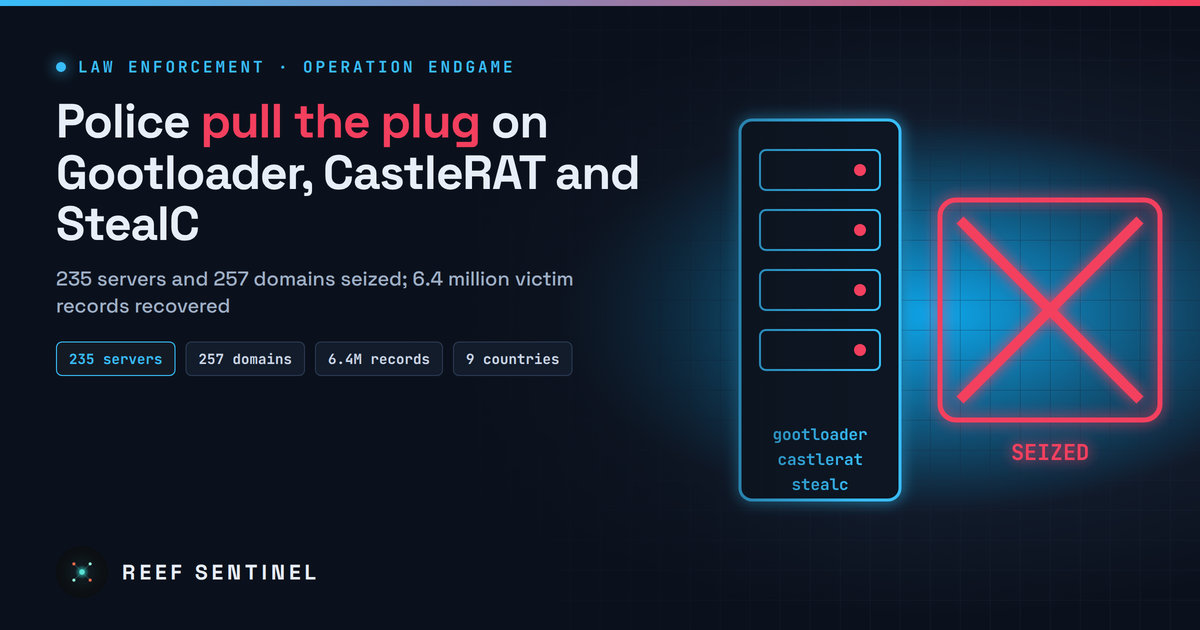
Police in nine countries, coordinated by Europol and Eurojust, dismantled the infrastructure of three malware families that fed initial access and stolen credentials to ransomware gangs, and are passing victim data to notification services.
Overview
Police in nine countries have taken down the servers behind three malware families that sell access and stolen data into the ransomware economy: the Gootloader loader, the CastleRAT remote access trojan and the StealC infostealer. Europol announced the action on 12 November 2026 as the latest round of Operation Endgame, the long-running international campaign against the tools ransomware gangs use to get into networks.
Authorities say they seized or disrupted 235 servers and 257 domains, identified more than 6.4 million sets of stolen victim data, and arranged for 681 compromised websites to be cleaned up. No arrests have been announced.
The Campaign Being Disrupted
All three families sit at the start of the attack chain. Their job is to give someone else a way in:
- Gootloader – a loader active since 2020. Its operators hacked websites, often WordPress sites, and planted fake legal documents and contract templates on them. Victims who downloaded the "document" got a loader that pulled in more malware. Investigators linked these infections to later ransomware and extortion. Seized: 14 servers, 218 domains, and 681 infected sites remediated.
- CastleRAT – a remote access trojan first seen in 2025, which Europol describes as built to avoid detection. It gives an operator full remote control of the infected machine and has been linked to data encryption, disrupted IT systems and ransom payments. Seized: 120 servers and 39 domains.
- StealC – an infostealer that collects saved passwords, browser sessions, cryptocurrency wallets and other identity data so they can be sold, and can also drop further malware. 102 servers were taken down. This continues action against StealC that began in June 2026.
Europol's per-family server counts add up to 236, one more than its headline total of 235. Europol has not explained the gap.
Timeline
All dates below are Mauritius time (UTC+4). The Europol announcement did not give exact hours.
- 2020 – Gootloader activity first documented.
- 2025 – CastleRAT first seen.
- June 2026 – earlier Endgame phases clean about 15,000 infected WordPress sites, seize 106 SocGholish and Evil Corp servers, then disrupt Amadey and StealC with 326 servers and 142 domains taken down.
- Week of 10 November 2026 – coordinated seizures against Gootloader, CastleRAT and StealC.
- 12 November 2026 – Europol and Eurojust announce the results.
Participants
Police from Bulgaria, Canada, Denmark, Germany, Moldova, the Netherlands, Poland, the United Kingdom and the United States took part. Europol and Eurojust coordinated, and private-sector partners helped.
Tradecraft
The common thread is access brokering. The operators did not need their own ransomware. They collected footholds and credentials and sold them on:
- SEO poisoning and compromised sites. Gootloader relied on hacked, trusted-looking websites ranking for searches like contract or agreement templates.
- Persistent remote control. CastleRAT gave buyers an interactive foothold they could pass to ransomware affiliates.
- Bulk credential theft. StealC logs feed credential markets. One infected laptop can expose VPN, SSO, cloud and email logins for a whole organisation.
Victim Notification
Stolen data recovered in the operation, especially CastleRAT victim data, is being passed to notification services so people can be alerted. Have I Been Pwned is among them, along with national CERTs and non-profit partners. Anyone who gets an alert should assume the device that leaked the data was infected, not only that a password leaked.
Detection
Seized infrastructure stops new commands from reaching infected machines. It does not remove malware that is already installed. Hunt for leftovers:
- Browser downloads of ZIP or JS files named like legal agreements or templates, followed by
wscript.exeorcscript.exerunning a.jsfile from the user's Downloads or Temp folder. - Unknown scheduled tasks or Run keys pointing to scripts or binaries in
%AppData%or%Temp%. - Unexpected outbound connections from workstations to recently registered domains or raw IPs.
- Sign-ins with valid credentials from new locations or devices, especially after an endpoint was flagged for an infostealer.
# List scheduled tasks whose action runs a script host (review, don't auto-delete)
Get-ScheduledTask | Where-Object { $_.Actions.Execute -match 'wscript|cscript|mshta|powershell' } |
  Select-Object TaskName, TaskPath, @{n='Action';e={$_.Actions.Execute + ' ' + $_.Actions.Arguments}}
Recommended Actions
- Check exposure. Subscribe your company domains to breach notification services so you hear about leaked staff credentials.
- Treat infostealer hits as full compromises. Reimage the device, then reset every password and revoke every session token that was saved in that browser, including SSO, VPN and cloud consoles.
- WordPress owners. Europol urges site owners to change admin credentials, turn on MFA and patch plugins and themes. Check for unknown admin accounts and injected scripts.
- Block script execution by default. Make
.jsand.vbsfiles open in a text editor rather than Windows Script Host on user endpoints. - Enforce phishing-resistant MFA so stolen passwords alone are not enough.
Analyst Assessment
This round goes after suppliers rather than ransomware brands, which is where Operation Endgame has been most effective. Taking out access brokers raises costs for every affiliate that bought from them. But history counsels caution. Earlier Endgame targets were partly rebuilt within weeks, no arrests have been announced, and malware already on victim machines keeps running. The biggest lasting value is probably the 6.4 million victim records, which should lead to notifications and credential resets that close doors attackers had already bought. Defenders should use this window to hunt for dormant infections before the operators move to new infrastructure.
