N-able N-central '4EverAble2Shell' Exploited Within Hours of Public PoC: Unauthenticated Root Chain Turns 21 RMM Servers Into Monero Miners
Critical · 2026-11-13 · By H.A

N-able N-central '4EverAble2Shell' Exploited Within Hours of Public PoC: Unauthenticated Root Chain Turns 21 RMM Servers Into Monero Miners

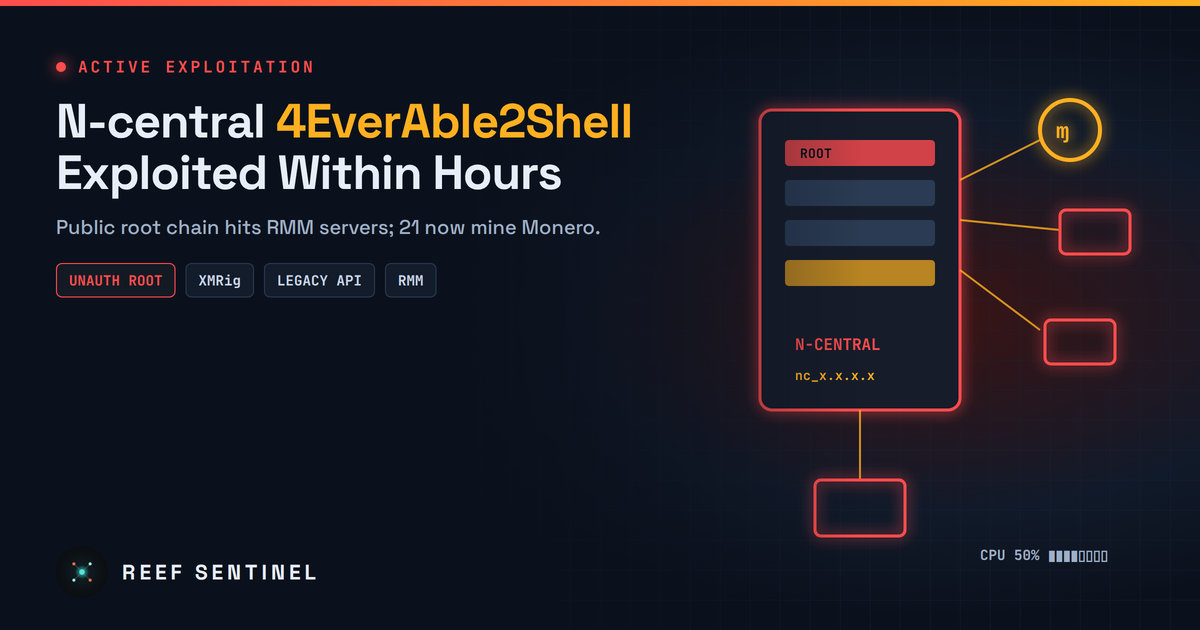
A public exploit chain giving unauthenticated root on N-central servers with the Legacy API enabled was used within hours on 12 November, and at least 21 production servers, most on the new 2026.4.1.26 HF2 build, are now running XMRig.

Overview

The N-able N-central story moved from disclosure to active exploitation on 12 November 2026. Hours after a researcher published proof-of-concept code for a new chain called 4EverAble2Shell, honeypots recorded attackers using it. By that afternoon researchers counted 21 production N-central servers quietly mining Monero.

Earlier in the week N-able took its hosted N-central environments offline. That followed the same researcher's release of more than 30 alleged zero-days in the remote monitoring and management (RMM) platform, and N-able urged on-premises customers to shut their servers down. What is new: a fresh unauthenticated root chain, public exploit code, and confirmed compromises of real servers, most of them running the hotfix released on 10 November.

The Vulnerability

4EverAble2Shell gives an unauthenticated attacker root command execution on Linux-based N-central appliances. It only works when the Legacy API is enabled. The chain has two stages:

The researcher tested the chain against N-central Appliance 2026.4.1.26 HF2, the build released on 10 November. They also released a second chain, Agent2Shell, which they say gives SYSTEM-level command execution on Windows devices through the N-central agent. No exploitation of Agent2Shell has been reported so far.

Timeline

Tradecraft

The observed operator is after money rather than espionage, at least so far. After gaining root, the chain downloads a shell script that installs the XMRig Monero miner. The miner is set to use about half of the CPU cores, likely so the slowdown is less noticeable. Each infected server joins the mining pool with a worker ID made of nc_ and the server's IP address. That naming let researchers count the victims: 21 servers, 19 of them on 2026.4.1.26, located in the US, Canada, South Africa, the UK, Germany, France and Sweden.

The bigger risk is the next attacker. Root on an RMM server means control of every endpoint it manages. A cryptominer is the mildest thing someone can do with that access.

Indicators of Compromise

Detection

Check web logs on the appliance for POSTs to the Axis endpoint, and check the host for the persistence artefacts:

# Suspicious Axis requests
grep -R "dms/services/ServerUI" /var/log/ 2>/dev/null | grep -i "TerminalLineSettings"

# Persistence and staging
systemctl list-unit-files | grep -i xvd
ls -la /tmp/.xvd /var/tmp/.xvd 2>/dev/null

# High-CPU processes and outbound connections
ps aux --sort=-%cpu | head -15
ss -tnp | grep -v "127.0.0.1"

Network teams should alert on connections to the IP above and to public Monero pool ports from RMM servers. If you find a compromised appliance, treat every managed endpoint as possibly exposed. Review recent scripts, jobs and agent deployments pushed from N-central.

Recommended Actions

Analyst Assessment

Exploitation started within hours of the code going public, and the vendor's own guidance fell behind events. N-able's advisory said it had seen no compromise even as researchers counted working miners on production servers. This is now a public, root-level, unauthenticated chain against a tool that controls fleets of customer endpoints. Expect more capable operators to follow the miners, including ransomware affiliates who already favour RMM platforms. Until N-able ships fixes for the full set of published issues, the safest N-central server is one the internet cannot reach.

COMPUTE NODE · · --:--:--

Fresh cybersecurity news,
daily threat intelligence.

Daily cyber news, live threat intel and exploited CVEs.

Everything in one place

Self-hosted, hardened, and yours.

RUN IT

Local AI console

Chat with a model on your own hardware via Ollama or any OpenAI-compatible server. No cloud, no key.

DEFEND

Cyber threat feed

Automatic daily intel from CISA KEV, NVD & GitHub advisories, a live cyber threat map, and your own notes.

NEWS

News & videos

Articles and updates on pentesting, AI, and cyber — with embedded video, including YouTube. Post your own.

DIRECTORY

Registry

Runtimes, models, MCP servers, agents, and a full security & pentest tooling section.

PUBLISH

Posts

Write, edit, publish, and share articles backed by a real database and your account.

COMMUNITY

Forum

Threads and replies across categories from Models to Hardware to Security.

CODE

Repos

Curated AI and security GitHub repos, plus a shelf for pinning your own.

DOWNLOAD

Skill packs

Agent starters, RAG scaffolds, and defensive security & VAPT report templates.

Registry

Runtimes, models, MCP servers, agent frameworks, and a security & pentest tooling section — all links out to the real projects.

Local AI console

Talk to a model running on your own machine through Ollama or an OpenAI-compatible server — your prompts and the model's replies always go straight from your browser to your local model, never through a Reef server. Attach files for context, and pick up saved chats where you left off.

Type /image a prompt in the box below to generate
Not connected

Local AI hardware benchmark

A spec-based compatibility advisor — tells you which local models your hardware can run well, which will be slow, and which to skip. Connect to Ollama below for a real, measured speed test instead of an estimate.

1. Your hardware

2. Live check against your local model server (optional)

If a local model server is running, this cross-references the table above with what you've actually got loaded — and runs a real, measured speed test instead of an estimate.

AI Database

A browsable catalog of AI models across providers — context windows, pricing, and capabilities.

Loading…

Cyber threat feed

Latest threats pulled automatically every day from CISA's Known-Exploited-Vulnerabilities catalog and NVD — plus threat intel you post yourself.

⇩ Export STIX
Loading threat feed…

Cyber threat map

Attacks happening right now, all over the world.

Connecting…
LIVE · MAURITIUS TIME--:--:--
attack route, country to country attack route into Mauritius attacker reported worldwide
Loading live data…
attackers reported per minute · click to rewindnow

Top attack routesweb

Attackers based inlast hour

Networkslast hour

Click any dot, feed row or table row to see that IP's profile.

Mauritius

Who attacks Mauritius

Loading…

Web attacks malicious requests to Mauritian websites that were blocked
Network DDoS floods meant to knock Mauritian servers offline

    Mauritius · last 24 h

    How Mauritius is attacked

    Network-level attacks (DDoS) aimed at Mauritius, by method. They try to knock servers and networks offline by sheer volume.

    • Loading…

    The ports or services these floods aimed at aren't published.

    Mauritius · last hour

    Attackers located in Mauritius

    0attackers located in Mauritius were reported in the last hour

    This counts attacks coming from Mauritius, not attacks on it: IPs in Mauritius that servers elsewhere reported for attacking them. Usually zero or one; when it rises, it's often a hacked local server or router.

    Worldwide today

    What attackers are knocking on

    Ports most targeted across a worldwide network of sensors .

    Worldwide today

    Most active attackers

    Ranked by how many separate sensors they hit. Click a row for its profile.

    IPCountryNetworkSensors hitReports
    What you're looking at
    Blue routes

    Share of attack traffic from one country to another. Thicker, faster streams carry more. Particles show volume, not one per attack.

    Every 15 min · published 1–2 h behind
    Amber flashes

    An attacking IP that servers around the world reported in the last minute, placed where the IP is. Its targets aren't published, so there's no line.

    Every minute · shown about 1 min behind
    Locations

    IP locations are approximate (city level at best) and show where the machine is hosted, not who controls it.

    Approximate · city level at best

    News

    Articles, guides and updates on pentesting, AI, and cybersecurity — with embedded video. Add your own, including YouTube.

    Loading…

    Posts

    Loading…

    Loading posts…

    Forum

    Questions, answers, and talk about running AI locally.

    Loading forum…

    GitHub repositories

    Curated AI and security repos, plus your own pinned shelf.

    Command board

    One-liners, configs, and advice worth keeping — shared by everyone here.

    ⚠ Commands are shared with all users. Never include credentials, tokens, or internal hostnames. Review anything before you run it.
    Loading commands…

    Skill packs

    Starter files served from the API — AI agent scaffolds plus defensive security & VAPT reporting templates. Click to download.

    Loading skills…

    Your watchlist

    Follow threat actors, malware, CVEs and vendors — we tell you when a new report, CVE record or exploitation alert mentions them.

    Threat Library

    Threat actors, malware and tools — their attack techniques, Reef Sentinel coverage and indicators of compromise.

    Loading…

    Threat Intelligence

    Curated threat write-ups, advisories and analysis — with cover media.

    Loading…

    Tutorials

    Step-by-step guides for running local AI, using the console, and tracking threats. Admins can add their own.

    Loading…

    Downloads

    Direct links to the official homepage/download page for well-known cybersecurity, penetration-testing, and local-AI software. Always verify checksums/signatures from the vendor before running anything.

    Loading…

    Terms & Conditions

    Loading…

    Help & FAQ

    Answers to common questions about Reef Sentinel, plus a formatting guide for posts, articles, and comments.


    Formatting guide

    Commands you can type into the body of a post, comment, or reply — no HTML needed. Comments and short replies only support bold, italic, and inline code.

    Contact us

    Questions, feedback, or a security disclosure? Reach us directly, or send a message and we'll get back to you by email.

    Loading…

    Send a message

    VAPT Report Generator

    Build an engagement, add findings with a live CVSS calculator, and generate a branded, print-ready report.

    Recon Toolkit

    Investigate any domain, IP, URL, file hash, email or CVE in one search, plus breach and password checks, hash identification and a payload cheatsheet.

    Website Checker

    Reads a website's HTTP response headers to identify its framework and server, shows any known CVEs for the exposed versions with details, and recommends what to do.

    Control panel

    Manage everything shown on the site — news & videos, posts, homepage headlines, and subscribers. Admin only.

    Overview
    Content
    Site
    Account & Security

    Email settings

    SMTP on ports 25/465/587 is blocked outbound by some hosts (e.g. DigitalOcean droplets by default) — Resend and Brevo send over their HTTPS API instead, so they work even then. Only the selected provider is used to send; the others stay saved but idle, so you can switch back any time without losing settings.

    Get a key from resend.com/api-keys. Uses the "From address" below as the sender — it must be on a domain you've verified with Resend.

    Get an API key (not an SMTP key) from app.brevo.com/settings/keys/api. Uses the "From address" below as the sender — it must be a verified sender in your Brevo account.

    "From address" and "Site name/URL" are shared by SMTP, Resend, and Brevo — they control what recipients see, regardless of which provider is active.

    Send a test email

    Sends through whichever provider is currently active above. Save your settings first if you just changed them.

    SIGNAL LOST

    We couldn't find this page

    The page may have been moved or deleted, or the address was mistyped.