Red Hat Quay CVE-2026-110697 (CVSS 9.9): An Unescaped Underscore Lets One Tenant Read Another's Robot Account Tokens
DevSecOps · 2026-11-13 · By H.A

Red Hat Quay CVE-2026-110697 (CVSS 9.9): An Unescaped Underscore Lets One Tenant Read Another's Robot Account Tokens

A SQL LIKE wildcard flaw in Red Hat Quay's robot account listing exposes other tenants' decrypted robot tokens to any user who can create a look-alike namespace, fixed in Quay 3.9.28 through 3.18.3.

What Happened

Red Hat has disclosed CVE-2026-110697, a critical SQL injection flaw in Red Hat Quay, the container image registry behind many private registries and the hosted Quay.io service. Red Hat rates it 9.9 out of 10 (CVSS 3.1: AV:N/AC:L/PR:L/UI:N/S:C/C:H/I:H/A:H). The CVE was published on 11 November 2026. Red Hat has already fixed Quay.io and released patched builds for every supported self-managed Quay branch.

The issue was found internally by a Red Hat engineer. There are no reports of exploitation in the wild so far.

Technical Details

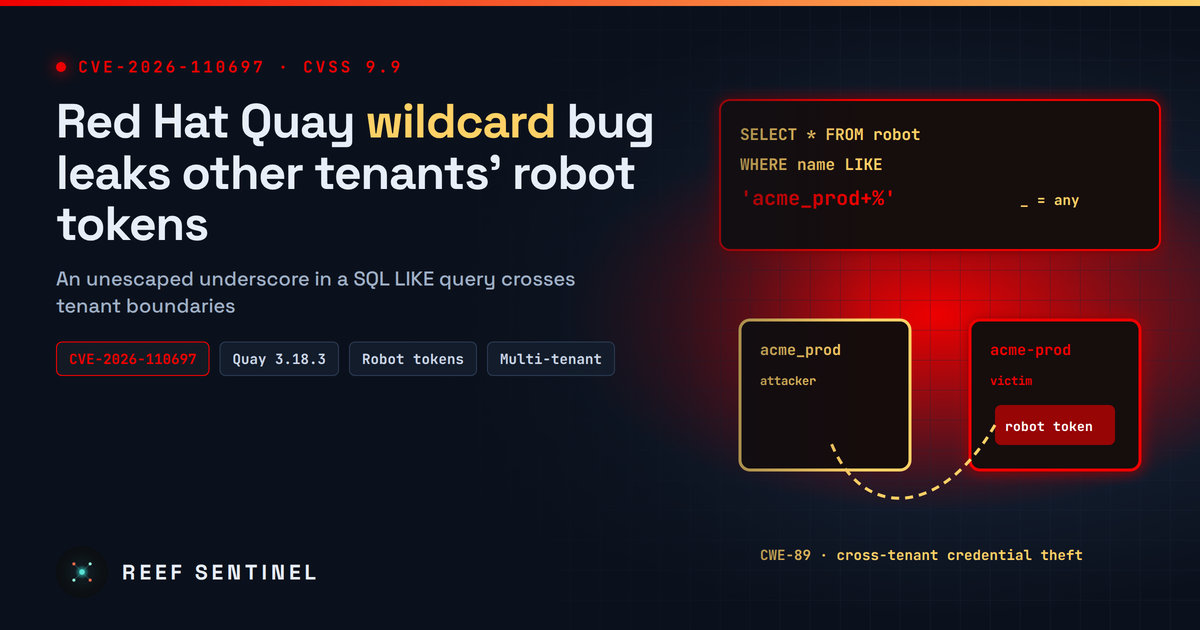
The bug is in how Quay lists robot accounts, the machine identities CI/CD pipelines and Kubernetes clusters use to push and pull images. When building the list, Quay creates a SQL LIKE pattern from the namespace name but doesn't escape SQL wildcard characters.

In a SQL LIKE clause, an underscore (_) matches any single character. That means:

Robot tokens are long-lived credentials that often have push rights. Whoever holds one can pull private images and may be able to push poisoned images into another tenant's repositories. That makes this a cross-tenant supply-chain risk, not just a data leak, which explains the "scope changed" rating and the near-maximum score. Red Hat classifies it as CWE-89 (SQL injection).

Who Is Affected

The highest risk is to multi-tenant Quay deployments where regular users can create their own organisations:

Single-tenant registries where only administrators can create namespaces are much less exposed, but should still be patched. Red Hat has also listed Red Hat OpenShift Update Service in the CVE record, so check its advisory for your product.

Patch Status

Red Hat has released fixes for these Quay versions:

Earlier builds on each branch are affected. Quay.io has already been fixed and needs no customer action for the vulnerability itself. Red Hat says there is no complete workaround other than updating.

What To Do Now

  1. Upgrade to the fixed release for your branch. On OpenShift, update the Quay Operator and confirm the running image version.
  2. Rotate robot tokens. If your instance is multi-tenant, assume tokens may already have leaked. Prioritise robots with push or admin permissions and any namespace whose name could collide through underscore wildcards.
  3. Hunt for suspicious namespaces. List organisations created recently that contain underscores and closely resemble existing names.
  4. Review audit logs. Look for image pulls or pushes by robot accounts from unexpected IP addresses, at unusual times, or against repositories the robot doesn't normally touch.
  5. Restrict namespace creation until you patch. Limit who can create organisations, or block names containing underscores.

A simple starting point for spotting look-alike namespaces, using an exported list of organisation names:

# orgs.txt: one organisation/namespace name per line
grep '_' orgs.txt | while read n; do
  pat="^$(printf '%s' "$n" | sed 's/_/./g')$"
  grep -E "$pat" orgs.txt | grep -vx "$n" | sed "s/^/$n may collide with: /"
done

After patching, re-sign or re-verify critical images if your pipeline uses image signing. If you aren't sure a repository was untouched, compare image digests against your build records.

Why It Matters

Container registries are a central link in the software supply chain. Every cluster that pulls from them trusts what they serve. A flaw that lets any tenant read other tenants' deployment credentials undermines the isolation multi-tenant platforms are built on. The root cause is old and familiar: an unescaped wildcard in a LIKE query. Treating user-controlled names as plain text instead of patterns is easy to forget, and on a shared registry it nearly reached the top of the CVSS scale.

Quay administrators should patch this week and rotate credentials rather than wait for exploitation reports. Because the bug is now public, it is straightforward to reproduce for anyone who can create an account on an exposed instance.

COMPUTE NODE · · --:--:--

Fresh cybersecurity news,
daily threat intelligence.

Daily cyber news, live threat intel and exploited CVEs.

Everything in one place

Self-hosted, hardened, and yours.

RUN IT

Local AI console

Chat with a model on your own hardware via Ollama or any OpenAI-compatible server. No cloud, no key.

DEFEND

Cyber threat feed

Automatic daily intel from CISA KEV, NVD & GitHub advisories, a live cyber threat map, and your own notes.

NEWS

News & videos

Articles and updates on pentesting, AI, and cyber — with embedded video, including YouTube. Post your own.

DIRECTORY

Registry

Runtimes, models, MCP servers, agents, and a full security & pentest tooling section.

PUBLISH

Posts

Write, edit, publish, and share articles backed by a real database and your account.

COMMUNITY

Forum

Threads and replies across categories from Models to Hardware to Security.

CODE

Repos

Curated AI and security GitHub repos, plus a shelf for pinning your own.

DOWNLOAD

Skill packs

Agent starters, RAG scaffolds, and defensive security & VAPT report templates.

Registry

Runtimes, models, MCP servers, agent frameworks, and a security & pentest tooling section — all links out to the real projects.

Local AI console

Talk to a model running on your own machine through Ollama or an OpenAI-compatible server — your prompts and the model's replies always go straight from your browser to your local model, never through a Reef server. Attach files for context, and pick up saved chats where you left off.

Type /image a prompt in the box below to generate
Not connected

Local AI hardware benchmark

A spec-based compatibility advisor — tells you which local models your hardware can run well, which will be slow, and which to skip. Connect to Ollama below for a real, measured speed test instead of an estimate.

1. Your hardware

2. Live check against your local model server (optional)

If a local model server is running, this cross-references the table above with what you've actually got loaded — and runs a real, measured speed test instead of an estimate.

AI Database

A browsable catalog of AI models across providers — context windows, pricing, and capabilities.

Loading…

Cyber threat feed

Latest threats pulled automatically every day from CISA's Known-Exploited-Vulnerabilities catalog and NVD — plus threat intel you post yourself.

⇩ Export STIX
Loading threat feed…

Cyber threat map

Attacks happening right now, all over the world.

Connecting…
LIVE · MAURITIUS TIME--:--:--
attack route, country to country attack route into Mauritius attacker reported worldwide
Loading live data…
attackers reported per minute · click to rewindnow

Top attack routesweb

Attackers based inlast hour

Networkslast hour

Click any dot, feed row or table row to see that IP's profile.

Mauritius

Who attacks Mauritius

Loading…

Web attacks malicious requests to Mauritian websites that were blocked
Network DDoS floods meant to knock Mauritian servers offline

    Mauritius · last 24 h

    How Mauritius is attacked

    Network-level attacks (DDoS) aimed at Mauritius, by method. They try to knock servers and networks offline by sheer volume.

    • Loading…

    The ports or services these floods aimed at aren't published.

    Mauritius · last hour

    Attackers located in Mauritius

    0attackers located in Mauritius were reported in the last hour

    This counts attacks coming from Mauritius, not attacks on it: IPs in Mauritius that servers elsewhere reported for attacking them. Usually zero or one; when it rises, it's often a hacked local server or router.

    Worldwide today

    What attackers are knocking on

    Ports most targeted across a worldwide network of sensors .

    Worldwide today

    Most active attackers

    Ranked by how many separate sensors they hit. Click a row for its profile.

    IPCountryNetworkSensors hitReports
    What you're looking at
    Blue routes

    Share of attack traffic from one country to another. Thicker, faster streams carry more. Particles show volume, not one per attack.

    Every 15 min · published 1–2 h behind
    Amber flashes

    An attacking IP that servers around the world reported in the last minute, placed where the IP is. Its targets aren't published, so there's no line.

    Every minute · shown about 1 min behind
    Locations

    IP locations are approximate (city level at best) and show where the machine is hosted, not who controls it.

    Approximate · city level at best

    News

    Articles, guides and updates on pentesting, AI, and cybersecurity — with embedded video. Add your own, including YouTube.

    Loading…

    Posts

    Loading…

    Loading posts…

    Forum

    Questions, answers, and talk about running AI locally.

    Loading forum…

    GitHub repositories

    Curated AI and security repos, plus your own pinned shelf.

    Command board

    One-liners, configs, and advice worth keeping — shared by everyone here.

    ⚠ Commands are shared with all users. Never include credentials, tokens, or internal hostnames. Review anything before you run it.
    Loading commands…

    Skill packs

    Starter files served from the API — AI agent scaffolds plus defensive security & VAPT reporting templates. Click to download.

    Loading skills…

    Your watchlist

    Follow threat actors, malware, CVEs and vendors — we tell you when a new report, CVE record or exploitation alert mentions them.

    Threat Library

    Threat actors, malware and tools — their attack techniques, Reef Sentinel coverage and indicators of compromise.

    Loading…

    Threat Intelligence

    Curated threat write-ups, advisories and analysis — with cover media.

    Loading…

    Tutorials

    Step-by-step guides for running local AI, using the console, and tracking threats. Admins can add their own.

    Loading…

    Downloads

    Direct links to the official homepage/download page for well-known cybersecurity, penetration-testing, and local-AI software. Always verify checksums/signatures from the vendor before running anything.

    Loading…

    Terms & Conditions

    Loading…

    Help & FAQ

    Answers to common questions about Reef Sentinel, plus a formatting guide for posts, articles, and comments.


    Formatting guide

    Commands you can type into the body of a post, comment, or reply — no HTML needed. Comments and short replies only support bold, italic, and inline code.

    Contact us

    Questions, feedback, or a security disclosure? Reach us directly, or send a message and we'll get back to you by email.

    Loading…

    Send a message

    VAPT Report Generator

    Build an engagement, add findings with a live CVSS calculator, and generate a branded, print-ready report.

    Recon Toolkit

    Investigate any domain, IP, URL, file hash, email or CVE in one search, plus breach and password checks, hash identification and a payload cheatsheet.

    Website Checker

    Reads a website's HTTP response headers to identify its framework and server, shows any known CVEs for the exposed versions with details, and recommends what to do.

    Control panel

    Manage everything shown on the site — news & videos, posts, homepage headlines, and subscribers. Admin only.

    Overview
    Content
    Site
    Account & Security

    Email settings

    SMTP on ports 25/465/587 is blocked outbound by some hosts (e.g. DigitalOcean droplets by default) — Resend and Brevo send over their HTTPS API instead, so they work even then. Only the selected provider is used to send; the others stay saved but idle, so you can switch back any time without losing settings.

    Get a key from resend.com/api-keys. Uses the "From address" below as the sender — it must be on a domain you've verified with Resend.

    Get an API key (not an SMTP key) from app.brevo.com/settings/keys/api. Uses the "From address" below as the sender — it must be a verified sender in your Brevo account.

    "From address" and "Site name/URL" are shared by SMTP, Resend, and Brevo — they control what recipients see, regardless of which provider is active.

    Send a test email

    Sends through whichever provider is currently active above. Save your settings first if you just changed them.

    SIGNAL LOST

    We couldn't find this page

    The page may have been moved or deleted, or the address was mistyped.