Apple Has No Confirmed Fix for 'worse_query': Public iOS Sandbox Escape Lets an App Read Other Apps' Data, and Binance Warns Wallet Keys Are at Risk
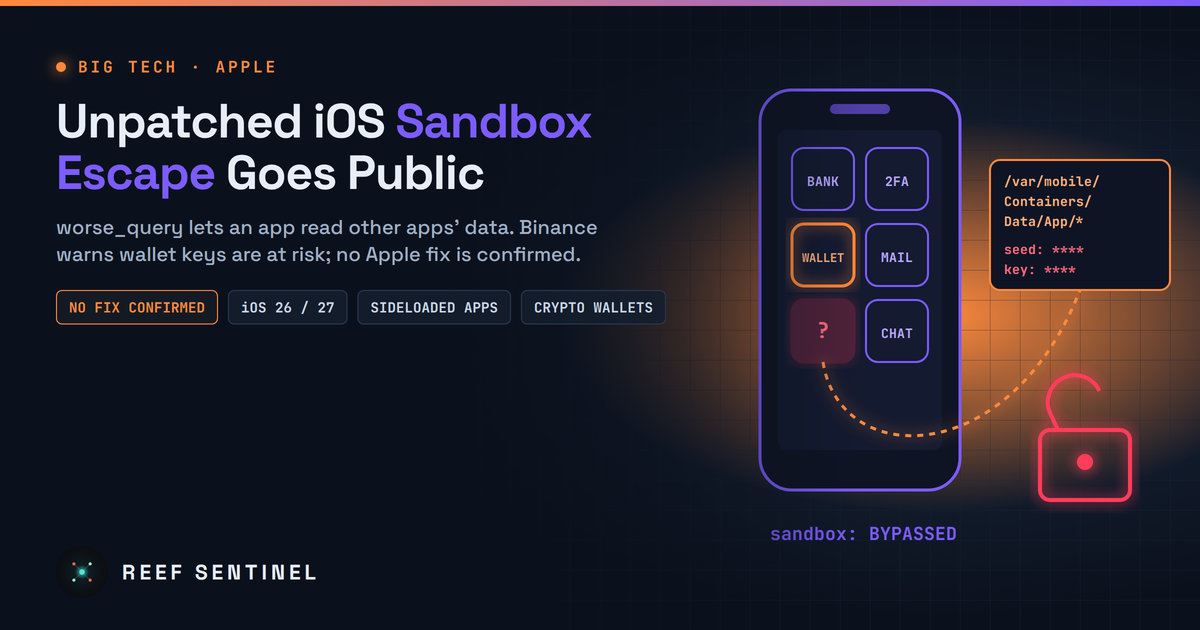
A public iOS 26/27 sandbox escape called worse_query lets an app with an App Group container reach other apps' data, Apple's November 9 updates don't mention it, and Binance has warned iPhone users to remove sideloaded apps.
What Happened
A public proof-of-concept called worse_query lets an iPhone app break out of the iOS sandbox and reach other apps' private data. Apple has not confirmed a fix. On November 10, 2026, Binance warned iPhone users that the flaw could expose crypto wallet secrets such as seed phrases, private keys and login credentials. The researcher who published the code, known as forcequitOS, says the bug still works on the newest iOS release.
Apple shipped iOS 27.2.1 and iOS 26.7.3 on November 9. Their security notes cover flaws in iMessage, Bluetooth and other components. They say nothing about worse_query or about any sandbox escape. As usual, Apple has made no public comment on an issue it has not yet patched.
The Details
The sandbox is one of the main defences in iOS. Each app gets its own data container, and other apps aren't supposed to see inside it. According to the project's README, worse_query reaches the data folders of every installed app. It also reaches shared App Group containers, plugin and internal daemon containers, and on iOS 27 some system folders as well.
Key points so far:
- No jailbreak or kernel exploit needed. The author says worse_query "is not relevant to a jailbreak." It escapes the sandbox but does not take over the device.
- One prerequisite. The app has to set up an App Group container. Sideloading tools such as AltStore and SideStore create one automatically when used with an Apple ID.
- Affected versions. The researcher lists iOS 26.0 through 26.7.2 and iOS 27 up to 27.2. Binance named iOS 26.7.1, 27.0.1 and 27.2. Nobody has publicly confirmed whether iOS 26.7.3 is affected.
- Disputed patch status on 27.2.1. The researcher says iOS 27.2.1 and the first iOS 27.3 beta do not fix the bug. The developers of one tool built on it list 27.2.1 as supported. One blockchain security executive has claimed 27.2.1 blocks it. Until Apple says something, treat 27.2.1 as possibly vulnerable.
- It's already being reused. Developers have built installable apps on the code, including a file manager that can read, edit and delete other apps' data.
worse_query replaces an earlier escape from the same author, bad_query, which worked up to iOS 26.6.1 and an early iOS 27 beta. Developers reported that bad_query stopped working in a later beta. The researcher says they published worse_query sooner than planned because Apple was slow to respond and others had started experimenting with the code in public.
Is Anyone Being Attacked?
No attacks or thefts have been reported. Neither Binance nor the researcher knows of any real-world abuse. The author also calls the proof-of-concept a developer tool that "isn't useful by itself."
The risk is in how it could be used. A malicious app built on this technique, such as a fake "wallet helper," cleaner or file manager installed outside the App Store, could quietly copy data from banking apps, password managers, crypto wallets and messaging apps.
Why It Matters
Many mobile security models assume that one app can't read another app's files. Crypto wallets, authenticator apps, enterprise apps and mobile device management (MDM) agents often keep tokens, cached data or keys in their own container. They count on the sandbox, not their own encryption, to protect that data. A working, public escape breaks that assumption until Apple patches it.
It also comes at a time when Apple's sandbox carries more weight than before. Alternative app marketplaces and sideloading are growing, especially in the EU. Every app installed from outside the App Store now relies even more on the sandbox for protection. Apple's silence is standard practice, but defenders have nothing official to go on. They don't have a CVE, an affected-version list or a patch date.
No one has shown that an App Store app could use worse_query. It is also unclear whether App Review would catch one that tried. The evidence so far points to sideloaded apps as the realistic route.
What It Means for Users and IT Teams
For individual users:
- Remove apps you didn't get from the App Store or a trusted marketplace, especially manually signed IPAs and anything installed through AltStore, SideStore or developer certificates.
- Update to iOS 27.2.1 or iOS 26.7.3 anyway. They fix other real bugs, even though they may not fix this one.
- Hold crypto in a hardware wallet where possible. If you suspect a compromise, follow Binance's advice: create a new wallet on a clean device, move your funds to it, and sign out of all active sessions.
For IT and security teams:
- Check MDM inventory for sideloaded or developer-signed apps and for devices with personal Apple IDs used for sideloading.
- Restrict app installation on supervised devices to the App Store and approved in-house apps.
- Review your own iOS apps. Don't leave long-lived tokens, private keys or sensitive caches unencrypted in the app container. Store secrets in the Keychain or the Secure Enclave, which are separate from the file-system containers worse_query reaches.
- Watch Apple's security release notes for the next iOS 27.x and 26.x builds. Retest once Apple publishes a fix.
What Happens Next
Apple usually fixes publicly disclosed sandbox escapes in a point release or a later beta, and it did so with bad_query. Watch iOS 27.3 and any iOS 27.2.2 or 26.7.4 release notes for a sandbox entry that credits the researcher. Until then, the safest assumption is that any iPhone that runs apps from outside the App Store can expose other apps' data.
