Nvidia CEO Jensen Huang Resigns After Reports He Was Targeted by an Alleged Chinese Intelligence Asset
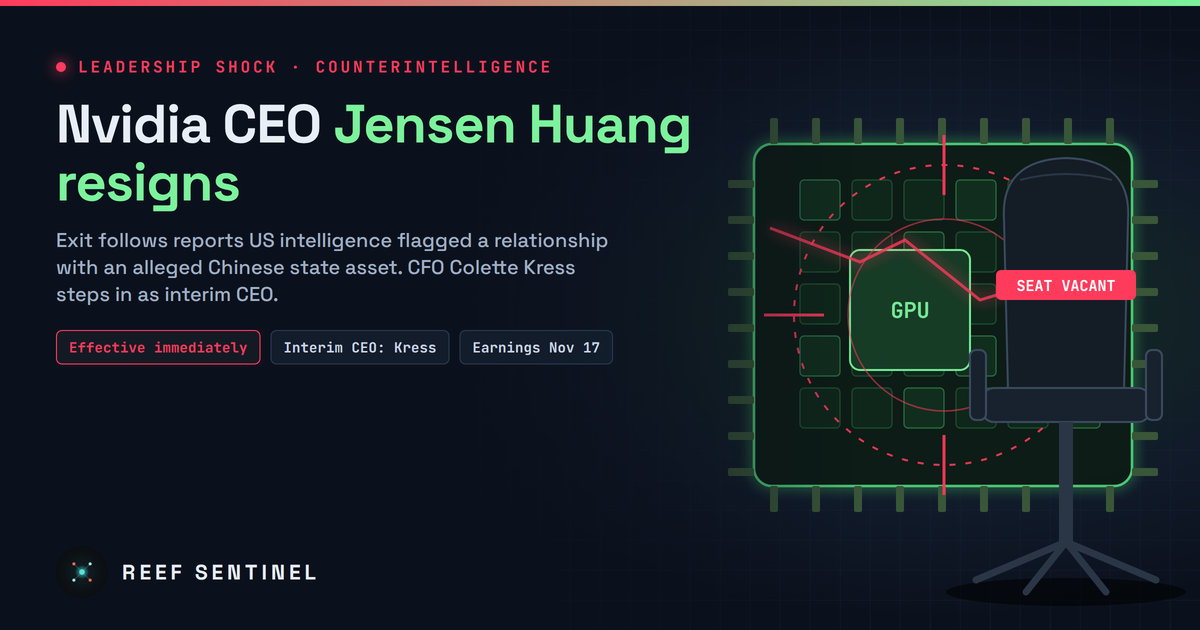
Jensen Huang has quit as Nvidia CEO with immediate effect; CFO Colette Kress is interim CEO and Harvey Jones becomes the board's first chair.
Jensen Huang, who co-founded Nvidia in 1993 and led it into one of the most valuable companies in the world on the back of the AI boom, has resigned as president, chief executive and board member, effective immediately. Nvidia confirmed the move in a regulatory filing on Thursday, 12 November 2026. The company gave no reason for his departure, but it ends weeks of escalating pressure over reports that US intelligence had flagged his relationship with a businesswoman alleged to be working for China's Ministry of State Security.
Who runs Nvidia now
Chief financial officer Colette Kress, who joined Nvidia in 2013, becomes interim CEO and keeps her CFO role until a permanent successor is found. Harvey C. Jones, a former chief executive of chip-design software firm Synopsys and a long-serving Nvidia director, becomes the board's first-ever chair, a significant governance change for a company that relied on Huang as its single leader for more than three decades.
The board says it will consider both internal and external candidates for the permanent role. Jones said the board has full confidence in Kress and the leadership team and expects operations, customer commitments and the product roadmap to continue without interruption. The company says Huang will not work with Nvidia in any capacity going forward. Third-quarter results are still due on Tuesday, 17 November.
How it unfolded
- Late October: reports revealed a close relationship between Huang and Alice Huang (no relation), an executive at Megaspeed, a Singapore-based AI infrastructure firm that bought advanced Nvidia chips and has been investigated over suspected diversion of restricted chips to China. Nvidia initially described the interactions as normal customer contact.
- 5 November: the chairs of three House committees covering China, foreign affairs and intelligence asked Huang for a closed-door briefing on the national security concerns.
- 6–8 November: reports surfaced of a US government memo, circulated in spring 2026, assessing that Alice Huang had been recruited by China's Ministry of State Security to gather information on the Nvidia chief. Huang admitted in a letter to staff that he had been unfaithful to his wife, and the board opened an independent investigation, saying it had no reason to believe national security or company secrets had been compromised.
- 9–11 November: shares slid, a shareholder class action was filed, the federal Megaspeed probe reportedly moved to the Justice Department, and fresh reports of a separate workplace relationship with a subordinate emerged. The board met on Wednesday night and accepted his resignation.
- 12 November: Nvidia confirmed the resignation publicly. Shares fell by double digits during the session.
China has rejected the espionage allegations as unsubstantiated, and no charges have been announced against Alice Huang. The allegations about her intelligence links come from reported US government assessments and have not been tested in court.
The bigger risk: executives as targets
Stripped of the personal details, this is a textbook case of executive targeting: a foreign intelligence service allegedly building a personal relationship with the head of the company that controls the world's most strategic AI hardware. That hardware sits at the centre of US export controls, and the person in question worked at a customer already under scrutiny for moving restricted chips toward China.
Whether or not any information was passed on, the risk sits in three places that security teams often overlook:
- Leaders are high-value targets. Intelligence services and criminal groups profile executives for access, influence and leverage, not just for their passwords. Personal relationships are a classic recruitment and pressure channel.
- Undisclosed relationships create leverage. A hidden conflict of interest is something that can be exploited, whether through blackmail, influence over deals, or quiet access to plans and people.
- Customers and partners extend the attack surface. When a business relationship is also a personal one, normal supply-chain and export-control checks can be bypassed by trust.
What organisations can take from it
- Include senior leadership in insider-risk and counterintelligence awareness programmes, not just staff with privileged IT access.
- Require clear, confidential conflict-of-interest disclosure for executives, covering relationships with customers, suppliers and foreign business contacts, and make sure the board sees it.
- Give executives a protective security programme: travel briefings, device hygiene, social-engineering awareness and a confidential route to report suspicious approaches.
- Treat high-risk customers and distributors, especially in export-controlled sectors, as part of your threat model, with independent checks on where products end up.
- Make sure governance does not depend on one person. Nvidia's move to appoint an independent chair is a reminder that a strong board is a security control too.
What to watch next
The board's independent investigation is continuing, Congress is pressing for testimony on the national security questions, and investors will be listening closely to Kress on the 17 November earnings call for any sign of disruption to customers or supply. The search for a permanent CEO, and whether it looks inside or outside the company, will shape how Nvidia handles export controls and its China exposure from here.