Fake AI-Event Pages Steal Corporate Logins: Device-Code and Reverse-Proxy Phishing Kits Relay the Session Past MFA
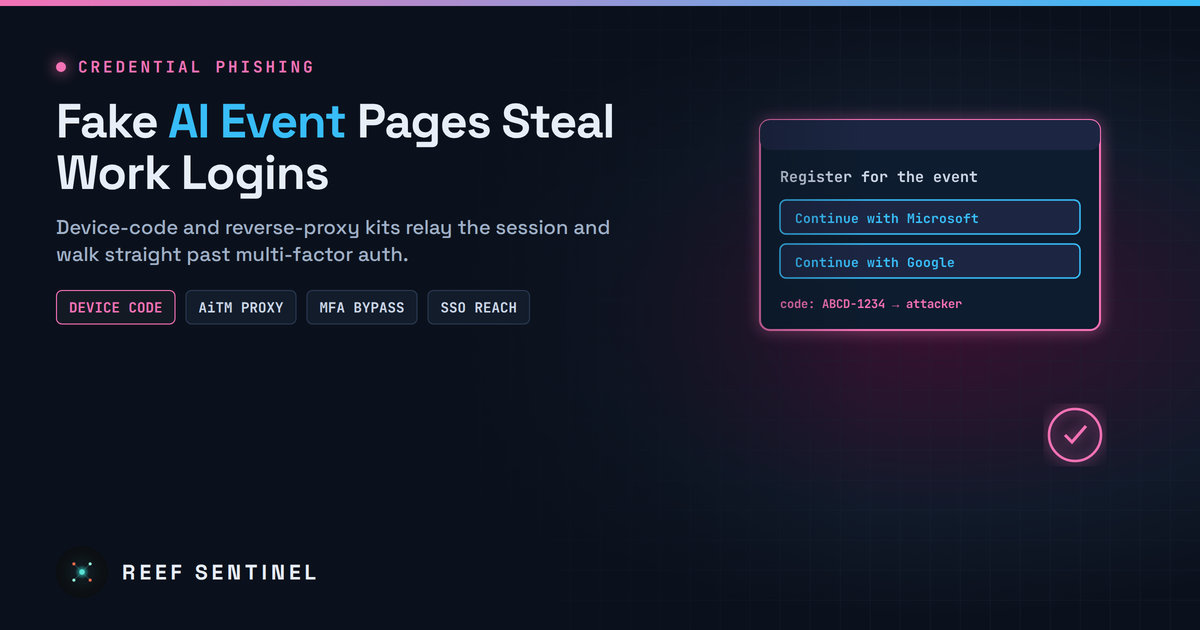
Phishing pages posing as OpenAI, SpaceX and Anthropic events push victims to sign in with work accounts, then use device-code and adversary-in-the-middle kits to capture tokens and session cookies and walk past standard multi-factor authentication.
Overview
A phishing operation is using fake invitations to AI-industry events to steal corporate Microsoft and Google accounts. The pages advertise exclusive OpenAI, SpaceX and Anthropic events with rewards such as free months of premium AI subscriptions, and ask visitors to "register with your work account". Behind the registration button, two phishing-as-a-service platforms take over the sign-in: Kali365 for Microsoft device-code attacks and VoidProxy as a reverse-proxy that sits between the victim and the real login page. Both defeat standard multi-factor authentication.
Researchers detected and blocked visits to these pages in late October 2026. The lures continue a run of AI-event phishing seen earlier in the year that abused legitimate webinar platforms.
The Campaign
Lures observed so far:
- OpenAI: "ChatGPT for Social & Digital Marketing Teams", promising three months of ChatGPT Pro.
- SpaceX: a "private event" offering three months of a premium AI subscription or a share giveaway.
- Anthropic: a page posing as an event at a major cloud conference (already offline when found).
The event pages are built with two custom kits that researchers track as ZoomMock and MSDRoot. Shared infrastructure and targeting suggest one operator runs both. Links reach victims through redirects on trusted services, including Google and Zapier URL shorteners, which helps them slip past email filtering. The initial delivery method has not been confirmed.
Tradecraft
A visitor who clicks through sees a Cloudflare-style "confirm you're not a robot" gate that blocks automated scanners, then a choice of "Continue with Microsoft" or "Continue with Google".
- Microsoft path: the kit uses a device-code flow. The victim is shown a code and told to enter it on Microsoft's genuine login page. Approving it hands the operator valid tokens without the victim ever typing a password on a fake page. The flow is then chained into a reverse-proxy Microsoft login to also capture the password and session cookie.
- Google path: a pop-up presents a Google login served through the reverse proxy, capturing the password, the MFA response and the resulting session cookie.
Because the operator ends up with a live, already-authenticated session cookie (or, in the device-code case, tokens that skip the MFA prompt entirely), ordinary MFA does not stop the account takeover. Once inside, the attacker can reach anything the account federates to through single sign-on, such as mail, file storage, Salesforce and Slack.
Indicators of Compromise
No domains or IP addresses were published with the research. The behavioural indicators to hunt for are:
- Sign-ins that follow a device-code authentication the user did not initiate.
- Authentications arriving through reverse-proxy infrastructure (new ASN, hosting-provider IP, impossible-travel against the user's normal location).
- Redirect chains that pass through Google or Zapier short links into event-registration pages.
Detection
- In Microsoft Entra ID, alert on device-code sign-ins, especially where the authenticating device and the approving user are in different locations. Device-code authentication is rarely needed for everyday users.
- Review sign-in logs for new or unusual session-cookie reuse and for tokens issued shortly after a device-code grant.
- Alert on logins from hosting-provider IP ranges and on impossible-travel events.
- In Google Workspace, watch for new OAuth sessions and MFA approvals from unfamiliar locations, and for new app passwords or session grants.
- Add brand terms for well-known AI vendors and major conferences to lookalike-domain monitoring.
Recommended Actions
- Do not enter Microsoft device codes shown by a website. Microsoft shows device codes only when you deliberately start that flow on a real device.
- Treat any "event" that requires a corporate sign-in to claim a reward as hostile.
- Restrict or disable device-code authentication where it is not required, using Conditional Access policies.
- Move high-value accounts to phishing-resistant MFA (FIDO2 security keys or passkeys), which cannot be relayed by a reverse proxy.
- Shorten session lifetimes and require reauthentication for sensitive apps, so stolen cookies expire sooner.
- Educate staff that free premium-AI offers tied to work logins are a current lure.
Analyst Assessment
This campaign is effective because it exploits genuine curiosity about AI products and because its two techniques, device-code phishing and reverse-proxy relaying, both sidestep the MFA most organisations rely on. The use of real cloud redirectors and a bot-check gate shows operators optimising for deliverability and for evading security crawlers. The underlying methods are not new, but packaging them into polished, topical event pages lowers the victim's guard. The durable defences are phishing-resistant MFA and tight control over device-code authentication; awareness training alone will not keep pace with lures this well made. Expect the AI-event theme to persist and rotate through whichever vendors are most in the news.
