FBI Job Portal Breach Widens: DOJ Memo Warns U.S. Attorneys' Office Staff and Background-Check Records May Be Exposed in ShinyHunters Intrusion
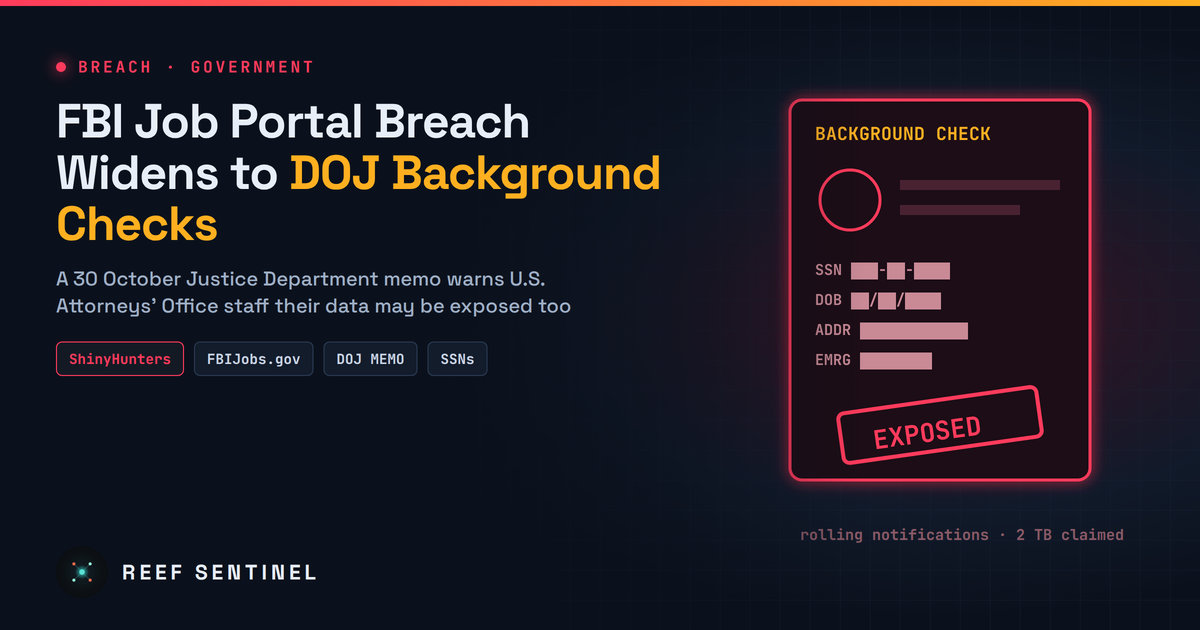
A 30 October Justice Department memo says the September intrusion into the FBI's recruitment portal, claimed by ShinyHunters, may also have exposed DOJ prosecutors' personal data and background-check records.
Overview
The breach of the FBI's recruitment portal, claimed by the cybercrime group ShinyHunters in September 2026, is wider than first described. An internal Justice Department memo dated 30 October 2026 warns staff in U.S. Attorneys' Offices that the same intruders may have obtained their personal information too. It also says the portal holds sensitive background-check data for Department of Justice employees and applicants. The memo was sent by the Director of the Executive Office for U.S. Attorneys and became public on 3 November.
What is new: earlier reporting focused on FBI agents and FBI job applicants. The memo extends the possible exposure to prosecutors and DOJ staff more broadly, and to the background-investigation records collected through the portal.
The Breach
- System: the FBI's job-application portal (FBIJobs.gov), which also processes applicant and employee vetting information.
- Data at risk: Social Security numbers, dates of birth, home addresses, phone numbers and emergency contacts. Background-check material is now also named as possibly exposed.
- Claim: ShinyHunters said it held "very sensitive data on almost ALL FBI Agents" and on job applicants, about 2 TB in total. It also claimed it had used the portal to reach other agency programs but gave no evidence. A former agent confirmed that a sample record the group shared was authentic.
- Scale: the FBI has not given a total. It says notifications are going out "on a rolling basis", with formal notices to follow once each person's data is confirmed.
Timeline
- 15 September 2026: Dutch police arrest a 24-year-old Amsterdam man they describe as a ShinyHunters leader. The FBI has not tied this arrest to the portal intrusion, which appears to have happened after he was detained.
- 21 September: the intrusion takes place.
- 22 September: the FBI classifies it as a cybersecurity incident.
- Late September: ShinyHunters goes public and demands that the FBI retract a May public service announcement. It then says it will not publish the data and calls the threat a "marketing campaign". An internal FBI message tells staff to assume their personal information may have been taken.
- 30 October: the DOJ memo warns U.S. Attorneys' Office staff and names background-check data as being at risk.
- 3 November: the memo's contents become public. Many affected workers say they still have not been notified.
Tradecraft
ShinyHunters is a financially motivated extortion group best known for mass data theft from SaaS and web platforms, often through stolen credentials, social engineering of help desks and abuse of exposed application interfaces. How it got into the FBI portal has not been disclosed. The group's usual pattern is to steal data in bulk, show a small verified sample to prove access, and then push for payment or concessions through public pressure. Its sudden promise not to leak the FBI data does not mean the data has been destroyed.
Detection
For agencies and contractors whose staff used the portal, the practical exposure is to targeted social engineering, not to direct network compromise:
- Watch identity-provider and help-desk logs for password-reset and MFA-reset requests that use knowledge-based answers (date of birth, address, SSN fragments). Treat these as possibly malicious.
- Flag calls and texts to staff that claim to be from HR, security or "background investigations" and ask them to confirm details or install software.
- Monitor for new-account fraud and credit applications using employee identities, through credit-monitoring services.
Recommended Actions
- Affected individuals: freeze credit with all three U.S. bureaus, enable carrier port-out and SIM-swap locks, and treat unexpected "verification" contacts as hostile until confirmed through a known channel.
- Agencies: stop using knowledge-based authentication for help-desk identity checks. Require in-person or phishing-resistant verification for MFA resets.
- Personal safety: prosecutors and agents should check what home addresses and family details are visible in public people-search databases and request removal where possible. The FBI's own guidance includes recording new voicemail greetings and watching for unusual contact.
- Security teams: add the exposed population to high-risk user groups for stronger monitoring of phishing and account-takeover attempts.
Analyst Assessment
The incident shows how recruitment and vetting systems collect some of the most sensitive data a government holds, often with less protection than operational networks. The DOJ memo suggests the government's own view of the impact is still growing six weeks after the intrusion. The most likely harm is not a public leak but quiet resale or targeted use: identity fraud, impersonation of officials, and threats to people working on criminal cases. Organisations running similar applicant portals should assume they are attractive to extortion groups, keep vetting records separate from public-facing systems, and limit how long that data is kept.
