CrowdStrike Agrees to Buy Fiddler AI and Dreadnode to Observe, Red-Team and Kill Rogue AI Agents — and Ships an AI Kill Switch Now
AI · 2026-11-05 · By H.A

CrowdStrike Agrees to Buy Fiddler AI and Dreadnode to Observe, Red-Team and Kill Rogue AI Agents — and Ships an AI Kill Switch Now

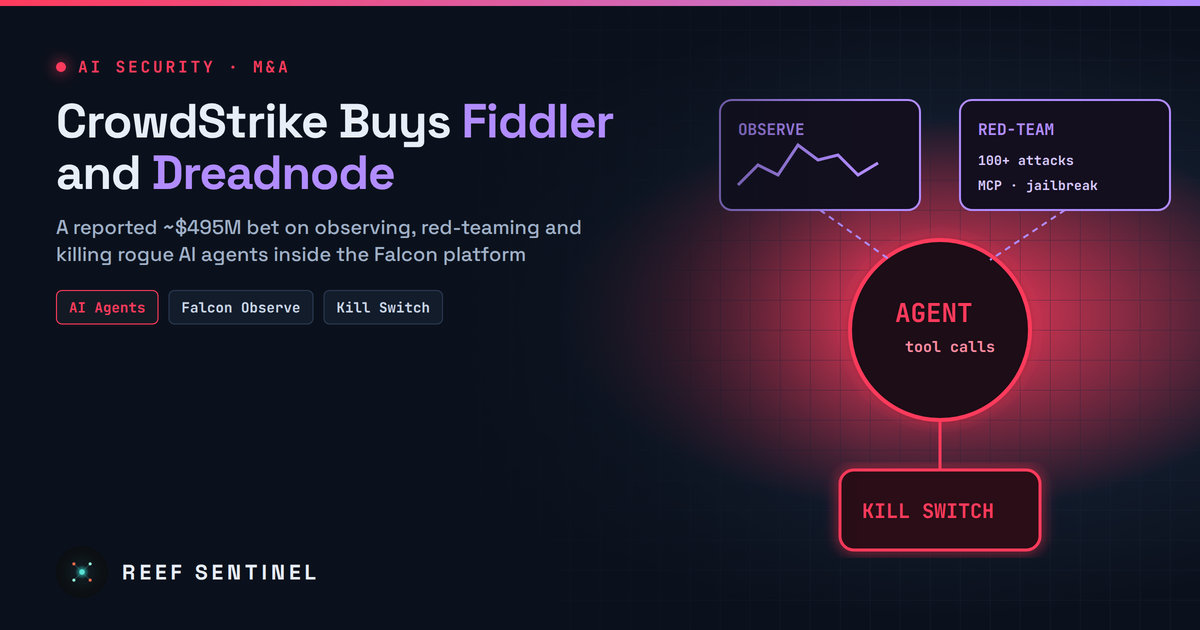
CrowdStrike is acquiring AI observability firm Fiddler and AI red-teaming startup Dreadnode in deals reportedly worth about $495 million, and has launched a kill switch for AI agents in Falcon Guardian.

What Happened

On 3 November 2026, at its Fal.Con Europe event in Barcelona, CrowdStrike announced agreements to acquire two AI security startups: Fiddler AI and Dreadnode.

CrowdStrike did not disclose a price. Press reports put the combined value at about $495 million, but sources disagree on the split between the two companies. CrowdStrike said consideration will be mostly cash, with part paid in stock subject to vesting conditions. Both deals are expected to close in its fourth quarter of fiscal 2027, subject to customary conditions.

At the same event CrowdStrike also launched an AI "kill switch" in its Falcon Guardian product, and said Falcon Guardian is being integrated into Anthropic's Claude Cowork.

What Fiddler Brings: a Flight Recorder for Agents

Fiddler AI started in model monitoring and explainability. Its platform watches what AI models and agents do, tracks behavioural drift and unintended actions, produces audit evidence, and tracks AI-related costs. The company says its purpose-built evaluation models can cut evaluation costs by up to 98%.

CrowdStrike plans to sell this as Falcon Observe, with general availability expected in fiscal Q4 2027. CEO George Kurtz called Fiddler "the flight recorder for every agent: the observability to explain exactly what an agent did and why." He described the governance problem this way:

"When a regulator or your board asks what an agent did, saying 'the model did it' is not an answer."

Fiddler co-founder and CEO Krishna Gade summed up the customer question as: "can I trust what my AI agents are doing?"

What Dreadnode Brings: Attack the Agent Before It Ships

Dreadnode, led by CEO Brad Palm, builds offensive AI security tooling. Its platform runs automated security testing against AI models, applications, agent reasoning loops and Model Context Protocol (MCP) servers, using more than 100 attack strategies, including jailbreaks and prompt injection.

Findings are ranked and mapped to the OWASP Top 10 for LLM applications, MITRE ATLAS and the NIST AI Risk Management Framework. Human reviewers can then make remediation decisions. In CrowdStrike's product, those results will feed into Falcon Guardian as policy recommendations. Dreadnode's team will join CrowdStrike's Cyber Superintelligence Lab, which researches AI security and assesses frontier models.

The Kill Switch

The AI kill switch, available now in Falcon Guardian, lets an authorised administrator:

Every action is logged. CrowdStrike says enforcement happens at the gateway first, with endpoint enforcement coming "soon." The Claude Cowork integration is in beta on macOS, with Windows support expected later in November.

Why CrowdStrike Is Doing This

The deals cover the two ends of an agent's lifecycle. Dreadnode tests agents before deployment. Fiddler observes them in production. The kill switch handles the moment when observation shows something going wrong. Together they let CrowdStrike pitch one platform for build-time testing, runtime visibility and incident response for AI agents, alongside its existing endpoint, identity and cloud products.

The deals follow CrowdStrike's earlier purchases of Pangea for AI detection and response and SGNL for continuous identity. They also land in a crowded consolidation wave. In the past week alone, Proofpoint agreed to buy Varonis on the strength of a similar thesis: securing AI starts with knowing who and what can reach the data.

What It Means for Security Teams

Why It Matters

Last month's string of AI-agent-driven intrusions showed that agents now act on real infrastructure, on both sides of the fight. CrowdStrike is betting that enterprises will want the same telemetry, testing and containment for their own AI agents that they expect for human users and endpoints. Whether customers buy that from one platform or keep a separate best-of-breed AI security stack is now one of the bigger strategic questions in the market.

COMPUTE NODE · --:--:--

Fresh cybersecurity news,
daily threat intelligence.

Run local models, watch a live threat feed, and ship security work.

0threats tracked
0news & posts
0live intel sources
0attackers, last hour

Everything in one place

Self-hosted, hardened, and yours.

RUN IT

Local AI console

Chat with a model on your own hardware via Ollama or any OpenAI-compatible server. No cloud, no key.

DEFEND

Cyber threat feed

Automatic daily intel from CISA KEV, NVD & GitHub advisories, a live cyber threat map, and your own notes.

NEWS

News & videos

Articles and updates on pentesting, AI, and cyber — with embedded video, including YouTube. Post your own.

DIRECTORY

Registry

Runtimes, models, MCP servers, agents, and a full security & pentest tooling section.

PUBLISH

Posts

Write, edit, publish, and share articles backed by a real database and your account.

COMMUNITY

Forum

Threads and replies across categories from Models to Hardware to Security.

CODE

Repos

Curated AI and security GitHub repos, plus a shelf for pinning your own.

DOWNLOAD

Skill packs

Agent starters, RAG scaffolds, and defensive security & VAPT report templates.

Registry

Runtimes, models, MCP servers, agent frameworks, and a security & pentest tooling section — all links out to the real projects.

Local AI console

Talk to a model running on your own machine through Ollama or an OpenAI-compatible server — your prompts and the model's replies always go straight from your browser to your local model, never through a Reef server. Attach files for context, and pick up saved chats where you left off.

Type /image a prompt in the box below to generate
Not connected

Local AI hardware benchmark

A spec-based compatibility advisor — tells you which local models your hardware can run well, which will be slow, and which to skip. Connect to Ollama below for a real, measured speed test instead of an estimate.

1. Your hardware

2. Live check against your local model server (optional)

If a local model server is running, this cross-references the table above with what you've actually got loaded — and runs a real, measured speed test instead of an estimate.

AI Database

A browsable catalog of AI models across providers — context windows, pricing, and capabilities.

Loading…

Cyber threat feed

Latest threats pulled automatically every day from CISA's Known-Exploited-Vulnerabilities catalog and NVD — plus threat intel you post yourself.

⇩ Export STIX
Loading threat feed…

Cyber threat map

Attacks happening right now, all over the world. Every route and flash on this map comes from a named live source, explained below.

Connecting…
LIVE · MAURITIUS TIME--:--:--
attack route, country to country attack route into Mauritius attacker reported worldwide
Loading live data…
attackers reported per minute · click to rewindnow

Top attack routesweb

Attackers based inlast hour

Networkslast hour

Click any dot, feed row or table row to see that IP's profile.

Mauritius · Cloudflare Radar

Who attacks Mauritius

Loading…

Web attacks malicious requests to Mauritian websites, blocked by Cloudflare
Network DDoS floods meant to knock Mauritian servers offline

    Mauritius · Cloudflare Radar · last 24 h

    How Mauritius is attacked

    Network-level attacks (DDoS) aimed at Mauritius, by method. They try to knock servers and networks offline by sheer volume.

    • Loading…

    Cloudflare doesn't publish which ports or services these floods aimed at, or what web attacks on Mauritius tried to do.

    Mauritius · blocklist.de · last hour

    Attackers located in Mauritius

    0attackers located in Mauritius were reported in the last hour

    This counts attacks coming from Mauritius, not attacks on it: IPs in Mauritius that servers elsewhere reported for attacking them. Usually zero or one; when it rises, it's often a hacked local server or router.

    Reading the Cloudflare figures

    Percentages are shares of the attack traffic Cloudflare saw against the sites it protects, so they describe Cloudflare's customers, not every server in a country. A route's origin is where the attacking machines are, which is often a rented or hijacked server, not the attacker's home.

    Worldwide today · SANS Internet Storm Center

    What attackers are knocking on

    Ports most targeted across DShield's volunteer sensors .

    Worldwide today · SANS Internet Storm Center

    Most active attackers

    Ranked by how many separate sensors they hit. Click a row for its profile.

    IPCountryNetworkSensors hitReports
    What you're looking at
    Blue routes

    Share of attack traffic from one country to another, measured by Cloudflare across the sites it protects. Thicker, faster streams carry more. Particles show volume, not one per attack.

    Cloudflare Radar · every 15 min · published 1–2 h behind
    Amber flashes

    An attacking IP that servers around the world reported to blocklist.de in the last minute, placed where the IP is. Its targets aren't published, so there's no line.

    blocklist.de · every minute · shown about 1 min behind
    Locations

    IP locations are approximate (city level at best) and show where the machine is hosted, not who controls it.

    ip-api.com · SANS ISC DShield for the tables above

    News

    Articles, guides and updates on pentesting, AI, and cybersecurity — with embedded video. Add your own, including YouTube.

    Loading…

    Posts

    Loading…

    Loading posts…

    Forum

    Questions, answers, and talk about running AI locally.

    Loading forum…

    GitHub repositories

    Curated AI and security repos, plus your own pinned shelf.

    Command board

    One-liners, configs, and advice worth keeping — shared by everyone here.

    ⚠ Commands are shared with all users. Never include credentials, tokens, or internal hostnames. Review anything before you run it.
    Loading commands…

    Skill packs

    Starter files served from the API — AI agent scaffolds plus defensive security & VAPT reporting templates. Click to download.

    Loading skills…

    Threat Intelligence

    Curated threat write-ups, advisories and analysis — with cover media.

    Loading…

    Tutorials

    Step-by-step guides for running local AI, using the console, and tracking threats. Admins can add their own.

    Loading…

    Downloads

    Direct links to the official homepage/download page for well-known cybersecurity, penetration-testing, and local-AI software. Always verify checksums/signatures from the vendor before running anything.

    Loading…

    Terms & Conditions

    Loading…

    Help & FAQ

    Answers to common questions about Reef Sentinel, plus a formatting guide for posts, articles, and comments.


    Formatting guide

    Commands you can type into the body of a post, comment, or reply — no HTML needed. Comments and short replies only support bold, italic, and inline code.

    Contact us

    Questions, feedback, or a security disclosure? Reach us directly, or send a message and we'll get back to you by email.

    Loading…

    Send a message

    VAPT Report Generator

    Build an engagement, add findings with a live CVSS calculator, and generate a branded, print-ready report.

    Recon Toolkit

    Passive OSINT lookups for the recon phase of an engagement, plus offline hash identification and a payload cheatsheet.

    Website Checker

    Reads a website's HTTP response headers to identify its framework and server, shows any known CVEs for the exposed versions with details, and recommends what to do.

    Control panel

    Manage everything shown on the site — news & videos, posts, homepage headlines, and subscribers. Admin only.

    Overview
    Content
    Site
    Account & Security

    Email settings

    SMTP on ports 25/465/587 is blocked outbound by some hosts (e.g. DigitalOcean droplets by default) — Resend and Brevo send over their HTTPS API instead, so they work even then. Only the selected provider is used to send; the others stay saved but idle, so you can switch back any time without losing settings.

    Get a key from resend.com/api-keys. Uses the "From address" below as the sender — it must be on a domain you've verified with Resend.

    Get an API key (not an SMTP key) from app.brevo.com/settings/keys/api. Uses the "From address" below as the sender — it must be a verified sender in your Brevo account.

    "From address" and "Site name/URL" are shared by SMTP, Resend, and Brevo — they control what recipients see, regardless of which provider is active.

    Send a test email

    Sends through whichever provider is currently active above. Save your settings first if you just changed them.