China Speeds Up a Single AI Law Covering Data, Compute, Algorithms and Apps — With Sandboxes and Incident Reporting
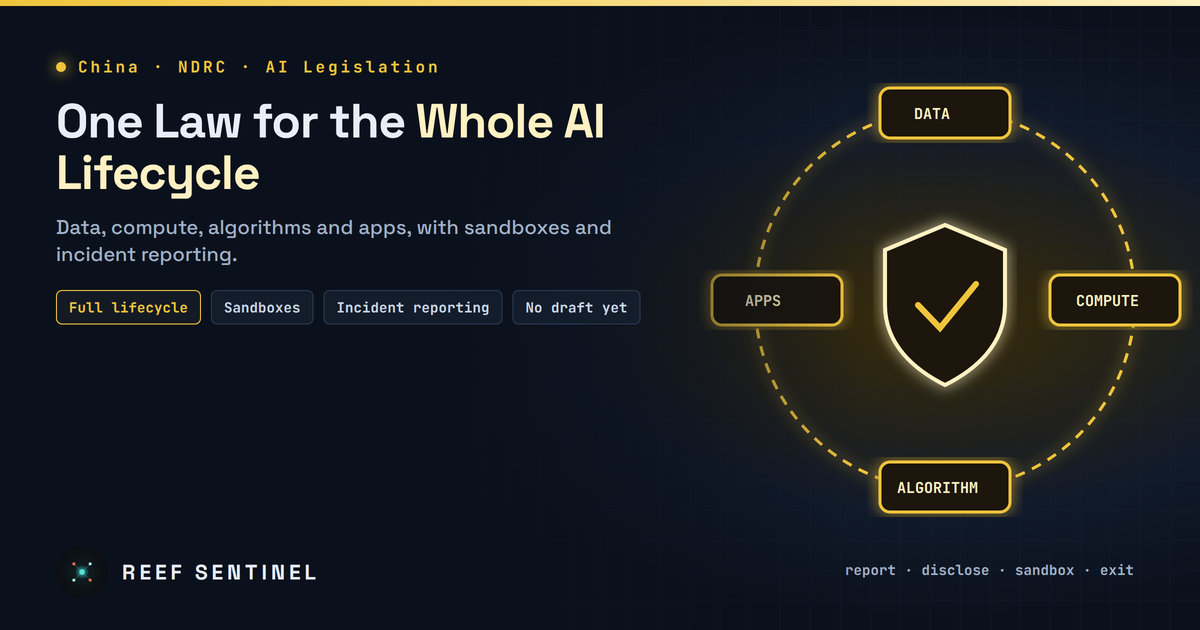
China's NDRC says it will speed up comprehensive AI legislation covering the full model lifecycle, with safety standards, regulatory sandboxes, a transition period and an expectation that developers disclose risks and report incidents and vulnerabilities.
What Happened
China's National Development and Reform Commission (NDRC), the state economic planner, said on November 3 that it will speed up comprehensive artificial intelligence legislation covering the entire lifecycle of AI models: the data they are trained on, the computing power behind them, the algorithms themselves, and the applications built on top.
The announcement follows the State Council's decision, in its legislative work plan earlier this year, to include a comprehensive AI law. China already has narrower rules, including the 2023 interim measures for public-facing generative AI services, rules on recommendation algorithms and rules on deep synthesis ("deepfakes"). A single lifecycle law would replace that patchwork with one framework.
What the NDRC Described
According to the NDRC's statement, the legislation would:
- Cover the full lifecycle: research, development and deployment, across data, compute, algorithms and specific applications.
- Set safety standards and ethical guidelines for that whole lifecycle.
- Push developers and operators toward disclosure: they would be expected to promptly disclose security risks and proactively report incidents and vulnerabilities.
- Create regulatory sandboxes in different industries, with defined mechanisms for application, testing, use and exit, so companies can trial new AI systems under supervision.
- Allow a "reasonable transition period" before new rules take effect, with rules reviewed regularly and adjusted as needed.
Beyond technical safety, the NDRC listed social risks the law is meant to address: jobs displaced by AI and the need to strengthen social security, user addiction to AI and emotional dependence on it, plus deepfakes, algorithmic bias and privacy leaks.
Reports say a senior NDRC official named leading domestic model developers such as DeepSeek, Moonshot and Alibaba as the kinds of companies the rules would reach. The NDRC has not published a draft, and no enactment date has been announced.
The Security Angle
For security teams, the most significant part is the incident and vulnerability reporting element. China already has strict breach-reporting rules under its Cybersecurity Law and its rules on reporting network product vulnerabilities, which require vendors to report flaws to the government within tight deadlines. Extending that model to AI could mean:
- AI-specific incident reporting: model misuse, jailbreaks used at scale, harmful outputs, or data leaks caused by AI systems may become reportable events, not just traditional breaches.
- Vulnerability disclosure for models: flaws in models and AI pipelines, such as prompt injection, training-data poisoning or agent tool misuse, could be pulled into a formal government reporting channel.
- Lifecycle documentation: rules covering data and compute imply audit trails showing where training data came from and how models were tested before release.
This year, AI security incidents have moved from research papers into real breaches, abused API keys and AI-driven intrusions. A lifecycle law with mandatory or strongly encouraged reporting would give Chinese regulators visibility that most other jurisdictions still lack.
Who Is Affected
- Chinese AI developers and platforms, from frontier labs to companies building applications on their models.
- Foreign companies offering AI services in China or relying on Chinese models, compute or data. Lifecycle rules usually apply to the whole supply chain, not just the final product.
- Multinationals running AI governance programmes, which will need to map one more regime alongside the EU AI Act, sector rules in the US and voluntary frameworks elsewhere.
What To Do Now
Nothing is enforceable yet, but organisations with exposure to China can prepare:
- Inventory AI systems that touch Chinese users, data or infrastructure, including third-party models and APIs embedded in products.
- Set up an AI incident process that covers model-specific events (prompt injection, data leakage through outputs, agent misuse), not just classic breaches. Most reporting regimes assume you can detect and classify these.
- Document data provenance and pre-release testing for models you train or fine-tune. A lifecycle law makes these records the evidence regulators ask for first.
- Watch for the draft text. The details that matter most, such as reporting deadlines, thresholds, penalties and the length of the transition period, are not public yet.
Why It Matters
China has regulated AI one use case at a time since 2023. A single law covering data, compute, algorithms and applications would make it one of the most comprehensive AI regimes in the world. It sits alongside the EU's risk-based approach but is broader in scope, reaching into social issues such as emotional dependence and job loss. For the security community, the key question is whether AI incidents and model vulnerabilities become formally reportable. If they do, China would be building, by regulation, the kind of AI incident record that researchers elsewhere are still trying to assemble voluntarily.
