$2.58 a Bug, No Patch in Sight: AI Finds OT Flaws Cheaply, but Fixing Them Is Still Slow
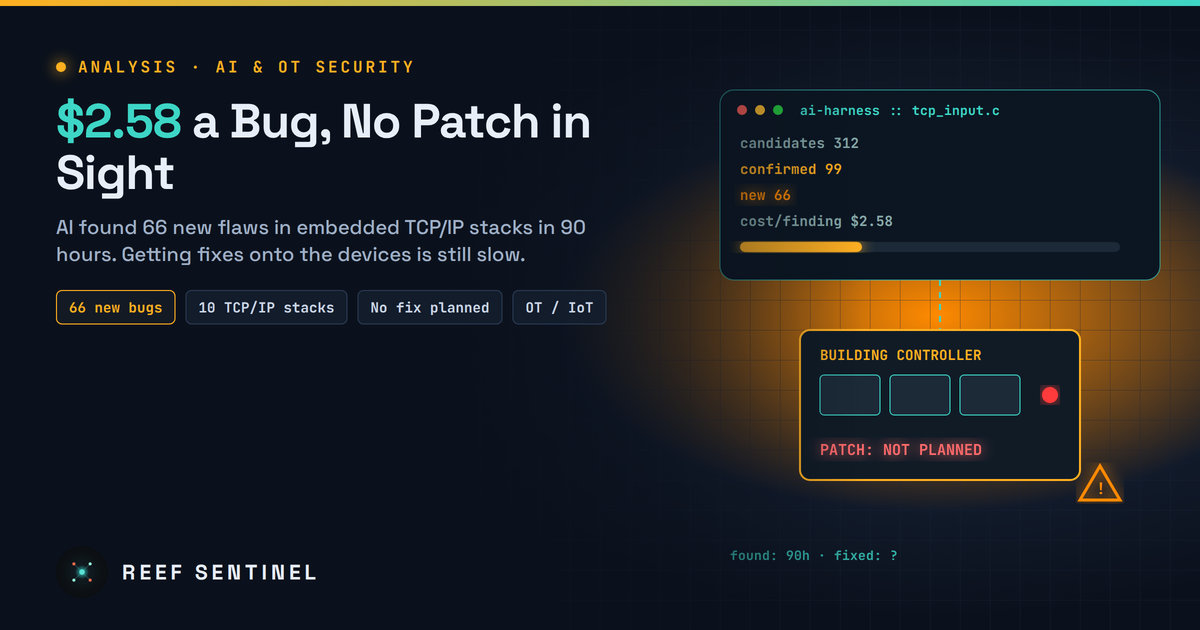
$2.58 a Bug, No Patch in Sight: AI Finds OT Flaws Cheaply, but Fixing Them Is Still Slow
Forescout's off-the-shelf AI harness found 66 new flaws in embedded TCP/IP stacks in 90 hours, but the Siemens advisory linked to the work shows the slow, expensive part is still getting fixes onto real devices.
What the research actually did
On 12 November, at 17:02 Mauritius time (13:02 UTC), Forescout's Vedere Labs published a study called "Finding Critical Infrastructure Bugs with Off-the-Shelf AI". The team returned to the type of target it had analysed by hand years earlier in its Project Memoria work: the small TCP/IP stacks built into PLCs, building controllers, medical devices, network gear and IoT products.
The team tested ten stacks. Six are open source: Contiki, Ethernut (Nut/Net), FNET, PicoTCP, lwIP and wolfIP. The other four are proprietary: Siemens' Nucleus NET and three that are still under disclosure and are not named. The researchers did not use a custom model. They used commercially available Claude models together with standard tools: Semgrep, Joern (with 32 rules they wrote), and Ghidra for the binaries.
The results:
- 99 vulnerabilities confirmed in about 90 hours. 66 were new and 33 were rediscovered from earlier work.
- 52% of the new bugs were rated high or critical. 29% were in core TCP/IP components.
- Static analysis cost about $935, or $2.58 per finding. The researchers put total model spend at $1,200 to $2,300.
- The researchers say the earlier manual project took about nine months.
These figures are easy to quote out of context, so the caveats matter. Building the harness, the rules and the emulation setup is not included in the cost. The "90 hours" includes human checking: Forescout's own release splits it into about 10 hours of AI analysis and 80 hours of validation. Precision also varied a lot. Across the ten stacks, between 11% and 70% of findings held up. In the authors' words, in the worst case "nine in 10" of the AI's candidate findings were wrong. Of 312 unique candidates, 99 were confirmed.
The cheap part and the expensive part
The headline says AI cut vulnerability research from months to days. Finding bugs is now cheap. Confirming them still takes expert time. Fixing them on devices that are already installed is as slow as ever, and in some cases it will never happen.
The vendor responses show this. Forescout reported 54 of the 66 new findings. The open-source maintainers of Contiki, FNET, PicoTCP, wolfIP and lwIP fixed theirs. Ethernut did not respond. Its denial-of-service bug is now public as CVE-2026-120596: a single TCP segment with an unknown option whose length byte is zero sends NutTcpInputOptions into an infinite loop and freezes every TCP service until the device is rebooted. The three unnamed proprietary stacks account for 29 findings and were still "investigating" when the report came out. One of them, S1, runs on a wireless access point that has been discontinued and whose maker no longer exists. That device has hardcoded admin credentials that cannot be changed. The researchers say plainly that no vendor will be able to provide a patch.
"Fixed" is not the same as fixed
The Siemens case shows a gap that the research summary hides. Forescout lists the five Nucleus NET findings as fixed and points to Siemens advisory SSA-333035. That advisory, published on 13 October, covers CVE-2026-89208 and CVE-2026-102073 to 102076. The affected products are building automation controllers: APOGEE PXC and TALON TC controllers, the APOGEE MBC/MEC, and a long list of Desigo PXC and PXM models.
- APOGEE PXC and TALON TC can be updated to V3.5.7 (BACnet) or V2.8.21 (P2 Ethernet), through the Siemens partner portal.
- For APOGEE MBC/MEC and the Desigo PXC/PXM models, Siemens says: "Currently no fix is planned."
- The worst of these flaws, CVE-2026-102073 (CVSS 3.1 score of 8.2), lets an unauthenticated attacker read device memory or crash the web service. Siemens' advice is to keep the FTP and web services disabled (they are off by default) and to segment the network.
So the stack was fixed, but many of the controllers running it will not be. For an asset owner, the question is not whether the vendor fixed the stack. It is whether the box in the plant room will ever get that fix. Usually a partner has to install the update, the site has to schedule downtime, and someone has to accept the risk of touching a controller that has worked for ten years.
Who benefits from cheap discovery
Forescout's CEO said that "containing risk, rather than patching, must be the priority". For embedded devices that is simply a description of how things already are. But cheap discovery does not help defenders and attackers equally:
- Attackers need one bug. Defenders need a fix for every bug. At $2.58 per candidate, it costs almost nothing to scan old firmware for memory-safety bugs. Fixes still depend on a vendor that may have stopped support or no longer exists.
- The harness works best on parsing bugs, which suits attackers. The authors say the tool is strongest at memory corruption in protocol parsing: 48 of the 99 bugs were memory corruption and 27 were integer issues. Those are the bugs that are reachable with one packet. It was weaker at logic and design flaws such as predictable sequence numbers or problems in the TCP state machine.
- Many devices only ever see a denial of service, and that is enough. Several of the Siemens and Ethernut bugs "only" crash the device. In OT, a controller that freezes until someone reboots it by hand is an operational incident.
- Maintainers will get more reports, and more noise. Forescout tells vendors to expect "more AI-generated vulnerability reports, many of them low quality". With precision as low as 11% on some targets, any team that forwards raw model output will overload small open-source projects. Forescout's results held up because they validated every finding.
None of this is surprising. It does change the timeline. The gap between a bug becoming findable and a fix reaching the device used to be protected by the cost of the research. That cost is now gone.
Practical takeaways
- Inventory the stack, not just the product. Ask suppliers which TCP/IP stack and version each device uses, and put SBOM requirements into procurement. Without that, you cannot tell whether an advisory like SSA-333035 affects you.
- Treat "no fix planned" as a permanent condition. Put those devices on isolated segments. Only named engineering hosts should be able to reach them, and they should have no internet path.
- Turn off services you don't use. FTP, Telnet, embedded web admin interfaces and IPv6 are where most parsing bugs are. Siemens' own mitigation for four of the five CVEs is to keep FTP and web disabled.
- Prioritise by reachability. A critical bug in a service that is turned off matters less than a medium one in the BACnet or HTTP handler on a network segment that is reachable.
- Watch for crashes as well as intrusions. Repeated controller reboots or a TCP service that stops responding may be the first sign that someone is sending malformed packets at a device.
- If you ship firmware, run these tools yourself first. The study used tools that anyone can buy and a few weeks of skilled time. Assume someone less friendly is already doing the same.
