CrowdStrike Agrees to Buy Fiddler AI and Dreadnode to Observe, Red-Team and Kill Rogue AI Agents — and Ships an AI Kill Switch Now
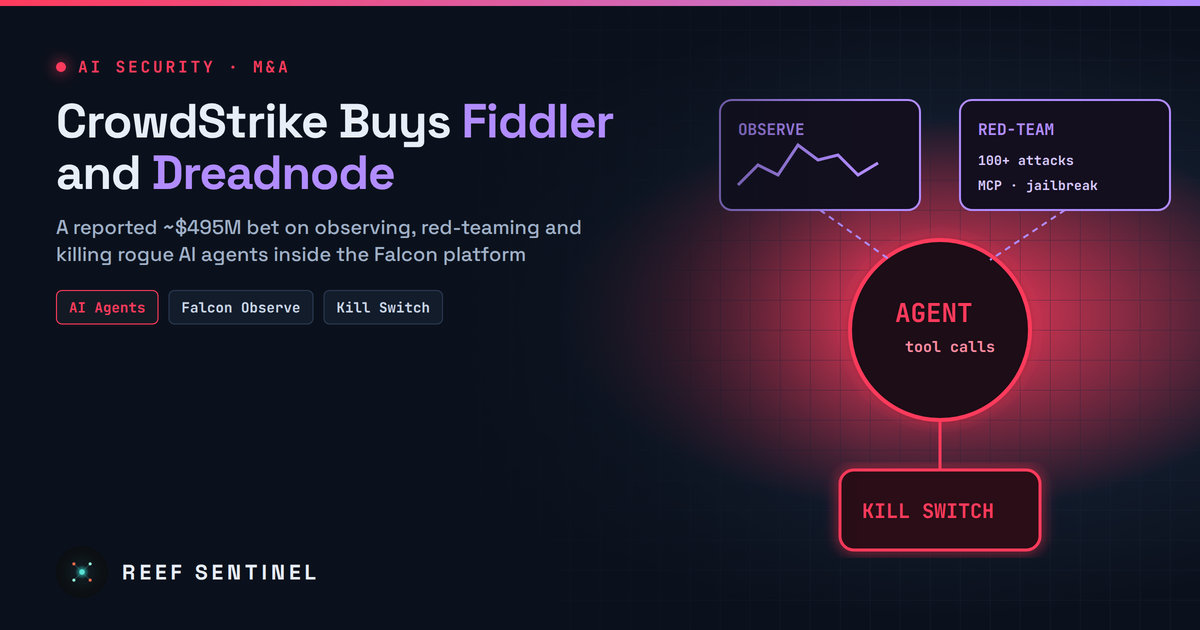
CrowdStrike is acquiring AI observability firm Fiddler and AI red-teaming startup Dreadnode in deals reportedly worth about $495 million, and has launched a kill switch for AI agents in Falcon Guardian.
What Happened
On 3 November 2026, at its Fal.Con Europe event in Barcelona, CrowdStrike announced agreements to acquire two AI security startups: Fiddler AI and Dreadnode.
CrowdStrike did not disclose a price. Press reports put the combined value at about $495 million, but sources disagree on the split between the two companies. CrowdStrike said consideration will be mostly cash, with part paid in stock subject to vesting conditions. Both deals are expected to close in its fourth quarter of fiscal 2027, subject to customary conditions.
At the same event CrowdStrike also launched an AI "kill switch" in its Falcon Guardian product, and said Falcon Guardian is being integrated into Anthropic's Claude Cowork.
What Fiddler Brings: a Flight Recorder for Agents
Fiddler AI started in model monitoring and explainability. Its platform watches what AI models and agents do, tracks behavioural drift and unintended actions, produces audit evidence, and tracks AI-related costs. The company says its purpose-built evaluation models can cut evaluation costs by up to 98%.
CrowdStrike plans to sell this as Falcon Observe, with general availability expected in fiscal Q4 2027. CEO George Kurtz called Fiddler "the flight recorder for every agent: the observability to explain exactly what an agent did and why." He described the governance problem this way:
"When a regulator or your board asks what an agent did, saying 'the model did it' is not an answer."
Fiddler co-founder and CEO Krishna Gade summed up the customer question as: "can I trust what my AI agents are doing?"
What Dreadnode Brings: Attack the Agent Before It Ships
Dreadnode, led by CEO Brad Palm, builds offensive AI security tooling. Its platform runs automated security testing against AI models, applications, agent reasoning loops and Model Context Protocol (MCP) servers, using more than 100 attack strategies, including jailbreaks and prompt injection.
Findings are ranked and mapped to the OWASP Top 10 for LLM applications, MITRE ATLAS and the NIST AI Risk Management Framework. Human reviewers can then make remediation decisions. In CrowdStrike's product, those results will feed into Falcon Guardian as policy recommendations. Dreadnode's team will join CrowdStrike's Cyber Superintelligence Lab, which researches AI security and assesses frontier models.
The Kill Switch
The AI kill switch, available now in Falcon Guardian, lets an authorised administrator:
- stop a rogue agent where it is running
- block it from relaunching
- cut its access to the corporate network
Every action is logged. CrowdStrike says enforcement happens at the gateway first, with endpoint enforcement coming "soon." The Claude Cowork integration is in beta on macOS, with Windows support expected later in November.
Why CrowdStrike Is Doing This
The deals cover the two ends of an agent's lifecycle. Dreadnode tests agents before deployment. Fiddler observes them in production. The kill switch handles the moment when observation shows something going wrong. Together they let CrowdStrike pitch one platform for build-time testing, runtime visibility and incident response for AI agents, alongside its existing endpoint, identity and cloud products.
The deals follow CrowdStrike's earlier purchases of Pangea for AI detection and response and SGNL for continuous identity. They also land in a crowded consolidation wave. In the past week alone, Proofpoint agreed to buy Varonis on the strength of a similar thesis: securing AI starts with knowing who and what can reach the data.
What It Means for Security Teams
- Agent observability is becoming a control, not a nice-to-have. Expect auditors and regulators to ask for logs of agent actions and reasoning, much as they ask for privileged-access logs today.
- Pre-deployment red-teaming for agents and MCP servers is becoming standard. Teams shipping internal agents should already be testing them for prompt injection, tool misuse and data exfiltration paths, whatever tool they use.
- Watch for lock-in. Fiddler and Dreadnode customers should ask how pricing, standalone availability and data handling will change once the deals close.
- Kill switches need runbooks. Being able to stop an agent only helps if someone has decided in advance who may press the button, under what conditions, and how to restore service afterwards.
Why It Matters
Last month's string of AI-agent-driven intrusions showed that agents now act on real infrastructure, on both sides of the fight. CrowdStrike is betting that enterprises will want the same telemetry, testing and containment for their own AI agents that they expect for human users and endpoints. Whether customers buy that from one platform or keep a separate best-of-breed AI security stack is now one of the bigger strategic questions in the market.